Welcome back to another episode of Digital Dentistry Decoded. This one is a little different, because instead of one guest I sat down with three people from Ray at once. Mr. Lee is Ray's CEO, Dr. Kim is the Clinical Director and a practicing periodontist, and Min is Managing Director of Ray Australia.
If Ray sounds familiar, we have spoken to them before. In my earlier conversation with Yohan Kim, Ray's Chief Commercial Officer, we covered their 5D solution. This time the conversation comes from the CEO and clinical side, recorded while the Ray team was visiting us in New Zealand. Mr. Lee's answers come through in English translation. This episode was supported by Ray.
Listen to the episode below or continue reading to find out more.
Episode at a Glance
- Ray started in 2004 as a CBCT company, and its CEO says the goal now is a one click workflow across scanning, design, printing and milling.
- Ray's team puts CBCT adoption near 100% in Korea, and Mr. Lee estimates 30 to 40% in the US and Europe.
- Ray 5D is about moving from viewing a CBCT to working inside it, with teeth, jaws and the face separated into parts that can be moved and planned with.
- When choosing a CBCT, Mr. Lee points to image quality, how accurately the data converts to STL, scalability and price.
- Dr. Kim calls RayFace a very nice data provider, but says the face scanning software is not good enough yet.
- Ray's printer and milling machine are built for the clinic, not the lab, and several of the workflow and AI features discussed are still in development.
Who I Spoke With
Mr. Lee founded Ray in 2004, coming from a background in medical engineering and medical imaging. When I asked why he chose dentistry, he told me that anatomical structure matters far more in dental 3D imaging than it does in medicine.
"We knew that compared to 3D in medicine, in dental 3D imaging, the anatomical structure matters far, far more. So we set out to pioneer a field that didn't exist yet."
Dr. Kim is Ray's Clinical Director and brings the periodontist's perspective, while Min runs the Australian arm of the business.


I also asked Mr. Lee about the hardest part of building Ray over more than 20 years. His answer centered on clinics. Ray found that existing clinics did not want to change how they already practice, and teaching them step by step did not fix that. So the company shifted to making digital easy enough that clinicians do not have to change at all. He added that building the technology to make that easy is still the hard part, and that Ray is still at it.
"Cutting the buttons from five down to four can take us a whole year, or sometimes even two. It takes so long, and four to three takes even longer. So in the end, our goal is just one click."
Why CBCT Adoption Looks So Different by Country
Early on I asked about adoption rates. In Korea, Ray's team says it is close to universal.
"In Korea, and correct me if I'm wrong, guys, the government subsidizes implants for the general population, so this is why there's such a high rate of CBCTs."
That was my own comment, so treat it as context rather than something Ray confirmed. Dr. Kim's short answer was "Because of the implant." In the US, Mr. Lee put the figure at 30 to 40%, and said Europe is about the same. Those are his estimates, not iDD data.
Later in the conversation Dr. Kim added that Korean use goes beyond implants and into general orthodontics.
"They have to see the tooth's axis and tooth position."
I said I didn't think many other orthodontists routinely use CBCT, and he replied "Yes, they use."
What Ray 5D Adds on Top of a CBCT
When I asked Mr. Lee what 5D actually is, he started with the history of CBCT. In his words, CT has been around for about 20 years, and for all of that time it has ended at looking at DICOM images, leaving the clinician to build the 3D picture in their head. Ray's view is that improving image quality alone has not changed that.
The alternative he described is a CBCT you can work inside, with a lifelike avatar where teeth can be extracted and moved.
"So it's not just diagnosing and viewing. We felt we needed a CT where you can actually try the treatment inside."
He explained the name this way. 5D starts with the existing 3D, then the face and each of its functions are separated out, with articulation and virtual articulation planned as the next layers.
I also asked whether improvements in CBCT now come from hardware or from software. Min agreed that hardware is quite mature. Mr. Lee said many companies are building cloud based tools, and that Ray wants clinics and labs working on the same data in one place, with outputs such as a surgical guide, a temporary or a final restoration.
"And we're building really simple frameworks so that clinics can communicate with each other, and with dental labs, using this data without any other software."
From CBCT to STL, and Why It Matters Clinically
A lot of people don't understand why we turn a CBCT into STL files at all. Segmentation separates the mandible, the maxilla, the individual teeth and the nerve into individual STL files. I asked Dr. Kim why we bother doing that in clinical practice, and his answer stuck with me.
"Some Saudi Arabian guy says, 'The Stone Age didn't end because we ran out of the stone.' ... It's exactly same as nowadays."
His point was that a CBCT lets you see, but not touch. Once the data becomes STL files, you can work with it like a CAD/CAM model.
"We can edit it, we can move it, we can change it."
He summed it up as "not only see, but also we can do," meaning virtual planning and virtual treatment, with a time saving as well. I pointed out what that unlocks in the software, such as removing teeth from a CBCT for immediate implant planning, or repositioning the jaw once it has been segmented.
Open System, but One Click Needs Control
I asked how Ray plans to stand out in a tough scanner market, and what it is like running a dental manufacturer right now. Ray's answer was that its system is open, so you can use other scanners, CAD software, printers and mills with it. The catch is that one click needs Ray to control the whole chain. Using other products with it means two or three clicks instead of one.
Mr. Lee described the wider challenge as changing the existing way of treating patients, which he called really hard. His second goal is clinical, building solutions that let less experienced dentists draw on the know-how of veterans who worked in analog for years. Turning that know-how into digital tools, he said, is the most challenging part.
How Ray Says You Should Choose a CBCT
With so many CBCT machines on the market, I asked what actually separates them if you leave workflow out of it. Mr. Lee's answer was about how the data behaves once you leave the viewer.
"The key is image quality. When the quality is high, all of these things come out nice and clean, but when image quality drops or when there's some distortion, then naturally when you convert it to STL, you can end up producing different, inaccurate data."
He said price matters, but suggested also weighing scalability, meaning how far the machine can expand beyond diagnosis. Min added later that dentists mostly ask him about specs, and that in his experience the specs across machines are very similar, so what you can do with the data is where the difference lies. I raised alignment between the scan, the face scan and the CBCT as a big factor, and Mr. Lee agreed.
RayFace and the Push Into Aesthetic Planning
I have been a fan of RayFace for a long time and still use it in my clinic, so I wanted to know how Ray sees a face scanner market that has changed a lot. Mr. Lee explained why Ray built it in the first place.
"Until now, we built the face scanner because we ourselves needed it. Before, people took 2D photos and made things by looking at 3D data alongside 2D photos."
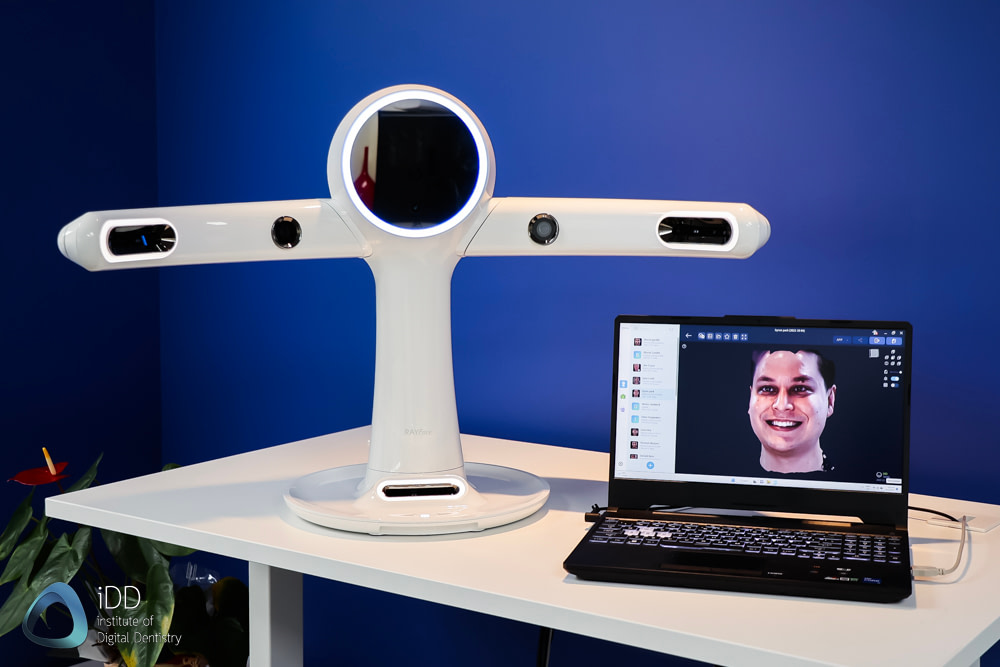


He said many companies started following once Ray launched it. His view is that the clinical usefulness of face scanning has not been fully discovered yet, and that it could become an almost essential product as prices keep coming down.
Dr. Kim tied it to aesthetics and patient emotion, and was candid about where the product falls short.
"Face scanner is very nice data provider, but unfortunately, software is not good enough."
Ray's stated plan is to improve the software through the 5D project and to build in more clinical functions for general dentists, not only specialists.
Dr. Kim was also clear that not every patient needs the full stack. In a simple case a CBCT alone is often enough, with a small field of view. A full mouth case may call for a larger field of view, and face scanning and an intraoral scan get added when the case calls for them.
Where Ray Is Taking the Software, Workflows and AI
I asked what else is planned beyond surgical guides. Mr. Lee said more clinical features and workflows will be added over time. What Ray is preparing right now, in his words, is automatic measurement and reporting of periodontal pocket depth, followed by a virtual articulator. Someone on the Ray side added that the final goal is AI agents.
I asked Dr. Kim whether the AI side is working yet. His answer was "we are trying." The idea is that AI suggests and the clinician decides, and he described a chairside agent a clinician could ask when a patient raises something outside their expertise.
"So I give the question to the AI agent. What is this? And then I explain."
The Hardware Side, RAYDENT Studio and RAYMILL C
Not everyone realizes Ray also makes a chairside 3D printer, the RAYDENT Studio, and a chairside milling machine, the RAYMILL C. I asked Mr. Lee about the printer first.
"Everyone's been making printers for quite a long time, but they all made lab-side printers. We thought, 'No, we need a chairside printer.'"
He said Ray won design awards, including Red Dot, and introduced disposable resin pouches about eight or nine years ago. Ray also built a water washable resin that rinses with water and soap, so clinics do not need isopropyl alcohol. Looking back, he thinks Ray made these a little too early and found it hard to get the word out.
I asked whether the focus is clinics rather than labs, and Mr. Lee answered "Clinic, just clinic."
The milling machine follows the same logic. He described a design built so that once you design and hit print, it starts milling right away. Ray worked on reducing noise, making parts easy to swap and adding sensors that flag anything running low.
"You just insert the block and then press the button, and it starts milling."
He framed it as a way to make zirconia restorations in the clinic instead of sending them to a separate lab. The noise comparison with other mills is Mr. Lee's own claim.
What's Next for Ray
When I asked what excites them most right now, both Dr. Kim and Mr. Lee pointed to 5D. Dr. Kim talked about how combining a CBCT, an intraoral scan and a face scan improves the quality of the virtual patient. Mr. Lee said companies around the world keep sending Ray ideas nobody imagined before, and that Ray keeps working through that homework one by one.
I also asked Dr. Kim about his focus for the year ahead in a saturated market. He answered with his goal for CBCT as a whole.
"Once after one CBCT acquisition, after that, every clinical solution, every clinical situation will be solved."
He called that his goal and mission. His closing message to clinicians was simple.
"So use 3D data. Turn your imagination into the reality."
Mr. Lee's final message was about where CBCT goes from here.
"CBCT has been around for 20 years now. It's about time for it to change. And that change means moving from simply viewing it to how you actually use it in practice."
As with any manufacturer conversation, the adoption figures, product comparisons and roadmap items here are Ray's own statements, and several of the AI and workflow features were described as in development rather than available today. If you are weighing a CBCT purchase or want to hear how a company that started with one imaging machine in 2004 thinks about scanners, printers, mills and AI, listen to the full conversation. You can find more episodes on the Digital Dentistry Decoded podcast, and if you want to learn the printing side hands on, take a look at our 3D Printing and Design course.
If you have any questions, please leave them below.