
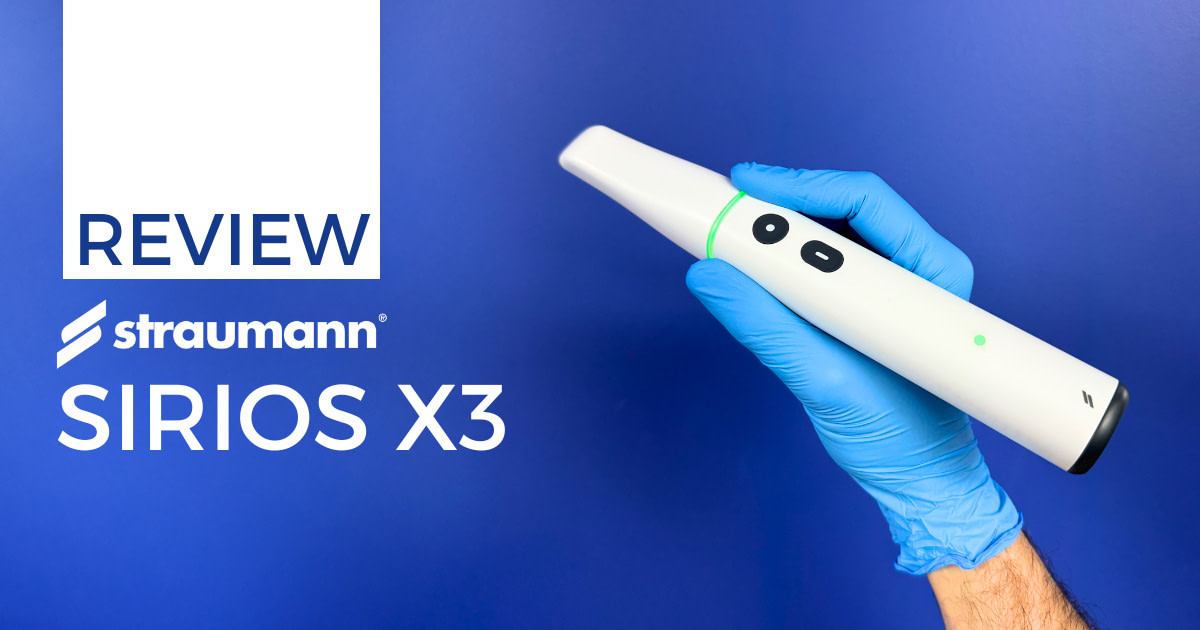

When Straumann acquired Alliedstar in 2023 and launched the original SIRIOS in 2024, it marked their strategic return to the intraoral scanner market after years of arguably underwhelming performance with the Virtuo Vivo. Well, one of dentistry's largest companies is back, and they are here to compete.
The Straumann SIRIOS Portfolio represents a smart move, leveraging Alliedstar's excellent scanning hardware and architecture while building Straumann's own software ecosystem around it, plus leveraging their brand. Now, just over a year later after the first SIRIOS was launched, Straumann has introduced the SIRIOS X3, its flagship scanner.
This is notable because it marks the first time we see a Straumann scanner that is different from Alliedstar. The first version of Straumann SIRIOS will be the only model to share a hardware design with Alliedstar, marking a new chapter in which Straumann is clearly charting its own path in scanner hardware development.
The SIRIOS X3 seems to represent more than just a hardware improvement. It's a complete reimagining of what the SIRIOS scanners could be. Lighter and more premium-looking, and backed by a more mature software platform since I reviewed the original SIRIOS.
The question is, has Straumann successfully transitioned from rebadging Alliedstar hardware to creating a genuinely competitive premium scanner?
As always, this review remains completely independent. While I maintain relationships with many companies in the digital dentistry space, including Straumann, this review was written without any influence from them. Our commitment to providing unbiased, reliable information to the dental community remains unchanged.
Enjoy the review.
Review At a Glance
The Straumann SIRIOS X3 represents a significant evolution from the original SIRIOS, marking Straumann's first true departure from Alliedstar's hardware design. With its lightweight, wireless design featuring an integrated battery, premium look, and a substantially improved software ecosystem, the SIRIOS X3 positions itself as a contender in the premium scanner segment. The integration with Straumann's broader digital ecosystem, particularly AXS and the forthcoming MIDAS integration, creates compelling workflows for practices already invested in Straumann products.
Pros:
Cons:
Download the Full PDF Review
View as a flipbook online or download a copy to read it later.
Unboxing Video
An Overview of What's New in the SIRIOS X3
As mentioned, the SIRIOS X3 represents Straumann's first scanner that doesn't simply rebadge Alliedstar hardware. This is a significant milestone; the company is now developing its own hardware identity while leveraging the scanning expertise gained through the Alliedstar acquisition.
I have said it before, I believe the Alliedstar acquisition was one of the best digital dentistry acquisitions ever. The Alliedstar scanners were excellent in 2022 when I first tried them, and with Straumann, I believe they will take this much further.
So what has changed?


Hardware Evolution - from Original SIRIOS to X3
New Wireless Design: The most obvious change is the SIRIOS X3's appearance compared to the original SIRIOS. It is a huge difference. At 214g, the SIRIOS X3 is slightly lighter than the original SIRIOS (which was already 245g). But it is much smaller in physical size. Even smaller than the Alliedstar Sensa.
Premium Feel: The build quality is noticeably higher. The materials, finish, and overall construction demonstrate that Straumann is serious about competing in the high-end scanner segment. This isn't just about specifications; it's about the entire experience of using the device. Including the box and travel case. The SIRIOS X3 looks like a more premium device.
Fast Wireless Charging: The SIRIOS X3 features fast charging capabilities like the Sensa – the company claims it reaches 50% charge in just 60 minutes and delivers over 2 hours of continuous scanning on a full charge. Additionally, it apparently has up to 6 months of standby time on a full battery, which is much better than the original SIRIOS.
LED Ring Guidance: An integrated LED ring provides real-time visual feedback during scanning and again gives a premium feel. A lot of high-end scanners feature these types of LED rings.

Software Maturation
Since the original SIRIOS launched, Straumann has also made substantial investments in its software platform:
- Refined the user interface significantly with a workflow-centric design - something that is becoming a market trend.
- Dedicated workflows for Full Arch Implants, coDiagnostiX, and Clear Correct.
- Improved integration with Straumann AXS with an automatic log in upon starting the software.
- Improved automatic scanbody recognition

Download the Full PDF Review
View as a flipbook online or download a copy to read it later.
Strauman SIRIOS X3 Scanning Speed
The SIRIOS X3 maintains the excellent scanning performance that characterized the original SIRIOS. Full-arch scans can be completed very quickly. It is a fast and enjoyable scanner, and, frankly, the Alliedstar scanning architecture is one of the easiest to use because of its excellent AI that ignores soft-tissue artefacts and stitches consistently.
The scanner handles all indications well – single units, multiple preps, full arches, implants, and orthodontic cases. The software makes the scanning process smooth and predictable.


For edentulous scanning, the SIRIOS X3 performs well, too, setting it apart from many other scanners on the market. Only about five scanners on the market do edentulous scanning well, in my opinion. The dedicated full-arch workflow is also a nice touch not seen in the majority of the market, grouping all scans (temporary and final prosthesis) into a single patient case. A nice organizational feature for those handling larger cases without having to open multiple cases for the same patient.
What sets the SIRIOS X3 (and Alliedstar) apart is the stitching algorithms. Genuinely, some of the most foolproof I have experienced. It is hard to get stitching errors when using this scanner. It handles soft tissue well and moving tissue without getting stuck. This flexibility is genuinely useful in daily practice, especially when dealing with challenging anatomy or for beginners.
What can be improved is the scanning textures. The default scanning textures have changed since the original SIRIOS, which used to create photo-like textures after post-processing. This time around, the textures are more cartoon-like and quite dark, in my opinion. This is obviously done to improve post-processing speeds, which used to take noticeably longer.
Interestingly, there is a setting in the SIRIOS software called "high-contrast colour" that restores the textures to more closely match the original SIRIOS (more photo-like). Once again, the post-processing time is longer in this setting, so it is up to you whether you want to use it. Also, whichever setting you use, I still find the value and colours to be too dark, and I feel like this should be a priority for the company to improve to be competitive.


Overall, though, great scanning performance and a strong contender for day-to-day dentistry. Not surprising given the track record of Alliedstar.
Design, Build Quality, and Ergonomics
The SIRIOS X3 is where Straumann has made the most obvious departure from its Alliedstar roots. This is no longer a grey-colored Alliedstar – this is Straumann's own design identity, and it looks nice.
At 214g, the SIRIOS X3 is one of the lighter wireless scanners available. Not the lightest, that goes to Shining 3D Elite Wireless at 194 grams, but lighter than DEXIS Imprevo, Medit i900 Mobility, TRIOS 5, 6, and basically every other wireless scanner. The weight, shape, and ergonomics are great.


The construction quality is also good and a big improvement over the original SIRIOS. This feels like a premium device from the moment you pick it up. The materials, fit and finish, and overall attention to detail demonstrate that Straumann is serious about competing with established premium brands. The black colour scheme is nice with a single, minimalistic Straumann logo at the bottom. It also feels really small in the hand.
The shape of the SIRIOS X3 is tubular, reminding me of the original Vivo in a way. This shape is comfortable, and its overall size of is something you notice immediately. It is not a very long scanner for a wireless device; in fact, it is quite small. Another great design choice is a slightly flat top, bottom, and sides rather than a completely round shape. What this means is that, even though it is tubular, it does not easily roll, which is handy when you place it on your scanner cart in a rush rather than in the cradle.


The LED ring near where the scanner tip connects provides feedback about scanner status, whether you're capturing data properly, if there's an issue, etc. It's a subtle but another 'premium feeling' addition.
One feature carried over from the Alliedstar scanners is the dual scan button design. The SIRIOS X3 has 2 scan buttons on either side of the scanner. I have mentioned many times in previous reviews that I like this design. It allows you to hold the scanner in almost any way and always have a scan button within reach of your finger or thumb, without needing to adjust your grip.
The only other button is an 'Action Mode' button beneath the scan button on the top. This can be assigned to do various things within the software. I like to keep it on the default setting and have it move through the scanning windows when pressed.
The SIRIOS X3 is a wireless scanner with an integrated battery; there is no way to replace the batteries. It supports fast charging like the Sensa and can be charged via a USB-C-to-USB-C cable from the scanner cradle.
The charging cradle is also improved over the original SIRIOS. One thing I found is that there is a little bit of room between the scanner and the cradle when you put it in, meaning the scanner can jiggle back and forth slightly, especially if you're moving a cart around. Something I feel could have been a little tighter. The scanner uses a standard TP-Link dongle for WiFi connection with the computer.


Download the Full PDF Review
View as a flipbook online or download a copy to read it later.
SIRIOS Scanner Tips
The SIRIOS X3 comes with four scanner tips in a single size designed to handle the majority of clinical situations, like the Sensa. Straumann's approach here is to provide a single tip that works well across applications, rather than multiple tips for different scenarios, as most other scanners do.
Do take note that while Straumann claims the optimized tip suits a variety of clinical applications, some clinicians may prefer multiple tip sizes for different clinical situations, especially with the rise of large-FOV scanner tips on the market. I would have liked to see a larger tip option, to be honest, but the single tip is not small at 16 x 14 mm.
The tips are autoclavable up to 180 cycles at standard sterilization temperatures. At $80 USD per pair (that's 2 tips), the per-patient cost is approximately $0.30 per scan. This is quite economical compared to some premium scanners, where tips can cost significantly more.


SIRIOS X3 Calibration
One of the advantages of the SIRIOS X3 compared to some other premium scanners is that it's completely calibration-free. This is increasingly the standard in modern intraoral scanners and is a significant convenience factor.
No calibration means no calibration tools to purchase or store, and no time spent on calibration procedures during day-to-day use. It's simply one less thing to worry about, and Straumann says it designed the SIRIOS X3 for long-term reliability without requiring manual calibration.
SIRIOS X3 Accuracy
The SIRIOS X3 inherits the solid accuracy of Alliedstar technology, which underpinned the original SIRIOS. In our testing, the scanner produces consistently accurate results across a range of clinical indications.
For single-unit and multi-unit restorative cases, the accuracy is more than adequate for clinical success. Margins are clearly captured, and mesh quality is suitable for CAD design.


The dedicated full-arch workflow is designed specifically for implant restorative treatments, and Straumann claims high-accuracy validation for these cases, particularly when combined with its EXACT full-arch solution. The automatic scanbody recognition helps streamline the workflow and validate scan quality in real-time.
Based on the platform's track record and our clinical use and testing, it performs well.

SIRIOS Software and Ecosystem
This is where things get interesting. Since the original SIRIOS launched, Straumann has evidently invested a lot in software development, and the SIRIOS X3 benefits from all of these improvements. There is still room for improvement, however.
The SIRIOS software has been redesigned with a cleaner, more modern interface. As soon as you start the scanner software, you can select your account and enter a PIN. Once you do this, it automatically opens a web browser to log in to your Straumann Account. It is clear that the company wants you to use this account as a central management platform for all your scan storage and to access the wide range of applications. I just wish it were a more refined process within the software itself, rather than opening up a web browser.

After logging in, you see the new UI. The focus is on workflow-centric design. The UI is less cluttered than the original, with the menu providing quick access to commonly used functions without overwhelming the main scanning interface.
You can immediately start scanning a case with a click of one button, "Quick Scan", or alternatively, click one of the other workflow options, "Crown and Bridge", "Full Arch", "coDiagnostiX", or "Clear Correct", enter patient details, and then begin.


This type of workflow-first UI is also another market trend we are seeing, and it is nice to see Straumann move in this direction. Gone are the days of overly complicated, lab-form-like menus with excessive options to begin with; instead, pick your workflow, then decide how much information to include in the lab form.
The scanner software itself (used to take scans) is built into the same program, rather than opening another software (like Alliedstar). This speeds up the workflow slightly and feels more cohesive.
All the standard features are here, like adding pre-op scans, etc., and the software has a modern, minimalist feel rather than lots of buttons. The only controls are to toggle colour on/off and adjust the soft-tissue AI filter to 3 levels (low, medium, and high).
After scanning, you can mark preps, trim the scan, and lock areas. After post-processing, you can check the bite and preparations for undercuts. All the standard features.

The UI includes helpful tips on-screen and a guide at the top right for new users on how to connect the scanner. These have some animations that are a nice touch.
One thing that puzzles me is that you cannot complete a case without scanning the upper, lower, and bite. So if you want to scan a single arch for whatever reason, you cannot. In my opinion, this should change to offer more flexibility. Speaking of flexibility, you cannot easily add extra scan windows; rather, they are built into the specific workflows. Also, you can currently take only 2 bites from a single case, not multiple. Dynamic bite scanning is also not a feature here like other premium scanners.
These are all things that I feel the company can improve with further software maturation.

Otherwise, the software generally feels faster, better optimized, and more responsive than the original SIRIOS software, with improved real-time rendering and smoother overall performance.
Bite scans seem accurate and rarely miss, and the software includes AI-driven automation for several scanning steps. In full-arch cases, for example, the AI can duplicate scans and intelligently filter out scanbodies, allowing you to rescan only clinically relevant areas. This saves time and improves workflow efficiency.
Dedicated Full-Arch Workflow
The SIRIOS X3 includes a validated full-arch workflow specifically designed for edentulous cases. What's useful here is the organizational approach – all scans related to a full-arch case (temporary, final, try-ins, etc.) are grouped in a single patient case rather than scattered across multiple scanning files.
The automatic scanbody recognition works well, but only with Straumann Group scanbodies (including Neodent, Anthogyr, and Medentika). The software validates scan quality in real-time, providing confidence that you've captured everything needed before dismissing the patient.

Straumann AXS Integration
The SIRIOS X3 is designed as the entry point to Straumann's digital ecosystem, and AXS is clearly central to that vision. As mentioned, when you log in, your scans are automatically uploaded to AXS, which provides cloud storage and access to Straumann's suite of digital services.

What AXS Includes
Automatic Upload: Scans are automatically uploaded to AXS upon completion. Patient data is synchronized between SIRIOS and AXS, avoiding duplicate data entry. All your scan data is accessible from anywhere. No storage fees currently.
Integration Hub: AXS serves as the integration point for various Straumann digital solutions:
- Smile in a Box - all on x restoratives and guides
- Implant Registry
- coDiagnostiX for surgical planning
- Straumann Signature MIDAS for chairside 3D printing
- Rapidshape 3D printer integration
- SmileCloud for 3D smile design - one of the best smile design software on the market
- ClearCorrect Dr. Portal for aligner workflows
- eShop and Education portal
Lab Communication: You can share cases with labs in a single click, with all relevant scan data automatically packaged.
Future improvements
The AXS integration, while functional, isn't 100% seamless yet. Currently, many AXS features open in a web browser window with your scans automatically uploaded. It works, but it's not as elegant as having everything natively integrated into the scanner software itself. To Straumann's credit, they're clearly working on this, and it has improved since the original SIRIOS.
The trajectory is toward deeper integration, but as of now, there's still work to do to match the seamless experience of platforms like Medit Link or 3Shape Communicate.
The other consideration is that the AXS ecosystem, while growing, isn't as open as some other platforms. If you're using third-party CAD software, lab workflows, or prefer specific design applications, you may find the integration less comprehensive than with more open platforms. There is a focus on integrating with Straumann products for obvious reasons.
This is the area that needs the biggest improvement. Making the entire SIRIOS software AXS platform more cohesive and integrated within a single platform. Straumann is one of the few companies that has all the pieces - digital acquisition, smile design, CAD, surgical guide software, CAM, implants and restorative, and now a 3D Printer. They just need to figure out a way to make it as seamless as possible.
SIRIOS X3 Applications Suite
All applications used with SIRIOS X3 are available within the AXS platform. These are currently limited compared to other market leaders, but include:
Model Builder: A standard but capable model builder for creating hollow and solid models for 3D printing. It handles the basics well and integrates nicely with the Straumann ecosystem. This app is built within the SIRIOS software.

Scan Compare: Another standard app seen on the market. It allows you to compare 2 scans taken. Notably lacking the comprehensive feature set seen in other premium scanners, and it is currently not built into the SIRIOS software, requiring you to use the AXS portal on a web browser.

Straumann's decision to host applications in AXS rather than in the scanner software represents a clear philosophical choice; they're building toward a cloud-centric ecosystem where capabilities are accessible from anywhere, not just the scanning workstation.
There are pros and cons to this approach. On the positive side, you can access these tools from any device, work can be done remotely, and updates happen automatically without requiring software installations. On the negative side, you need internet connectivity for many features, the experience can feel less integrated, and there's more dependency on cloud services.
This contrasts sharply with companies like 3Shape, iTero, Medit, etc, which have built application ecosystems directly into their scanner software. Alliedstar also has all these things built into their software, so it will be interesting to see how Straumann develops this and what direction they take in the future.
Download the Full PDF Review
View as a flipbook online or download a copy to read it later.
SIRIOS X3 Price + Ongoing Costs
The SIRIOS X3 is priced at $17,995 USD.
This positions it in the mid-to-premium scanner segment alongside scanners like the Medit i900 Classic ($18,999 USD). It is notably more affordable than other premium scanners, such as Shining 3D Elite, iTero Lumina, and TRIOS 5/6. But now with the release of Shining 3D's ELF scanner, it may be an interesting 2026 to see how the company responds.
Operating costs are quite reasonable for a premium scanner:
Scanner tips: $80 USD per pair (2 tips), autoclavable up to 180 cycles (~$0.22-0.44 per patient
Software: All core functionality included, applications accessible through AXS. No subscriptions, no costs.
Straumann Excellence Club: $1,200 USD per year (included first year, optional renewal for up to 2 additional years)
- Extended warranty coverage
- Full accidental damage protection
- Priority technical support
- Straumann customer care services
Cloud storage: Included with AXS currently, scalable based on practice needs

Conclusion
The Straumann SIRIOS X3 represents a pivotal moment for Straumann in the intraoral scanner market.
This is the first scanner that feels like Straumann's own product rather than an Alliedstar device. The lightweight wireless design, premium construction, and maturing software platform demonstrate that Straumann is serious about competing in the scanner market.
From a hardware perspective, the SIRIOS X3 delivers everything you'd expect in a modern IOS - excellent scan speed, comfortable ergonomics, calibration-free operation, and solid accuracy. The tubular design is comfortable, and at 214g, it's one of the lightest wireless scanners available. The dual scan buttons are also a nice-to-have.
Where Straumann has made some nice progress is in software development. The refined user interface, dedicated full-arch workflow, and growing AXS ecosystem show a real commitment to creating a complete digital dentistry platform. The automatic integration with Straumann AXS, while not as seamlessly implemented as some competitors, provides a clear path toward end-to-end workflows, especially when combined with MIDAS for chairside production and EXACT for full-arch restorations.
The challenge for Straumann is that they're competing in a market segment with well-established players. Medit, 3Shape, Shining 3D, and others have had years to refine their platforms and build extensive third-party integrations. The SIRIOS X3's ecosystem, while functional and growing, isn't yet as comprehensive as these established platforms and only integrates seamlessly with Straumann's ecosystem. Although it is an open scanner, as expected these days, and allows free export of all scanner file types, it does seem to work best within the Straumann ecosystem.
For practices already invested in Straumann products, implants, restorative solutions, surgical guides, ClearCorrect, etc., the SIRIOS X3 makes considerable sense. The validated workflows, ecosystem integration, and Straumann's excellent education and support infrastructure create genuine value. The combination of SIRIOS X3, AXS, and MIDAS represents one of the few truly complete chairside workflows available from a single manufacturer, and I am eager to see how that plays out.
For practices seeking maximum flexibility, extensive third-party integrations, or the most mature software ecosystems, platforms like Medit or 3Shape may still offer advantages. The SIRIOS X3 is catching up, but there's still ground to cover.
At $17,995 USD, the SIRIOS X3 offers good value in the scanner market, particularly given its Excellence Club benefits and lower running costs than other scanner yearly subscription and warranty packages. If Straumann continues investing in software development at this pace and further integrates its digital ecosystem, the SIRIOS platform will become increasingly compelling over the next 1-2 years.
To me, the SIRIOS X3 shows that Straumann has successfully transitioned from a scanner-market outsider to a legitimate contender. It's not just about having a good scanner anymore – it's about having a complete digital ecosystem, and that's exactly what Straumann is building.
Evaluation Ratings
Scanning Speed
Scanning Flow
Scanner Size
Ease of Use
Scanner Software
Investment Cost
Additional Features
Wireless Scanner
Wireless via TP-Link Dongle
Caries Detection
No caries detection or diagnostics
Software Apps
Model Builder via SIRIOS software; Scan Compare via Straumann AXS
CAD/CAM Software
Straumann CARES
Subscription Requirements
None
Autoclavable Tips
180 times per tip