
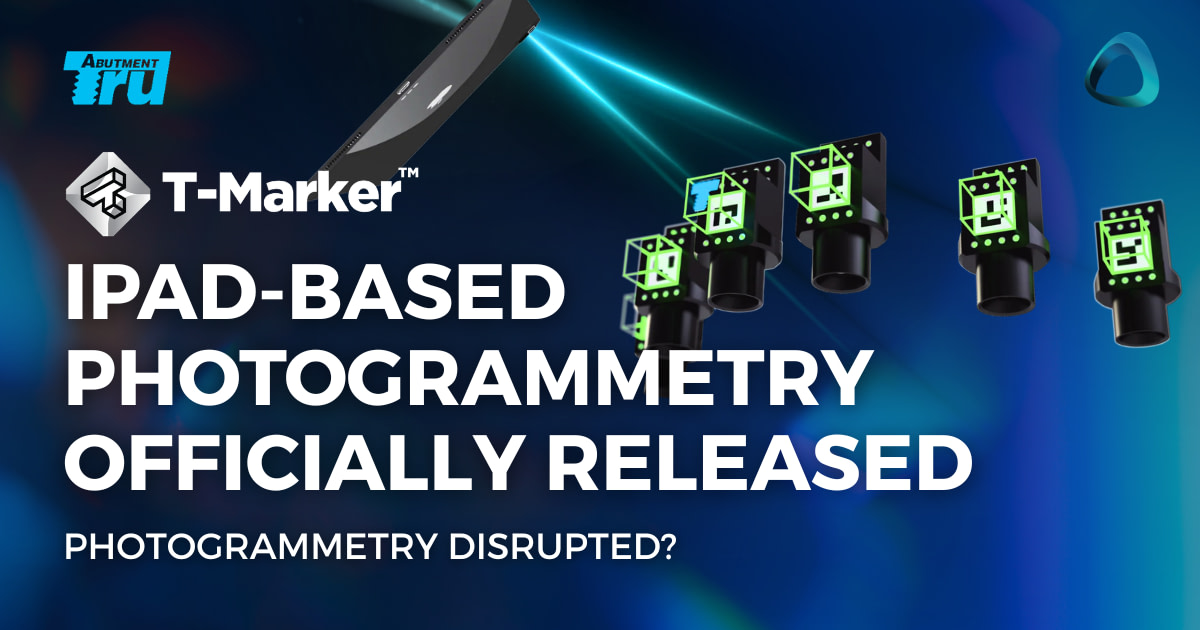

If you've been following the digital dentistry space over the past two years, you'll know that TruAbutment has been teasing something big.
At multiple exhibitions, from AEEDC 2024 to IDS 2025, the company showed off prototype markers and hinted at a system that would bring photogrammetry capabilities to your iPad. Well, at AEEDC Dubai 2026, T-Marker officially launched, and it could be one of the most significant product releases of the year.
The concept is straightforward but ambitious: replace dedicated photogrammetry hardware (which can cost upwards of $15,000 to $25,000) with an iPad Pro and a set of proprietary markers.
If TruAbutment has truly pulled this off with clinical-grade accuracy, the implications extend far beyond simply adding another tool to the market. It forces a much bigger conversation about the future of traditional photogrammetry itself.
Let's break down everything we know so far.

TruAbutment - From Custom Abutment Manufacturer to Full-Arch Solutions Provider
Before getting into T-Marker itself, it's worth understanding the company behind it.
TruAbutment was founded in 2013 in Irvine, California, and started as a CAD/CAM custom abutment milling centre. Their original value proposition was simple but compelling: high-quality custom titanium abutments milled "head-to-toe" from Grade 5 titanium rods on Swiss-type CNC turning machines. They were one of the first to push custom abutment pricing below the market average, disrupting a space that had been dominated by higher-cost providers.
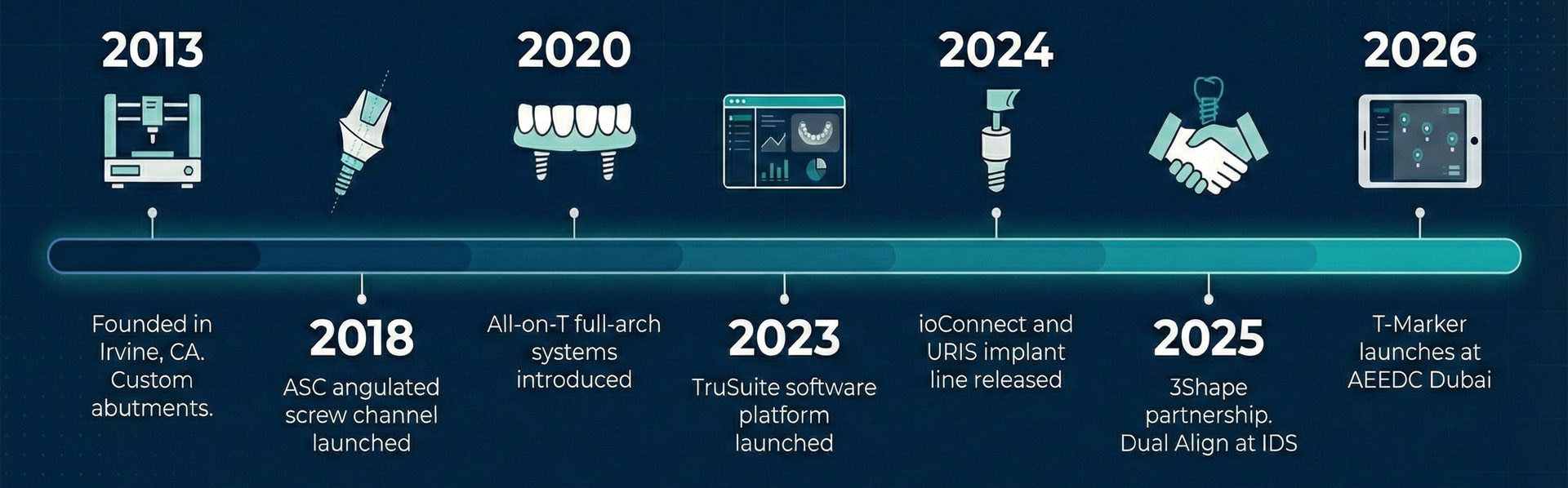
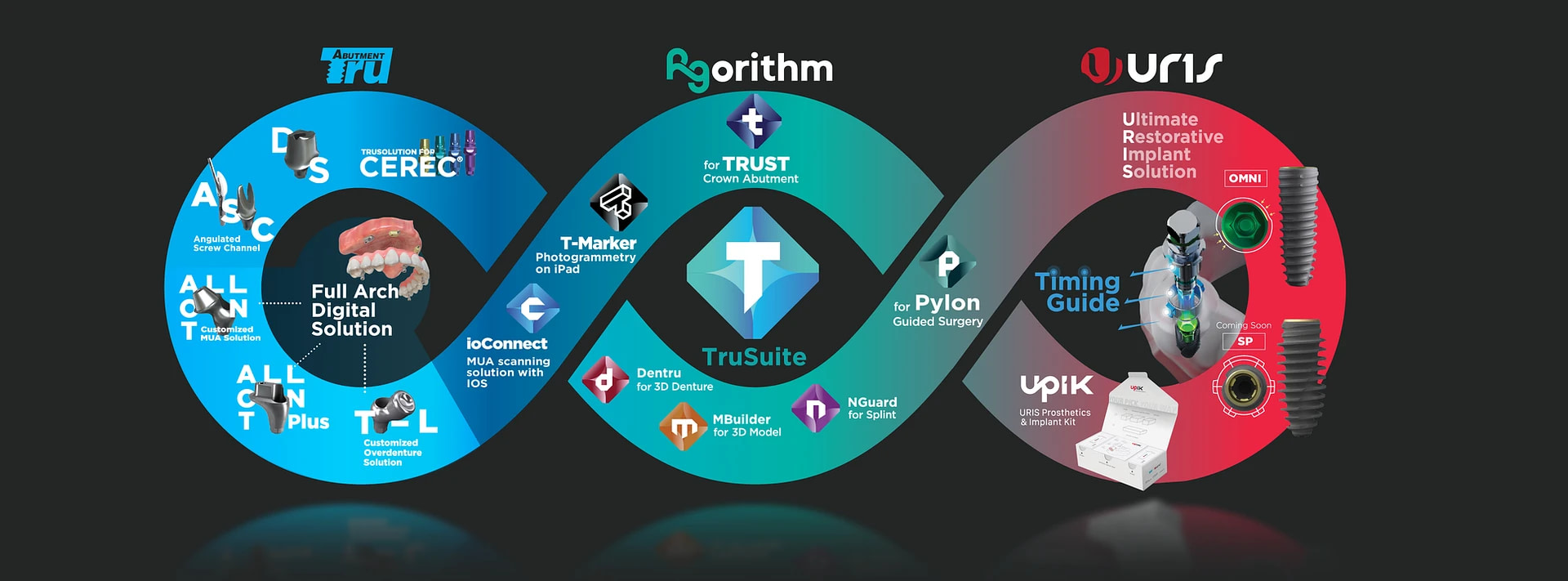
Over the years, TruAbutment has steadily expanded beyond abutments. Their product portfolio now includes TruBase (Ti-bases), scan bodies, the All-on-T and T-L full-arch prosthetic systems, angulated screw channel (ASC) solutions, and URIS implants (their own implant line). They also developed TruSuite, a comprehensive software platform that includes Pylon (treatment planning), TRUST (prosthetic design with AI), and denture design capabilities.
The company's pivot toward becoming a full-arch digital solutions provider became especially visible with the launch of ioConnect, its intraoral scanner-based photogrammetry system that uses horizontal scan bodies designed to reduce stitching errors during full-arch scanning. ioConnect represented TruAbutment's first major step into the photogrammetry space, and it has gained meaningful traction, particularly through partnerships with companies like 3Shape for TRIOS integration.
T-Marker represents the next evolution of this strategy, and arguably their most ambitious product yet. TruAbutment's evolution from a custom abutment milling centre to a comprehensive digital solutions provider mirrors a broader industry trend - companies across the dental technology space are expanding their product ecosystems to offer end-to-end workflows rather than standalone components.
If you want to learn more about them, I had a great chat with Jay Kim from TruAbutment on the iDD Podcast - listen here.
What is T-Marker and How Does It Work?
T-Marker is an iPad-based photogrammetry system designed to capture the 3D positions of implants in full-arch cases. The system uses physical markers (similar in concept to traditional photogrammetry dies or flags) placed on the multi-unit abutments (MUA) in the patient's mouth.
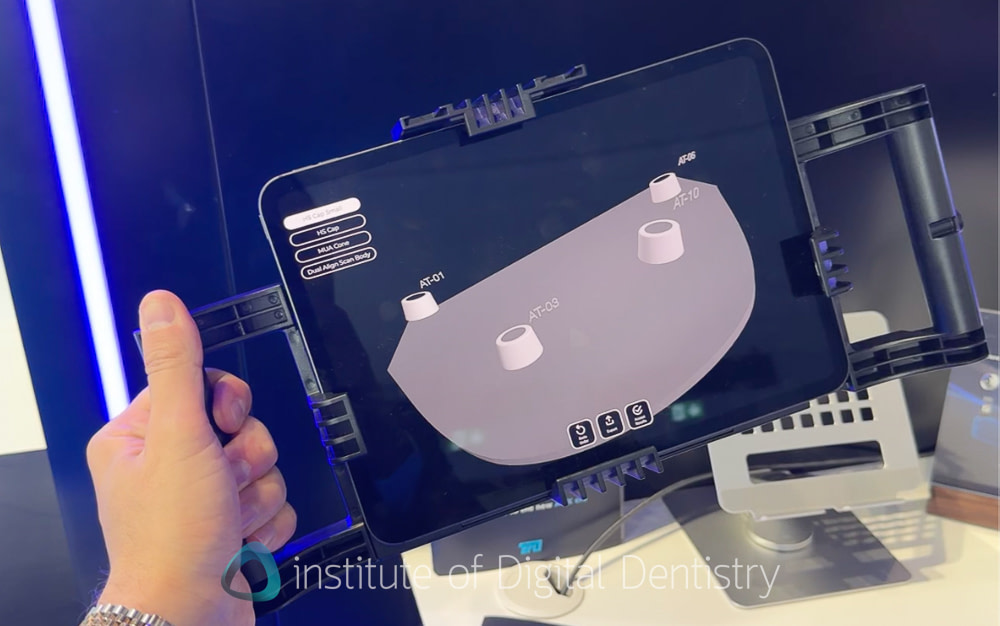
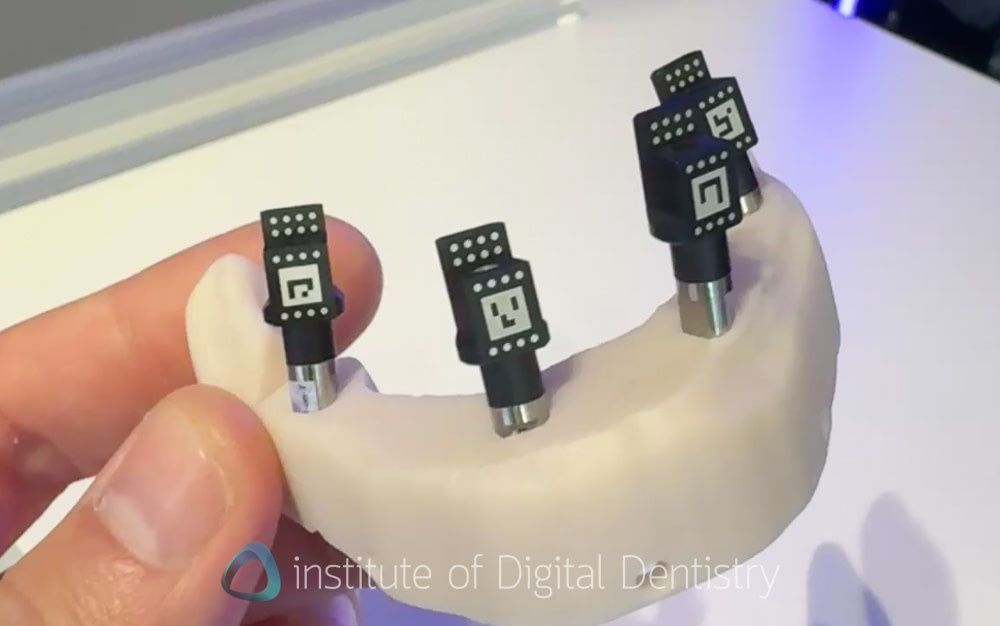
Instead of using a dedicated photogrammetry camera that costs thousands of dollars, T-Marker uses the iPad Pro's camera system, combined with TruAbutment's proprietary software, to calculate implant positions from multiple images.
The workflow I tested is simple: place the T-Marker markers on the MUA, position the iPad Pro, and the T-Marker app captures images from multiple angles. The software then processes these images using photogrammetry algorithms to calculate the precise spatial positions and angulations of each implant.
The output is an STL file containing the implant position data, which can then be combined with soft tissue scans (from an intraoral scanner) and imported into any open CAD software for prosthesis design.

No calibration is required, no cables, and no complicated setup. The system is designed to be as plug-and-play as a consumer device, which is a significant part of its appeal.
T-Marker Pricing and Subscription Model
TruAbutment has published pricing for the T-Marker system, and it's worth laying out the numbers clearly.
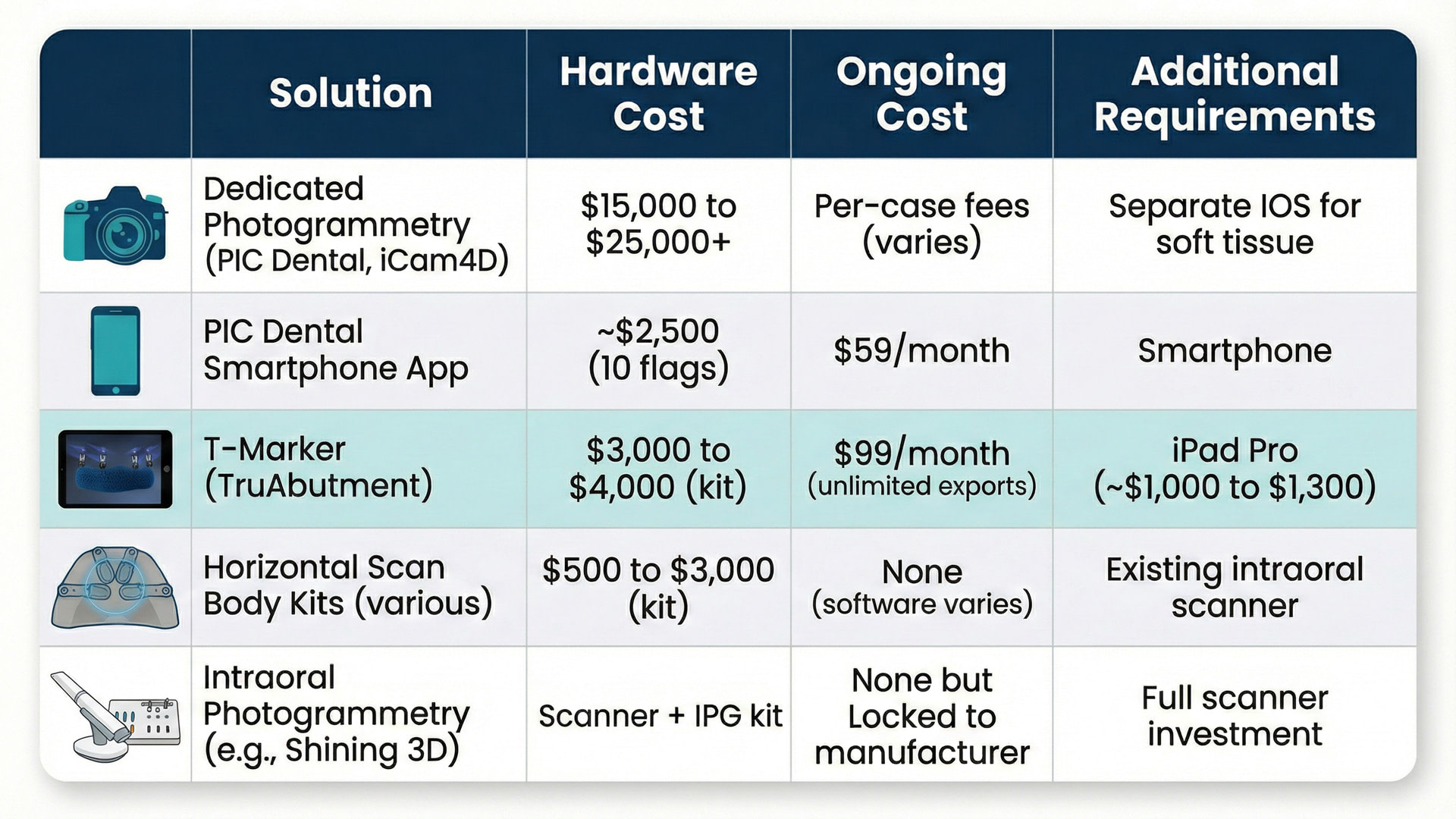
The hardware kits, which include the physical markers, are priced at $3,000 for the AOT (All-on-T) compatible version and $4,000 for the Straumann-compatible version. A URIS-compatible version is also listed.
On the software side, TruAbutment is implementing a subscription model. The T-Marker app is complimentary until March 1, 2026, after which a subscription applies. The pricing tiers are:
- Monthly: $99 per month
- 6 Months: $499 ($83.17/month, saving approximately 16%)
- 12 Months: $899 ($74.92/month, saving approximately 24%)
The subscription includes unlimited STL exports with no additional per-case fees. This is an important distinction, as some competing systems charge per-scan or per-export fees that can add up quickly in high-volume practices.
For context, let's compare this to the alternatives:
- A dedicated photogrammetry system like the PIC Dental camera has traditionally cost upward of $15,000+ for hardware alone, plus per-case fees.
- PIC Dental also introduced their own smartphone-based solution at IDS 2025, priced at $59/month with a $2,500 initial investment for ten PIC flags.
- Meanwhile, horizontal scan body systems from companies such as Shining 3D, Alliedstar, and others typically require an intraoral scanner (which you may already own) and a scan body kit, priced at around $1,000 to $3,000 dollars.
T-Marker sits in an interesting middle ground. The initial investment of $3,000 to $4,000 plus $99/month is significantly less than dedicated photogrammetry hardware, but it does require an iPad Pro (which TruAbutment explicitly notes is not included). An iPad Pro currently starts at around $1,000 to $1,300, so the total initial outlay for a practice that doesn't already own one would be $4,000 to $5,300.
T-Snap: The Other Half of the Story
Alongside T-Marker, TruAbutment also showcased T-Snap at AEEDC 2026. This is a separate iPad app that turns the iPad into a rudimentary intraoral scanner, specifically designed to capture arch scans needed for temporary (provisional) prosthetics in full-arch cases.
The significance of T-Snap is that it potentially completes the full-arch workflow on a single consumer device. T-Marker captures the implant positions via photogrammetry, while T-Snap captures the surface anatomy needed for provisional restorations.
In theory, a clinician could handle the digital capture phase of a full-arch case using only an iPad Pro, the appropriate marker kits, and TruAbutment's software.
This is a compelling proposition, particularly for practices that may not yet own an intraoral scanner or those looking for a dedicated, portable full-arch capture solution.
I have doubts about how well an iPad can capture the distal ends of the arch, but I look forward to testing it.
Why Photogrammetry Became Essential in Full-Arch Workflows
To understand why T-Marker is generating so much attention, and why it could disrupt traditional photogrammetry, it helps to grasp the challenge it's trying to solve.
Full-arch implant cases require extremely accurate capture of implant positions to produce passive-fitting prostheses. Even small deviations in implant position (100 microns) can result in misfit restorations, leading to screw loosening, prosthetic failure, or the need for costly and time-consuming adjustments.
Full-arch implant cases place extreme demands on digital accuracy. Unlike single-unit restorations or even bridges, full-arch workflows must contend with:
- Cumulative stitching errors over long spans
- Implant divergence and angulation
- Soft tissue movement and collapse
- Limitations of intraoral scanning across multiple implant positions, cross-arch
Traditional techniques for full-arch cases involve verification jigs, which are technique-sensitive, time-consuming, and uncomfortable for patients.
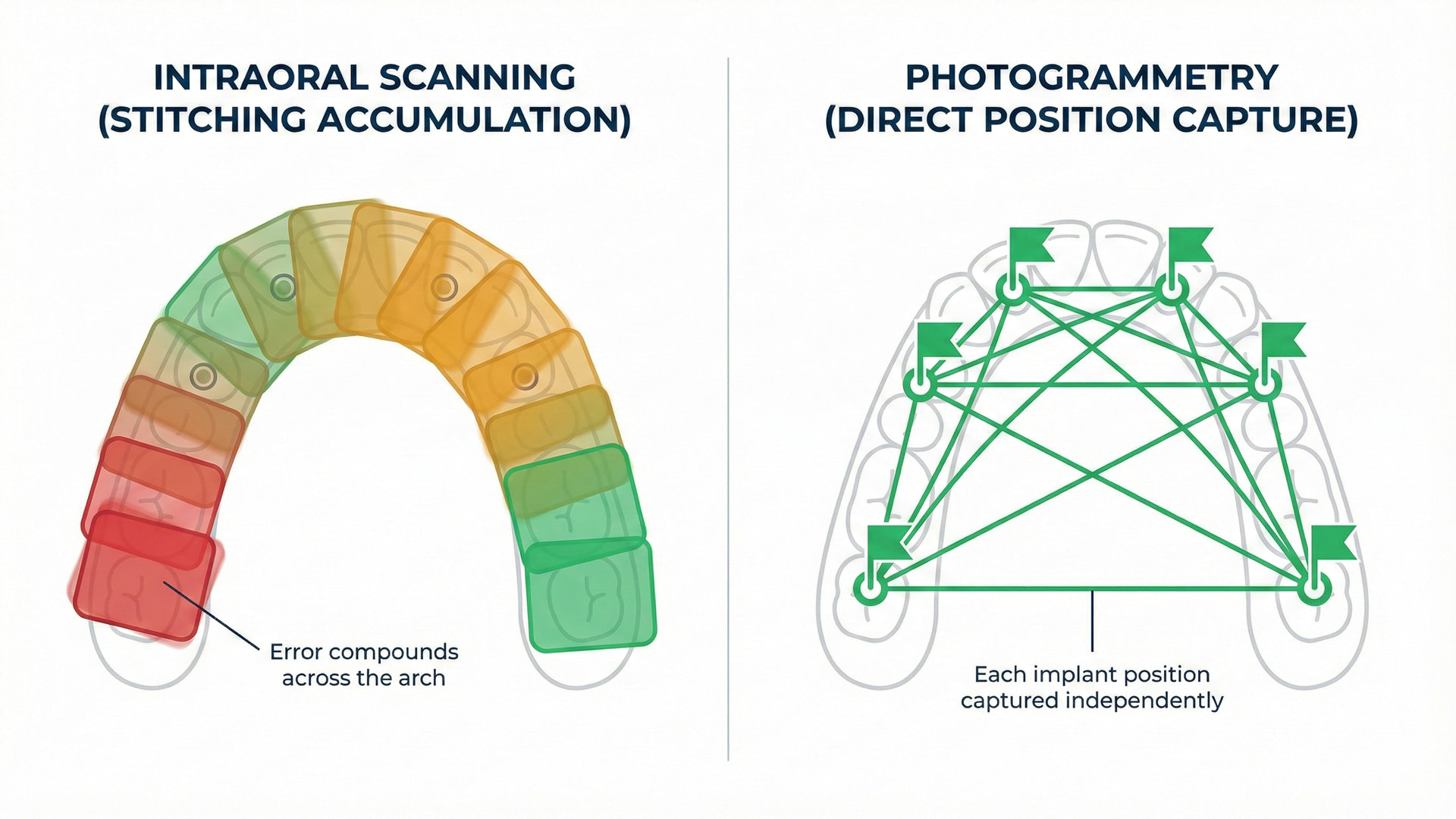
Digital approaches using intraoral scanners have improved dramatically, but full-arch scanning still presents challenges. As the scan area increases, stitching errors accumulate across the arch, potentially reducing accuracy at the cross-arch level.
This is where photogrammetry comes in. Dedicated photogrammetry systems like PIC Dental and Imetric's ICam4D capture implant positions using stereo cameras that identify the spatial coordinates of specific markers, bypassing the stitching error problem entirely by:
- Capturing implant positions simultaneously
- Eliminating cumulative stitching errors
- Providing highly reliable spatial relationships between implants
Research has consistently shown that photogrammetry is more precise than intraoral scanning in full-arch implant cases, particularly at the cross-arch level. A recent in vivo study published in the Journal of Prosthetic Dentistry confirmed that photogrammetry showed greater precision across all measurement tests than intraoral scanning.
As a result, photogrammetry became the gold standard for high-precision full-arch digitization.
The Traditional Photogrammetry Trade-Off
Photogrammetry works extremely well - but at a cost.
Photogrammetry systems have historically been expensive and have captured only implant positions, not soft-tissue anatomy. This means you still need an intraoral scanner to capture the tissue surface or take an impression, making photogrammetry an additional step and cost rather than a replacement.
Traditional photogrammetry require:
- Dedicated hardware units
- Significant financial investment ($15,000-$25,000+)
- Additional training and workflow complexity
For many practices, this placed photogrammetry firmly in the realm of high-end clinics and specialized laboratories. Accuracy was excellent. Accessibility was not.
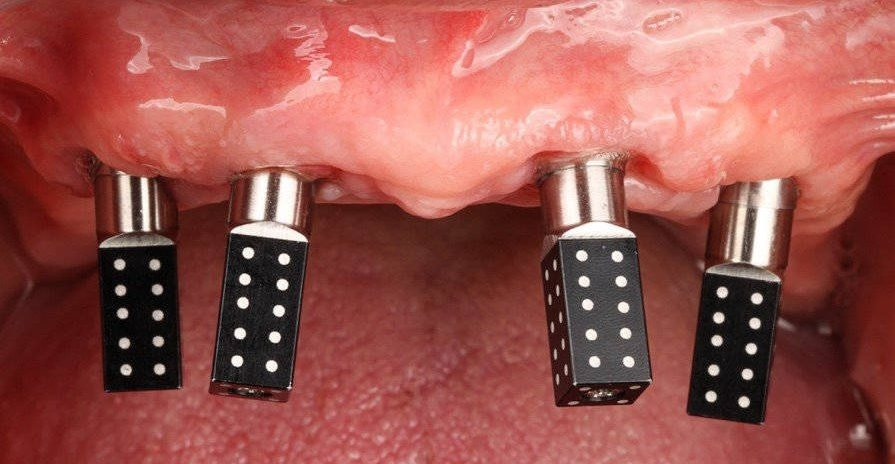
Traditional Photogrammetry with iMetric iCam4D
This is the context in which horizontal scan body systems and now T-Marker enter the market. T-Marker attempts to democratize this technology. By bringing photogrammetry capabilities to an iPad, it dramatically lowers the barrier to entry and makes accurate full-arch implant capture accessible to a much wider range of practices.
T-Marker proposes a fundamentally different approach. Instead of a standalone photogrammetry unit, the system uses:
- Photogrammetry-style markers
- An iPad or iPhone camera
- Software designed to reconstruct implant positions with photogrammetry-level precision
The implication is significant: "Photogrammetry" without photogrammetry hardware.
If TruAbutment has genuinely achieved reliable, repeatable accuracy using consumer devices, it challenges the assumption that photogrammetry must be tied to expensive, purpose-built systems.
The iPad Trend in Digital Dentistry
T-Marker doesn't exist in isolation. It's part of a broader trend toward leveraging consumer tablet technology in clinical dental workflows. Medit's i900 Mobility, which I've reviewed, demonstrated the viability of iPad-native intraoral scanning. The i900 Mobility transforms an iPad into a complete scanning workstation, and the reception has been positive.
What we're seeing is a convergence: consumer devices are becoming powerful enough to handle clinical capture tasks that previously required expensive, purpose-built hardware. The iPad Pro's camera systems, processing power, and LiDAR sensors provide a hardware foundation that companies like TruAbutment are building clinical applications on top of.
The implications extend beyond just cost savings. iPad-based solutions offer portability that traditional systems can't match. A clinician could carry an iPad Pro and a T-Marker kit to a satellite office, a mobile clinic, or even an operating theatre without needing to transport bulky scanning equipment.

What This Means for Traditional Photogrammetry
T-Marker does not necessarily make traditional photogrammetry obsolete, but it does redefine its role.
Dedicated photogrammetry systems still offer:
- Established clinical validation
- Mature, proven workflows
However, if T-Marker proves accurate enough for full-arch cases, traditional photogrammetry faces genuine disruption. The most disruptive aspect of T-Marker is not the technology itself, but what it enables.
By removing the need for dedicated hardware, photogrammetry-level workflows could become:
- Portable
- Affordable
- Accessible to far more practices
This has profound implications for how full-arch implant dentistry is delivered globally. More clinicians may gain access to workflows that were previously cost-prohibitive, while laboratories may see a shift in how implant data is captured and transferred.
The Big Question: Accuracy and Validation
The critical question with T-Marker, and the one that will ultimately determine its success or failure, is accuracy.
TruAbutment claims "photogrammetry-level accuracy," but independent clinical validation will be essential before the profession can fully embrace this technology.
There is a significant technical challenge in achieving photogrammetry-level accuracy with a consumer device. Dedicated photogrammetry systems use precisely calibrated stereo camera systems, controlled lighting, and purpose-built optical components. The iPad Pro's camera, while impressive for a consumer device, was not designed for this.
That said, software algorithms and computational approaches have advanced enormously. It's entirely plausible that sophisticated image processing, marker geometry optimization, and multi-image averaging could compensate for hardware limitations. The T-Marker markers appear to be carefully designed with specific geometries that help the software determine precise spatial positions.
Traditional photogrammetry earned its place through years of clinical validation. T-Marker must now do the same. The concept is compelling. The execution must prove itself.
My take: until we see independent studies comparing T-Marker accuracy against established photogrammetry systems and intraoral scanners in controlled and clinical conditions, it's important to maintain a healthy balance of optimism and caution.
The concept is sound. The potential is enormous. But clinical dentistry demands evidence, and T-Marker needs to demonstrate its accuracy claims in peer-reviewed research before practitioners can confidently build their full-arch workflows around it.
I fully intend to test this system in my own practice and will report back with honest findings.
How T-Marker Fits Into the Broader Full-Arch Landscape
AEEDC 2026 was dominated by full-arch solutions. Nearly every major scanner manufacturer and digital workflow company showcased horizontal scan body systems, photogrammetry integration, or All-on-X workflow enhancements. This saturation reflects a simple reality: full-arch cases represent some of the highest-value treatments in dentistry, and the digital tools to execute them efficiently are in enormous demand.

The competitive landscape for full-arch implant capture now includes several distinct approaches:
Dedicated photogrammetry systems (PIC Dental, Imetric ICam4D) remain the gold standard for accuracy in capturing implant positions, but they carry significant cost premiums and require separate soft-tissue scanning.
Intraoral photogrammetry (Shining 3D Aoralscan Elite with IPG scan bodies) introduced the concept of photogrammetric accuracy within an intraoral scanner and has been widely adopted. This approach uses horizontal scan bodies that the scanner reads within a single field of view.
Horizontal scan body kits from numerous manufacturers (Alliedstar, Eighteeth, BLZ Dental, Panda Scanner, DEXIS, and others) offer alternatives that are compatible with existing intraoral scanners. At AEEDC 2026, it felt like nearly every scanner company had its own version.
Smartphone and tablet-based photogrammetry (T-Marker, PIC Dental's smartphone app) represents the newest category, trading dedicated hardware for consumer devices and sophisticated software.
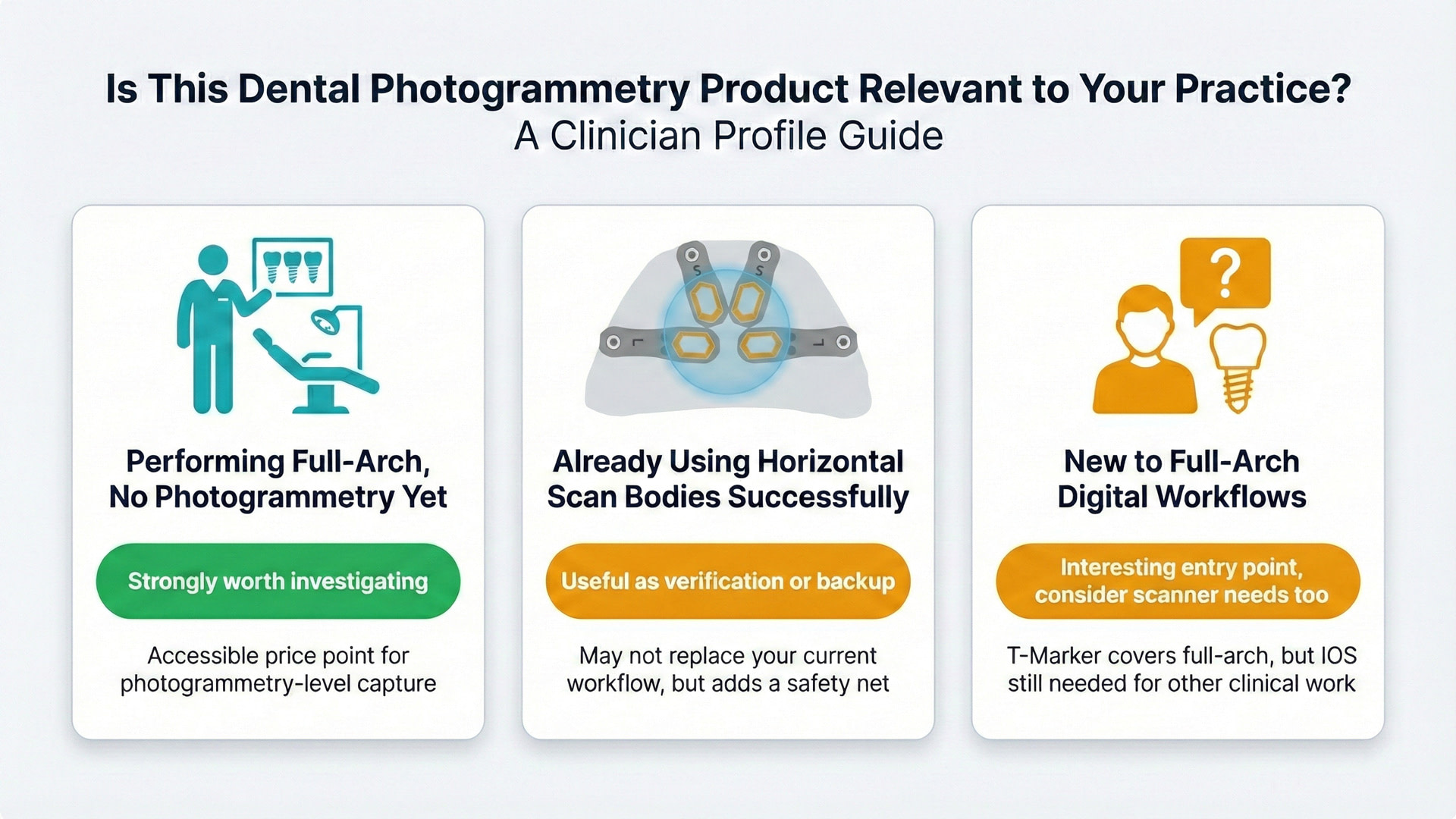
T-Marker differentiates itself primarily on accessibility and cost. For practices that don't already own an intraoral scanner, it offers a path to full-arch digital capture without the $15,000 to $40,000 investment a scanner requires.
It will be interesting to see how the company communicates the difference between their T-Marker system and their horizontal scan body IO Connect system.
Final Thoughts
TruAbutment's T-Marker launch at AEEDC 2026 marks a significant milestone in full-arch implant digitisation. The idea of achieving photogrammetry-level accuracy with an iPad is bold, and if the accuracy holds up under scrutiny, this product could genuinely expand access to high-precision full-arch capture for practices worldwide.
TruAbutment has positioned T-Marker as more than just another digital accessory. It represents a challenge to one of the most entrenched technologies in full-arch implant dentistry. If successful, T-Marker could mark the beginning of a new era in which photogrammetry is no longer defined by expensive hardware but by intelligent software and widely available devices.
The broader trend is clear: full-arch digital workflows are being democratised.
What once required significant capital investment in dedicated hardware is increasingly achievable with smarter software running on more accessible devices. Whether it's T-Marker, PIC Dental's smartphone app, or horizontal scan body systems, the industry is collectively working to make full-arch implant digitisation faster, cheaper, and more accessible.
Traditional photogrammetry may be facing its biggest disruption yet.
It will be fascinating to see how this technology performs in clinical practice and whether independent research validates TruAbutment's accuracy claims. I'll be testing T-Marker firsthand and will share my findings with you.
If you have any questions, please leave them below.
Thanks for reading.