

An implant with less-than-ideal primary stability, an implant crown screw access hole through the facial surface, and a ridge that turned out softer than the scan suggested.
Ask where each of these problems actually started, and the honest answer is rarely the day of surgery. It started at the planning appointment, in a decision that felt small at the time.
I have been placing and restoring implants for over a decade, since my first year out of the University of Western Ontario in 2010, under my father-in-law's mentorship. I built the Canadian Implant Dentistry Network out of that experience, now with more than 13,000 members. None of that has made implant dentistry bulletproof. It has made me certain that when a case goes wrong, the surgery is where the problem became visible, not where it began.
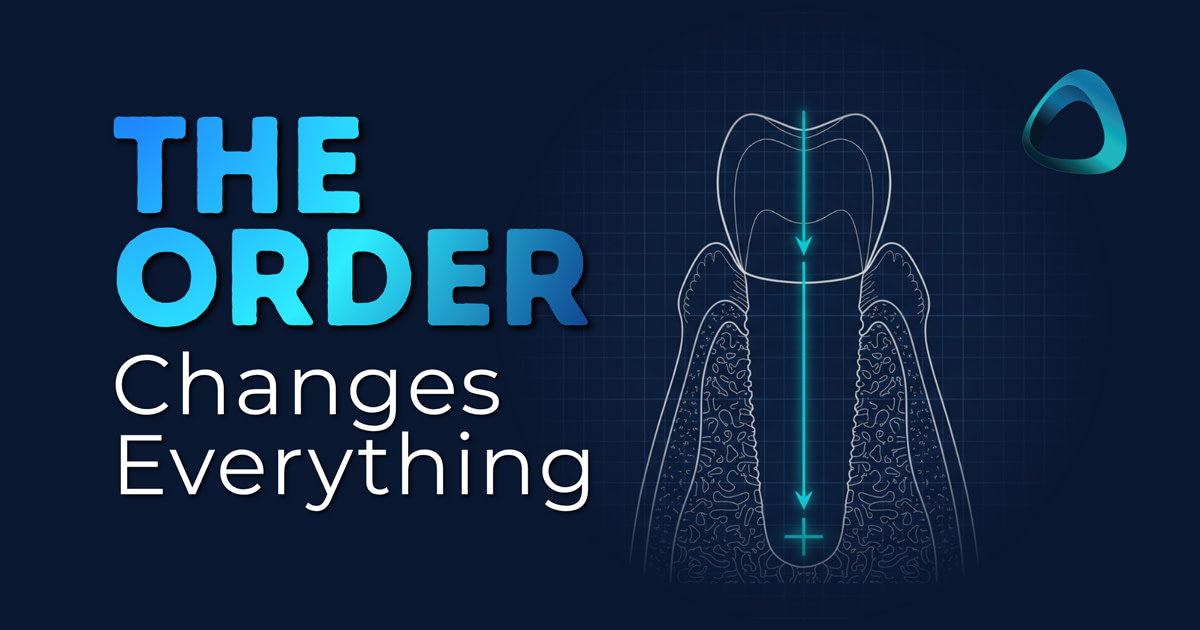
Implant dentistry is a prosthetic-driven discipline with a surgical component. We always start with an end goal in mind, then work the plan backward to the surgery that gets us there. Plan with the end in mind, and most of what looks like a surgical problem later turns out to be a planning problem that surfaced late.
The complication almost never starts at the drill
Most dentists focus their anxiety on the surgical moment, the osteotomy angulation, primary stability, flap management, closure. Those matter, and they deserve the attention they get.
But walk back through a difficult case and the decision that mattered most is almost always earlier. An implant placed a few degrees off the ideal restorative axis, because the bone was softer there. A site chosen before anyone fully mapped where the final crown needed to sit. None of that is a surgical error in the moment. It gets executed cleanly, by a steady hand, following a plan that was already compromised.
Prosthetically driven planning is not just a mindset. It is a set of measurements, once you know where the crown needs to emerge.
Mesiodistally, I want the implant at least 1 to 1.5mm away from the adjacent tooth, to preserve the bone between them and keep the tooth next door out of danger. That number drives the space arithmetic backward: 1.5 mm of clearance on each side plus a 4mm implant diameter in the middle, which is why a single implant needs about 7mm of space in most cases. Narrower sites, like lateral incisors or lower incisors, call for a 3mm diameter implant instead.
Facially, I want 1.5 to 2mm of facial plate thickness left in place, which helps prevent the buccal bone from resorbing in the years after placement. Place the implant too far facial, and you risk recession as the thin plate remodels away. Place it too far palatally, and the final restoration has to ridge-lap to reach the tooth position, making it bulky and uncomfortable for the patient.
Coronally, plan the implant platform 3 to 4mm apical to the mid-facial gingival margin of the planned restoration. Get any of these numbers wrong, and the crown inherits the error for as long as it stays in the mouth.
The RPD rule - resist palatal density
There is a reason implants drift facially during osteotomy prep, and we have a name for it. The RPD rule, resist palatal density.
Palatal bone is dense, and when your drill meets that density, it wants to kick the osteotomy toward the softer facial bone. Left unchecked, your implant ends up too far buccal before you notice.
The fix is not a different drill, it is deliberate pressure. Prep to the appropriate depth, and do not undersize in this area since the bone is dense enough to resist it on its own. Apply pressure apically and palatally as you go, so the implant does not drift into the facial wall of the original socket.

Know what’s next in dentistry. Before everyone else.
The innovations, clinical insights, and digital trends that matter - curated by iDD and delivered straight to your inbox every week.
Sequencing is still a planning decision
A plan is not finished once it settles on a position. It also has to settle on order, whether you graft first and place later, or build the site and place at the same time.
My own preference, especially early in a dentist's implant experience, is to graft the area first and come back to place the implant afterward. It is more predictable that way. Defect shape matters too. A horizontal defect is easier to rebuild than a vertical one, so the sequencing decision is not the same for every site.
Good records protect the plan, and protect you
Every plan starts with a meet-and-greet, then a comprehensive exam and records, in that order. Part of that first conversation is understanding the patient's motivation for being there. Are they ready to work with you as a team, or are they arriving already blaming the last dentist for what went wrong. That is a genuine warning flag, and it is worth noticing before the plan gets built.
The records list itself does not shrink because you are in a hurry. Medical history and ASA classification, an odontogram, periodontal charting, a panoramic and periapical radiograph, then CBCT, diagnostic models, and photographs. From there, a diagnostic wax-up, and confirmation of implant stock and backup sizes before the day of surgery.
CBCT is not optional in that list. Tissue thickness can vary greatly and can be deceiving. A case can look like ample bone and thick tissue in the mouth, and read the opposite once you look at the CT.
Good records do two jobs. They help you plan the case and convey that plan to the patient. They also protect you, for the cases when things do not go as expected.
What a plan actually needs to settle before you touch tissue
A plan worth operating from answers a short list of questions before the day of surgery, not during it.
Where does the final restoration need to sit, and does the proposed implant position actually support that? What is the sequence if the site needs bone or soft tissue built up first, and does the patient understand what that sequence involves?
And what happens at the moment of placement if the torque does not cooperate? That question has a number attached to it, not a guess.
Hit adequate primary stability, usually around 35 newton-centimeters, and you can place the healing abutment the same day, a one-stage approach. Come in low on torque, or you have grafted the site, and the safer route is to submerge the implant and let it heal for three to four months before you go back in. That threshold is the fallback, decided in advance, not improvised chairside.
Answer all three before you pick up a scalpel, and the surgery becomes the part of the case with the least uncertainty in it.
Do not let the calendar or the budget write the plan
Patients come in wanting things fast or facing financial constraints, and sometimes they ask for a plan that is less than ideal as of result. Do not compromise your ideal treatment plan. Make sure you do not take shortcuts in planning a case, so it does not come back to haunt you with a remake or an early failure.
If this is the layer of implant dentistry you want deliberate, structured training in, the Advanced Surgical Implantology Mini-Residency is built around exactly this: judgment, case selection, and risk assessment, through to the surgical protocols themselves.
It runs as a 12-month mentored program, 14 modules and 34 hours of training with monthly live case-review calls and 40 hours of CE credit, the course content is yours for life, and enrollment is rolling, so your mentored year starts the day you join. You can view the full course here.
The plan is the case. Get that right, and the surgery mostly takes care of itself.