


I just returned from back-to-back conferences - CIOSP in São Paulo and AEEDC in Dubai - and the contrast between these two events was pretty striking.
While CIOSP highlighted Brazil's unique market dynamics, with a focus on implants, cosmetics, and facial aesthetics, AEEDC 2026 reinforced its position as one of digital dentistry's premier annual showcases.
The numbers tell the story: over 70,000 attendees from 160+ countries descended on the Dubai World Trade Centre, with exhibition space expanding once again to accommodate 5,000+ brands from across the globe. AEEDC has unquestionably cemented its place as one of the world's largest annual dental exhibitions, rivaling long-established European and American shows in sheer scale and international reach.
Yet despite this impressive growth, something felt different this year. While we witnessed several noteworthy product launches, the overall volume of "groundbreaking" announcements seemed more measured than the innovation frenzy that characterized 2019 and the early 2020s. The digital dentistry industry appears to be entering a maturation phase - less focused on introducing entirely new product categories and more concentrated on refining existing technologies and perfecting workflows.
That's not to say innovation has stopped. The nature of innovation has simply shifted. Rather than revolutionary new hardware at every turn, we're seeing something perhaps more clinically significant: the industry has collectively aligned around solving specific high-value challenges.
If AEEDC 2026 had a single dominant theme, it was full-arch implant solutions. Nearly every major scanner manufacturer and digital workflow company showcased either new or enhanced capabilities for capturing, planning, and executing full-arch cases. Photogrammetry units, specialized scan bodies, AI-driven treatment planning, and streamlined manufacturing workflows have converged to make full-arch dentistry faster, more accurate, and more accessible.
Walking through the exhibition halls, this focus was impossible to miss. What began with Shining 3D's Aoralscan Elite scanner, demonstrating the viability of 'intraoral photogrammetry' with horizontal scan bodies, has evolved into an industry-wide commitment to delivering complete full-arch scan solutions. The question is no longer whether companies will address full-arch workflows, but how effectively their approach will perform in clinical practice.
Beyond full-arch solutions, other patterns emerged: AI integration becoming more common rather than novel, 3D printing solidifying its position in both chairside and laboratory workflows, and scanner manufacturers differentiating through software sophistication rather than hardware specifications alone.
Let's dive into what each company brought to AEEDC 2026, starting with the innovations that caught my attention and the broader patterns reshaping digital dentistry's competitive landscape.
Want more of the latest in dentistry?
Join the RAPID community
and get insights straight to your inbox.
Key Industry Trends at AEEDC 2026
Full-Arch Scan Solutions
If AEEDC 2025 introduced full-arch implant scanning as an emerging priority, AEEDC 2026 confirmed it as the industry's primary focus. The proliferation of solutions was remarkable - dedicated photogrammetry units, iPad-based capture systems, specialized scan bodies, and AI-driven verification software all competed for attention across nearly every major booth.
The clinical and economic drivers are clear. Full-arch implant cases represent some of dentistry's highest-value treatments, yet traditional workflows remain complex, time-consuming, and error-prone. Digital solutions promise streamlined processes with improved accuracy, reduced chair time, and broader access to this treatment modality.
What's particularly striking is how comprehensively the industry has aligned around this challenge. Companies that once competed primarily on general scanning capabilities now differentiate themselves specifically on full-arch scan performance. Marketing materials prominently feature full-arch case studies, accuracy specifications explicitly reference horizontal scan body scanning, and product demonstrations center on full-arch workflows rather than single-tooth restorations.
Scanner Market Reaches Maturity
The intraoral scanner market revealed interesting maturation dynamics at AEEDC 2026. While a few new models debuted, the emphasis has clearly shifted from introducing entirely new hardware to enhancing existing platforms through software updates, workflow integrations, and ecosystem connectivity.
Price points have largely stabilized after years of dramatic decline. The race to the bottom appears to have slowed (though not ended), with even budget-focused manufacturers recognizing that competing solely on price creates unsustainable business models and devalues the entire category.
Instead, we're seeing more strategic positioning - companies defining clear value propositions at specific price tiers rather than simply undercutting competitors. Software capabilities increasingly define competitive advantage. As hardware components become somewhat commoditized, the user experience, feature sets, AI integration, and ecosystem compatibility now set leaders apart from followers in the scanner market.
Chinese Products Dominating the Exhibition Floor
Walking through AEEDC 2026, the sheer dominance of Chinese manufacturers was impossible to ignore. From intraoral scanners to 3D printers, milling machines to materials, Chinese companies commanded a significant portion of the exhibition space - far exceeding their presence at other shows like Chicago Midwinter or CIOSP.
This wasn't just about the quantity of booths, but the breadth of product categories where Chinese manufacturers now compete. Nearly every digital dentistry segment featured multiple Chinese options, often at price points that undercut Western competitors while offering increasingly comparable capabilities. The budget scanner market is almost entirely dominated by Chinese manufacturers. The entry-level and mid-range 3D printer space is overwhelmingly Chinese. Even in premium categories, Chinese companies are making inroads with sophisticated hardware and software that challenge assumptions about quality and capabilities.
What's particularly striking is the evolution beyond simple OEM arrangements. While white-labeled products still exist in abundance, more Chinese manufacturers are building their own brands, developing proprietary technologies, and investing in user experience and software development. The gap between Chinese and Western digital dental products continues to narrow, and in some cases - particularly around speed, connectivity, and AI integration - Chinese manufacturers are actually leading innovation rather than following it. Look at Shining 3D Aoralscan Elite, for example.
It will be very interesting to watch this unfold in the coming years and see how the traditional old guard of digital dentistry responds.
A Period of Consolidation?
Perhaps the most notable trend at AEEDC 2026 was the absence of sweeping changes. Unlike previous years where the exhibition halls buzzed with revolutionary product announcements and paradigm-shifting technologies, this year felt markedly different - quieter, more measured, almost cautious.
Walking through the booths, the pattern became clear: refined versions of existing products, incremental software updates, and evolutionary improvements rather than revolutionary leaps. Major manufacturers largely showcased the same hardware as last year, with enhancements focused on software features and workflow optimizations rather than on fundamentally new capabilities. This wasn't due to a lack of effort or innovation, but rather suggests the industry has entered a period of consolidation after years of rapid expansion and disruption.
Is this the calm before the storm of IDS 2027? Quite possibly. Many companies may be holding back major announcements for the larger global stage, where historically the most significant launches occur. Or perhaps we're witnessing a natural maturation of digital dentistry - a market that has spent the past decade introducing revolutionary technologies now entering a phase where refinement and perfection matter more than novelty. Either way, AEEDC 2026 felt like an industry taking a breath, consolidating its gains, and preparing for whatever comes next.
Let's go over what we saw from each company in alphabetical order
Aidite - Zirconia Giant's Digital Transformation Continues
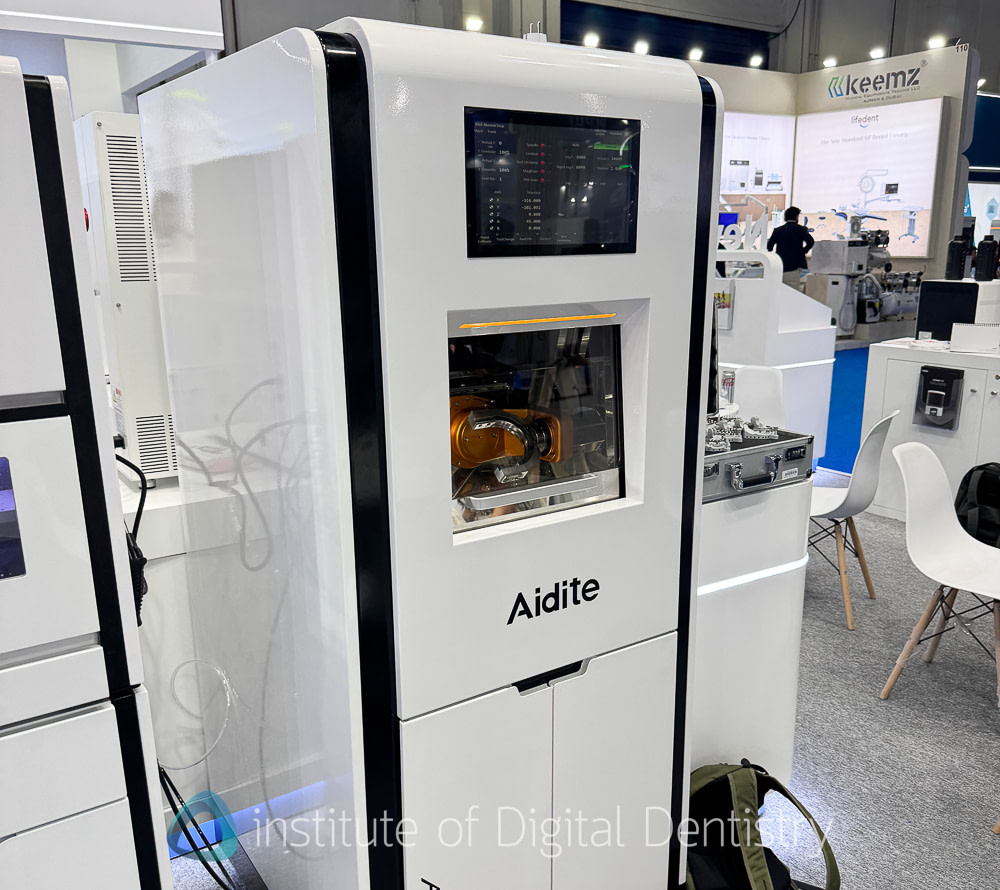
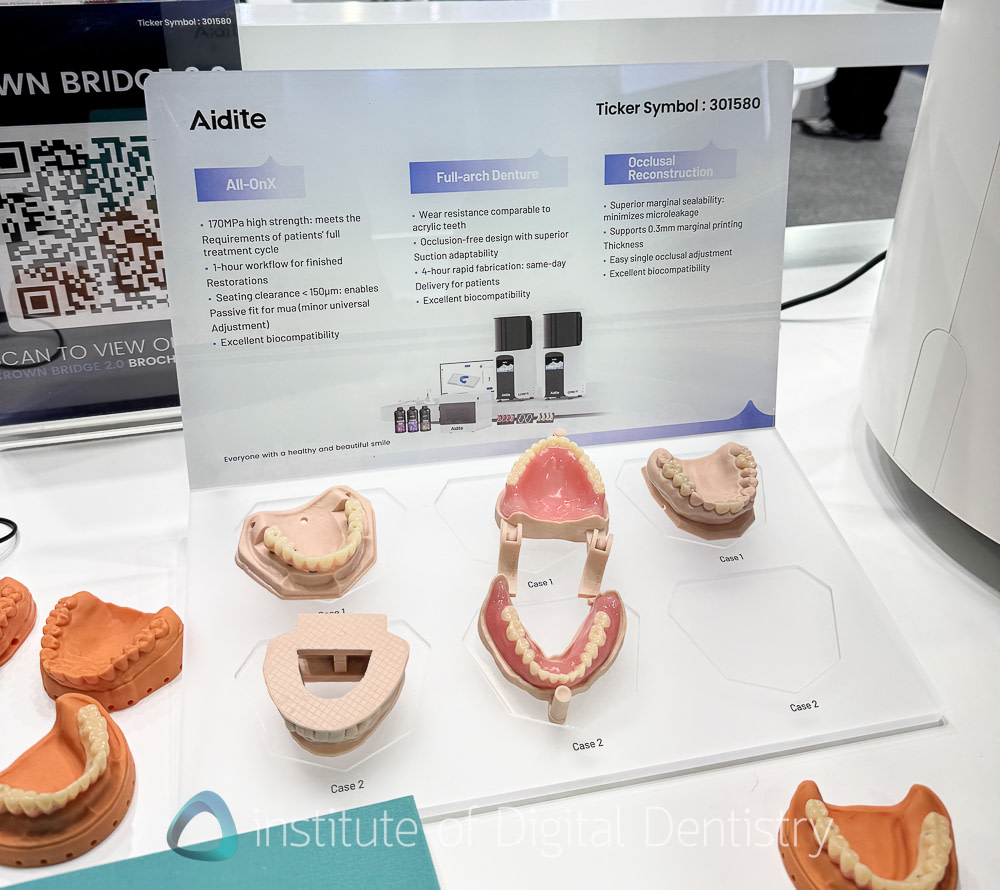
Aidite, returned to AEEDC 2026 with an even more comprehensive demonstration of their digital evolution. Once again, the Chinese zirconia giant showcased how they're systematically transforming from a materials-focused manufacturer into a complete digital solution provider.
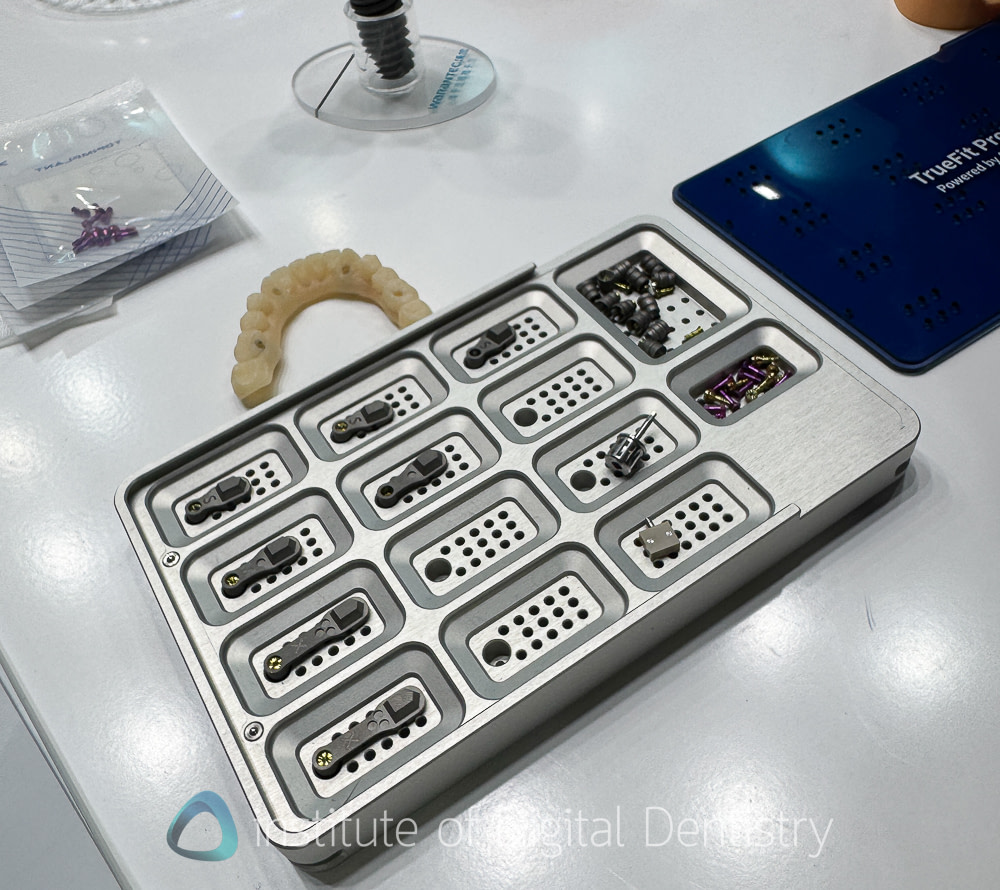
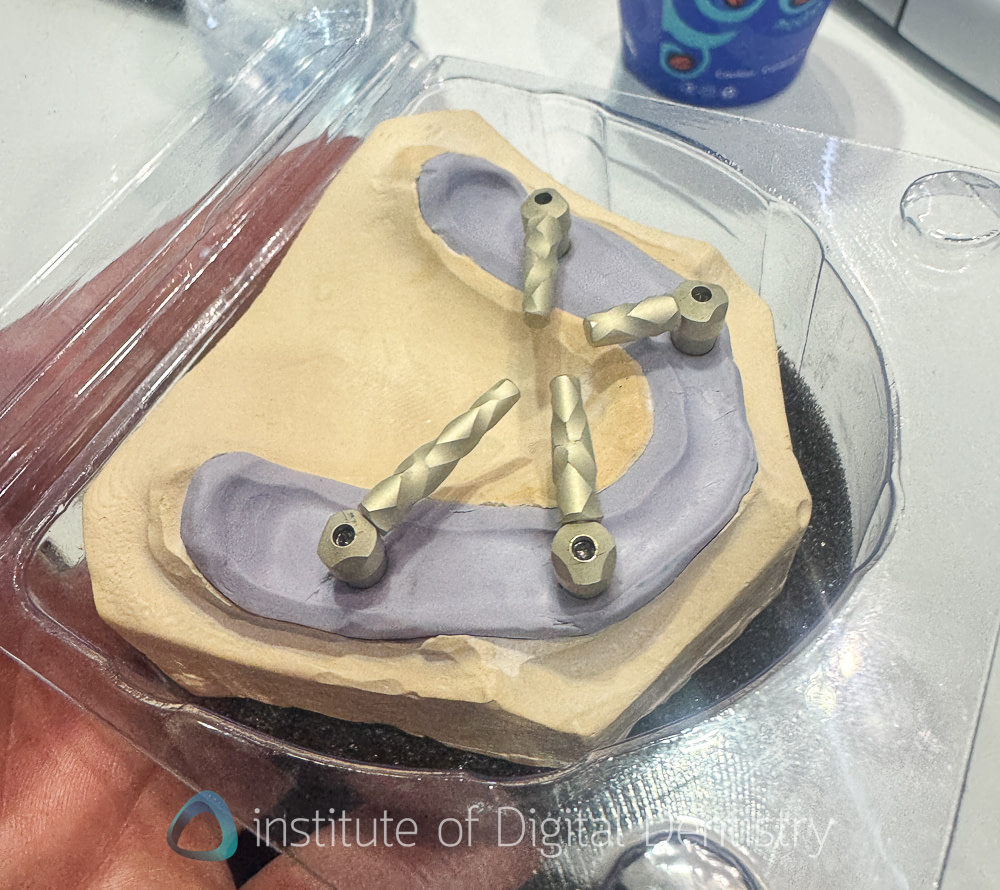
Their booth displayed the full digital workflow ecosystem they're building - from intraoral scanners and design services to the milling machines and 3D printers that process their materials. Aidite also showcased their own form of a horizontal scan body system for all-on-x workflows - something that you will notice is common throughout this post.
The company also highlighted its in-house design laboratory services, demonstrating a vertically integrated approach that few other materials companies have attempted. This comprehensive strategy represents one clear way Aidite is differentiating itself from other zirconia manufacturers who remain focused primarily on material sales.
Yet despite this digital expansion, their zirconia products remained center stage, and for good reason. Aidite's materials remain extremely popular globally, where their combination of quality and accessibility resonates strongly. Their booth traffic suggested that while practitioners appreciate the digital ecosystem Aidite is building, many still come primarily for the materials that built the company's reputation.
The question remains whether Aidite can successfully execute this dual identity - maintaining its material dominance while building credibility in the competitive digital equipment space. Their continued investment in this transformation suggests they're committed to the long game, but the digital dental market is crowded with established players who won't cede territory easily.
Alliedstar - DirectIP Horizontal Scan Body Launches
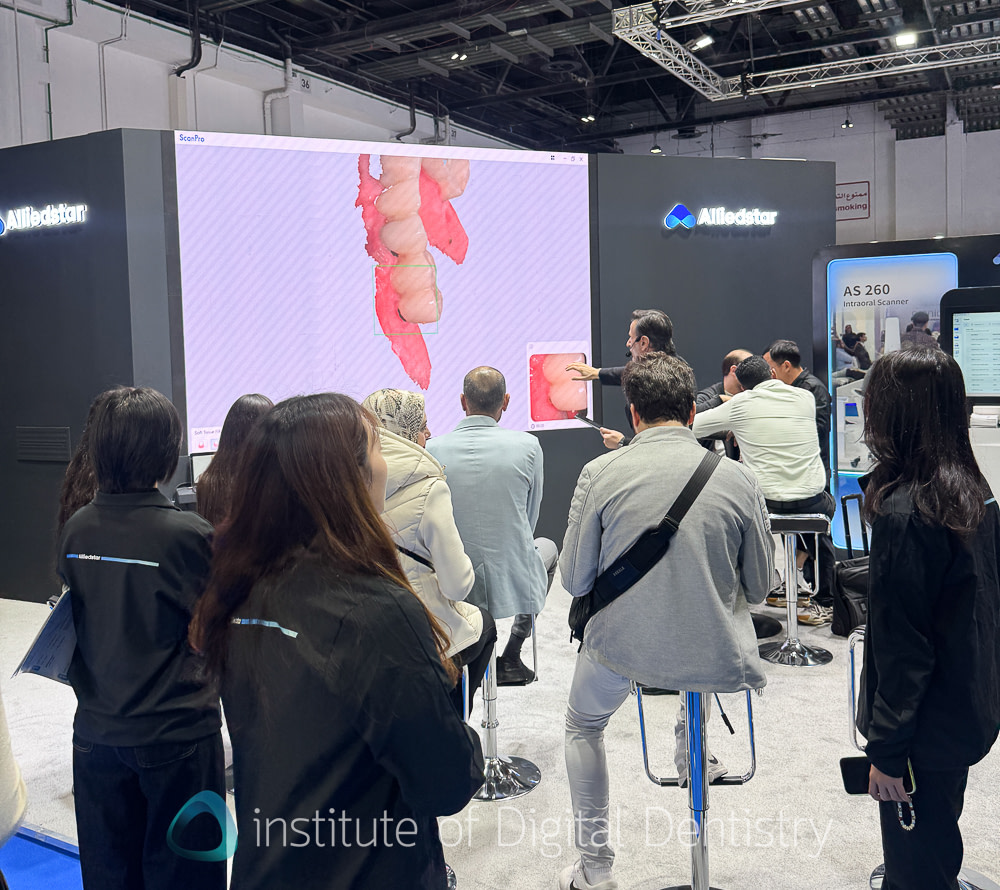
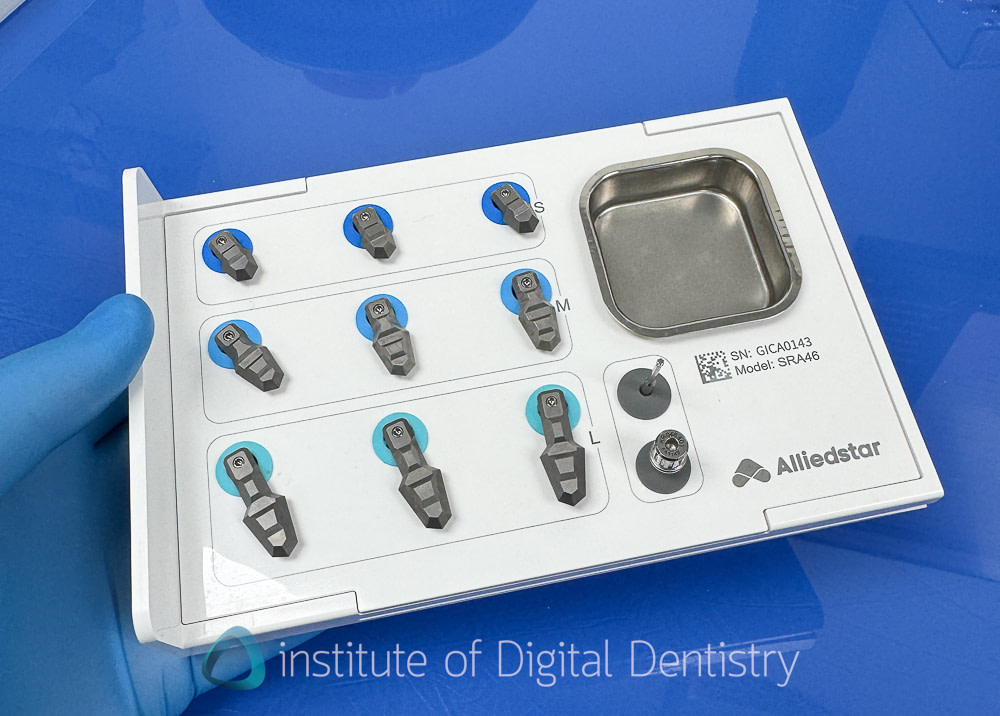
Alliedstar made AEEDC 2026 a major moment for their full-arch ambitions, hosting a significant launch event that drew substantial crowds throughout the exhibition. The star of their booth was the new DirectIP horizontal scan body and accompanying software update - their comprehensive answer to the industry's full-arch scanning obsession.
I've been beta-testing the DirectIP system before this launch, and I have to say I've been impressed by what they've achieved. The horizontal scan body approach, combined with their refined software workflow, horizontal scan body alignment, and scan body transfer, represents a thoughtful solution to the full-arch challenge. As mentioned earlier, full-arch scanning solutions dominated AEEDC 2026, and Alliedstar's entry into this space demonstrates how seriously they're taking this market opportunity.
Beyond DirectIP, their booth showcased their evolving scanner lineup, including the Sensa and AS200E, AS260, all of which continue to develop and mature. The progression of their entire portfolio reflects steady refinement and strategic focus rather than scattershot product releases.
What's particularly interesting is watching the Straumann and Alliedstar collaboration unfold. This partnership is proving to be absolutely killer - Straumann brings credibility, clinical trust, and global infrastructure, while Alliedstar provides accessible digital technology and rapid development capabilities. No one develops as fast as China. The combination gives them unique advantages in the full-arch implant market, where implant expertise and scanning technology must work seamlessly together.
Their commitment to the MENA region remained evident through both their significant booth investment and the continuous stream of lectures and demonstrations happening throughout the event.

Download the iDD Highlights PDF
A summarized version of this blog.
View as a flipbook online or download a copy to read it later.
Amann Girrbach - Austrian Milling
Amann Girrbach's presence at AEEDC 2026 showcased their established range of milling systems, with the Matron taking center stage. As expected, there were no major hardware announcements - milling technology has been mature for some time now, and the focus has shifted primarily to software improvements, workflow optimizations, and incremental refinements rather than revolutionary changes.
Their industrial-grade machines, known for handling everything from implant components to full-contour zirconia restorations, continue to meet the demands of labs and production facilities. The company's established reputation in the high-end milling market remains strong, particularly among laboratories requiring reliable, high-throughput solutions.
In many ways, Amann Girrbach represents the maturity of subtractive manufacturing in digital dentistry. While 3D printing captures headlines and innovation attention, milling remains the gold standard for certain applications. The lack of sweeping changes isn't a weakness but rather a reflection of refined, proven technology that simply works.


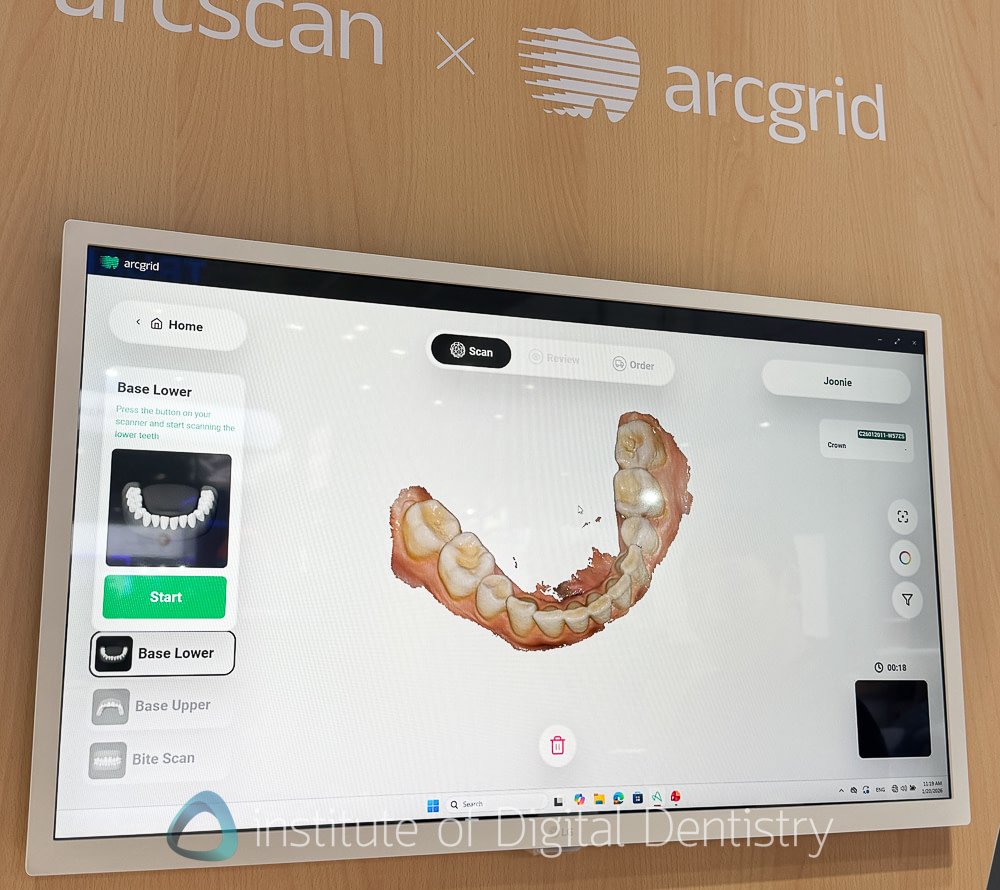
Arcreal - Arcscan Officially Launches
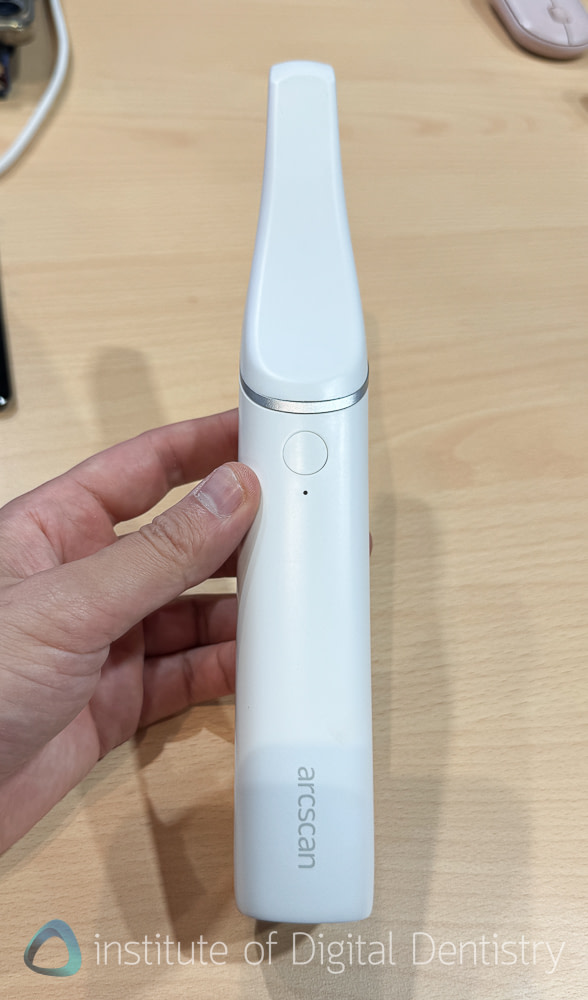
After years of development and prototype demonstrations at previous shows, Arcreal officially launched its Arcscan intraoral scanner at AEEDC 2026 - one of the only significant new scanner releases at the event.
The Arcscan stands out immediately for its exceptionally polished user interface and user experience design - something I tested at the booth and liked quite a lot. This isn't just marketing speak - the UI/UX implementation genuinely ranks among the most thoughtful I've seen in any scanner on the market. Their cloud-based management software maintains the same level of attention to detail, suggesting Arcreal has focused its development on the right priorities rather than rushing a half-baked product to market.
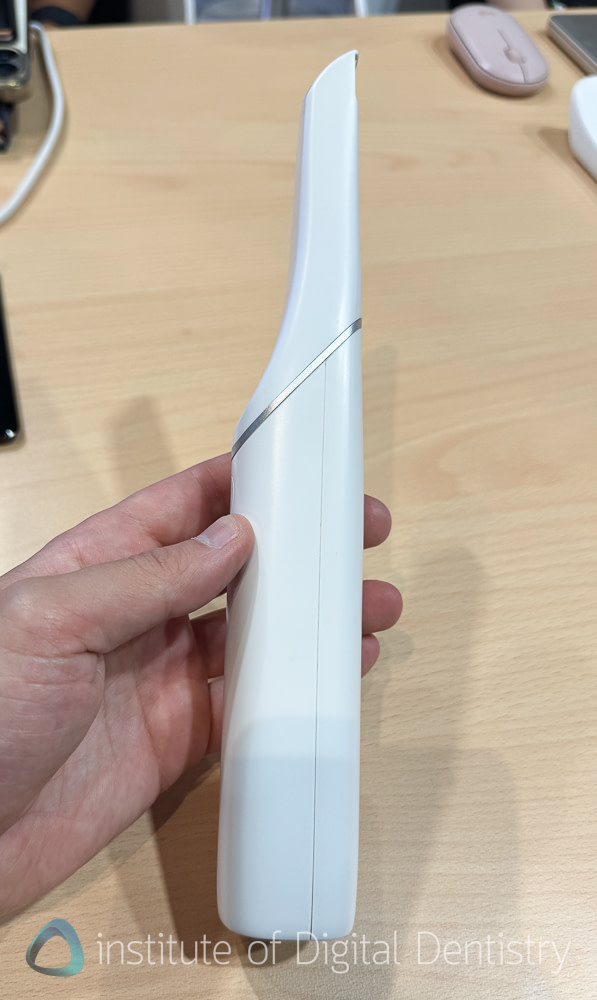
At just 200 grams, the Arcscan is very lightweight, making it one of the lightest scanners available. The scanner features an enhanced ultra-low-distortion optical design, according to the company, and a high-speed, high-quality CMOS imaging sensor. To me, this translates to a buttery-smooth scanning experience, which is nice.
All the standard practical features, such as anti-fogging and an autoclavable tip, are here. Their approach focuses on core scanning functionality executed exceptionally well, rather than overwhelming users with excessive feature lists that often overshadow usability.
Interestingly, Arcreal teased an exciting announcement coming at Chicago Midwinter in just a couple of weeks, suggesting they have more to reveal beyond the hardware itself.
The big question is whether Arcreal can successfully enter what is now an extremely crowded and competitive intraoral scanner market. Their emphasis on user experience and thoughtful design gives them a differentiation angle, but converting that into market share against established players and aggressive Chinese competitors will be the real challenge. The scanner market doesn't need another me-too product, but a genuinely well-designed solution with strong software could carve out its own space.
Asiga - Pod Printing for Chairside Applications
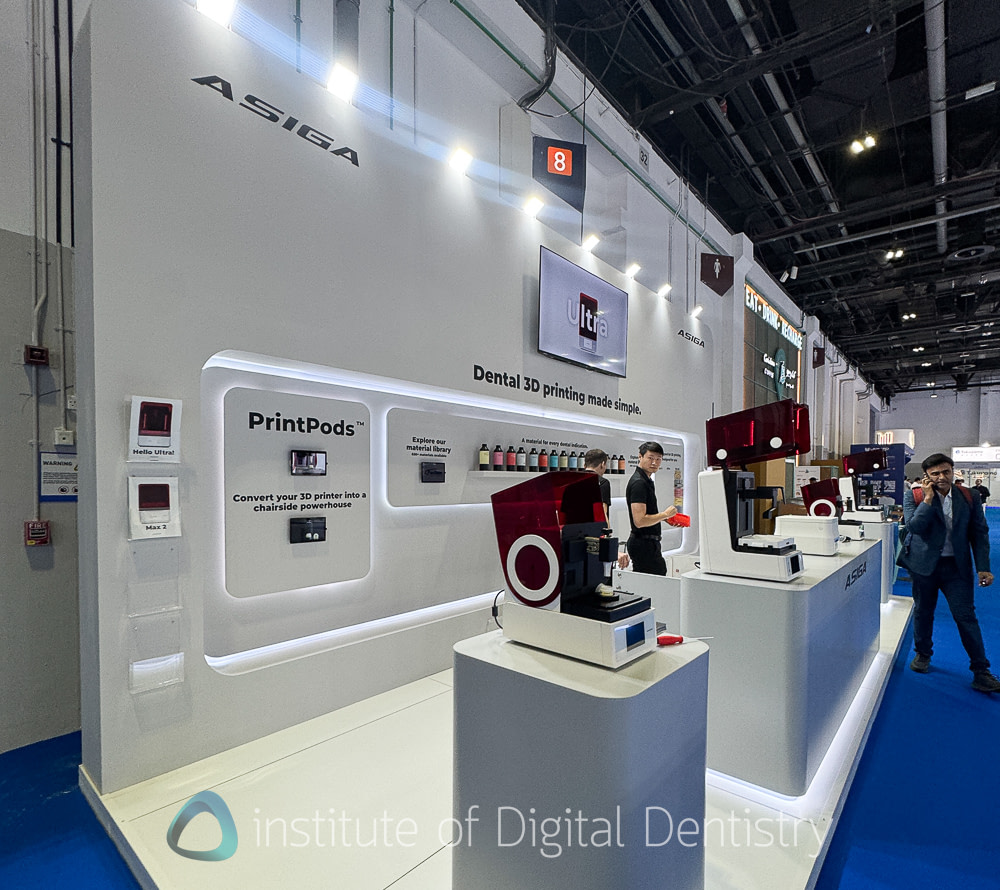
Asiga's booth focused on their established printer lineup, with the Ultra and MAX 2 taking center stage alongside some interesting new accessories. The Ultra, with its high-throughput capabilities and DLP technology, remains extremely popular in the dental lab space, while the MAX 2 demonstrates the company's commitment to precision manufacturing in a compact form factor.
The more interesting developments at their booth were the new Asiga Cure and their recently launched PrintPod system. These print pods represent Asiga's strategic move into what could become the next major trend in chairside 3D printing. The pod approach - where materials come in sealed, plug-and-play cartridges - dramatically simplifies the printing workflow by eliminating the messy resin handling.
Asiga has moved remarkably quickly to bring this pod-printing concept to market. While other companies have discussed similar approaches, Asiga is already shipping a production solution. This could prove significant for practices that want the benefits of chairside printing without the complexity of traditional resin management, cleaning protocols, and material waste concerns.
The company's continued dedication to open materials and software refinements shows its focus on enhancing its existing ecosystem rather than constantly chasing new hardware releases. Their methodical approach to product development has consistently resulted in reliable, well-thought-out solutions rather than rushed announcements.
Want more of the latest in dentistry?
Join the RAPID community
and get insights straight to your inbox.
Atomica.AI - From Surgical Guides to Digital Workflows
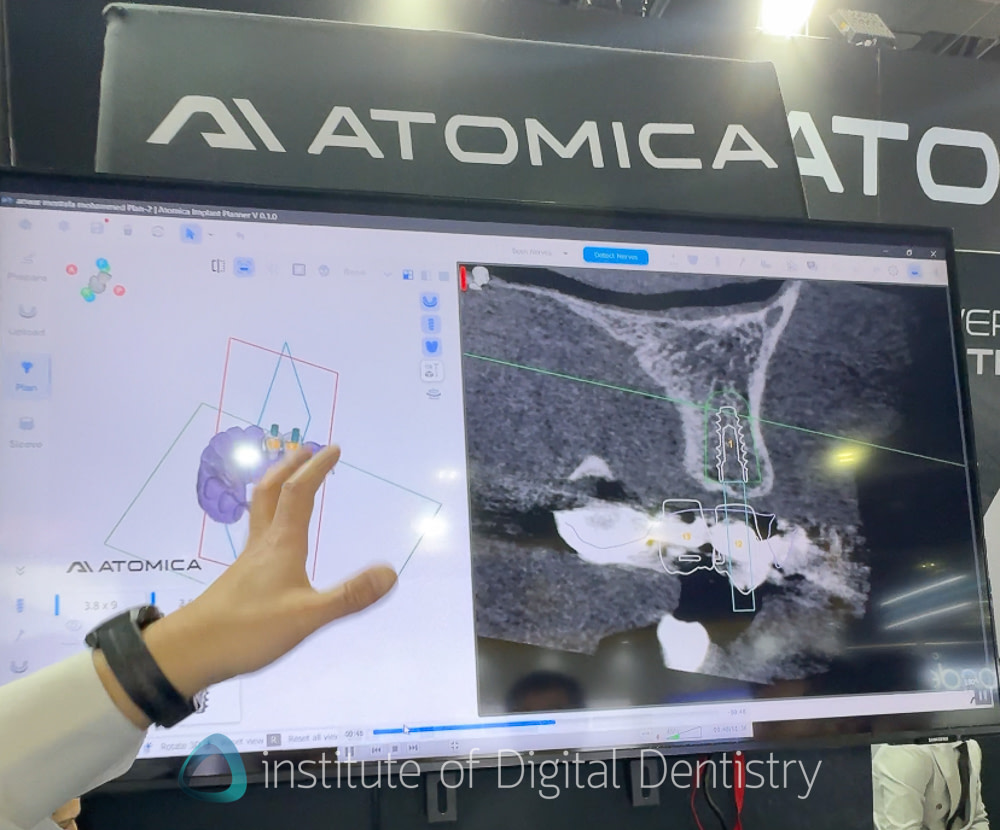
Atomica.AI's continues to make significant moves in the cloud CAD space, and their AEEDC 2026 booth showcased an expanding vision that goes well beyond their original stackable guide focus. The company is clearly positioning itself as a major player offering increasingly comprehensive digital solutions.
Their stackable guide technology remains the centerpiece - and rightfully so, as it's genuinely one of the best automated surgical guide design solutions available. The technology automates what has traditionally been a complex and time-consuming design process with impressive reliability. However, Atomica.AI is no longer content to be a one-trick pony.
The booth revealed several strategic expansions. They displayed their white-labeled Helios scanner, signaling their intention to offer complete workflows from capture through design rather than remaining purely software-focused. This move toward hardware partnerships demonstrates their ambition to control more of the digital dentistry value chain.
Perhaps most interesting were their new AI capabilities for treatment planning - specifically the ability to digitally remove teeth and plan implant positions. This represents a significant leap beyond simple crown design automation into comprehensive treatment planning assistance. It's exactly the kind of AI feature development that represents dentistry's future - not just automating design tasks but actually assisting with clinical decision-making.
With more and more software companies entering this space, Atomica.AI's expansion from surgical guides to restorative design and now to treatment planning AI shows that success requires comprehensive solutions rather than point products. The competition in cloud CAD is intensifying, but their track record with surgical guides gives them credibility as they venture into adjacent markets.
BEGO - Material Focus Remains
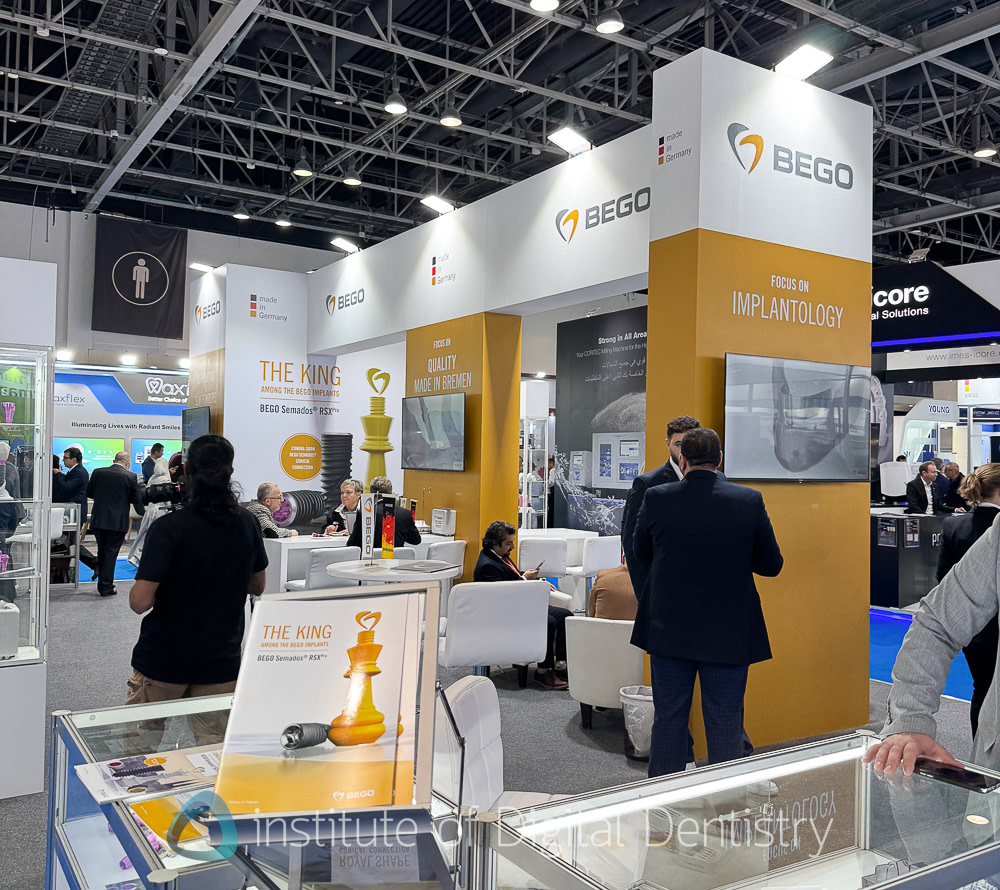
BEGO has maintained its presence at AEEDC 2026, focusing on its TriniQ resin line. Known for their long history in dental materials and equipment, they showcased the capabilities of their advanced printing materials without any significant new announcements.
The TriniQ resins continue to represent BEGO's strategic positioning in the 3D printing materials space. As 3D printing gains acceptance for permanent restorations and temporary solutions, high-performance resins become increasingly critical, and BEGO's decades of materials expertise position them well in this segment.
Their approach remains focused on material science rather than hardware expansion - a deliberate strategy that contrasts with many other companies at AEEDC who are building comprehensive equipment ecosystems. This specialization suggests BEGO believes there's enduring value in being the materials expert rather than competing in the crowded hardware market.
While nothing groundbreaking emerged from their booth this year, consistency and reliability in materials often matter more than constant innovation. BEGO's steady presence in the materials space serves practices and labs that prioritize proven performance over the latest releases.
Biotech Dental Group - Showcasing the IRIS scanner
The IRIS scanner from the Biotech Dental Group made another appearance at AEEDC 2026, continuing its multi-year exhibition cycle but still not having reached commercial release. The system's distinctive design remains visually striking, but questions about market readiness persist as competitors ship iterative improvements while IRIS remains in development.
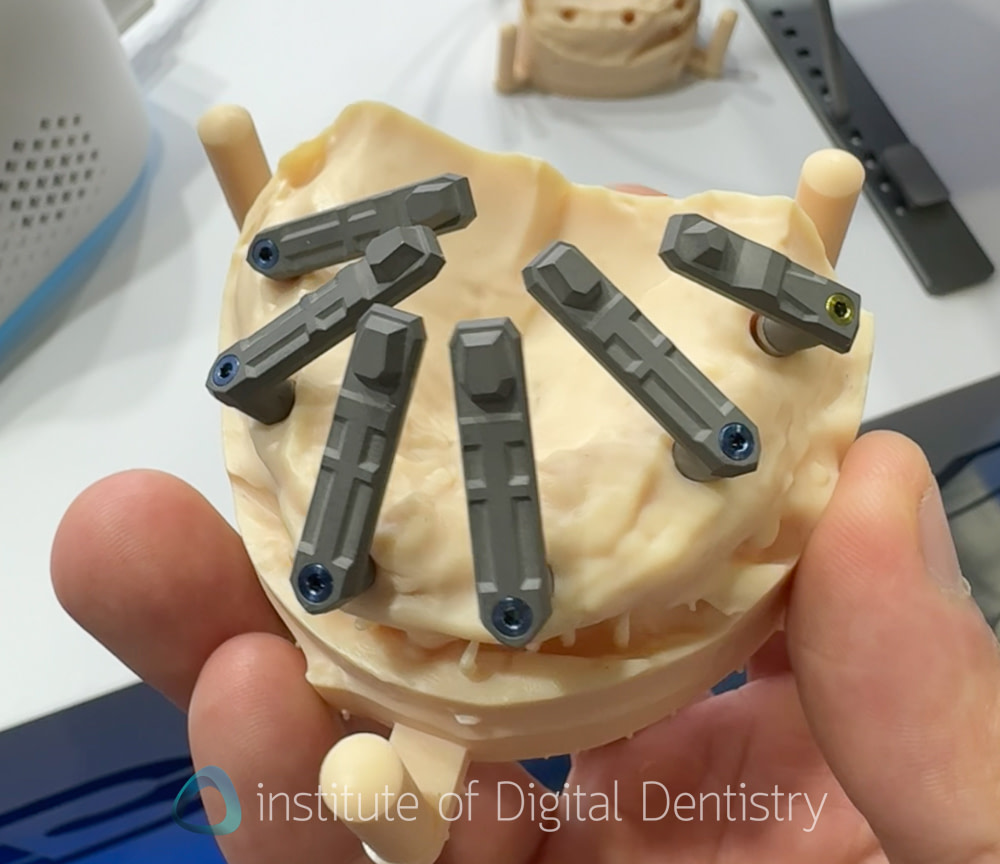
The 2026 iteration added modular capabilities, including a face scanning module (unavailable for testing at the booth) and a photogrammetry camera with proprietary all-on-X scan bodies. This expansion reflects the industry-wide focus on full-arch workflows, with IRIS seeking to differentiate through integrated photogrammetry rather than relying on third-party solutions such as TruAbutment's IO connect.
Testing revealed the same fundamental challenge observed in previous years: the scanning workflow remains slower and less intuitive than established competitors. The learning curve required to operate IRIS effectively represents a significant adoption barrier.
The scanner market has matured considerably since IRIS first appeared at trade shows - accuracy standards have risen, prices have fallen, and ecosystem integration has become table stakes. Launching today requires not just functional hardware but proven clinical workflows, material compatibility, and software partnerships that established players already provide.
Whether IRIS can gain meaningful market presence upon eventual launch depends on factors beyond design. The unique form factor generates booth traffic, but converting interest into sales requires demonstrating clinical advantages over scanners that practitioners already own and trust.
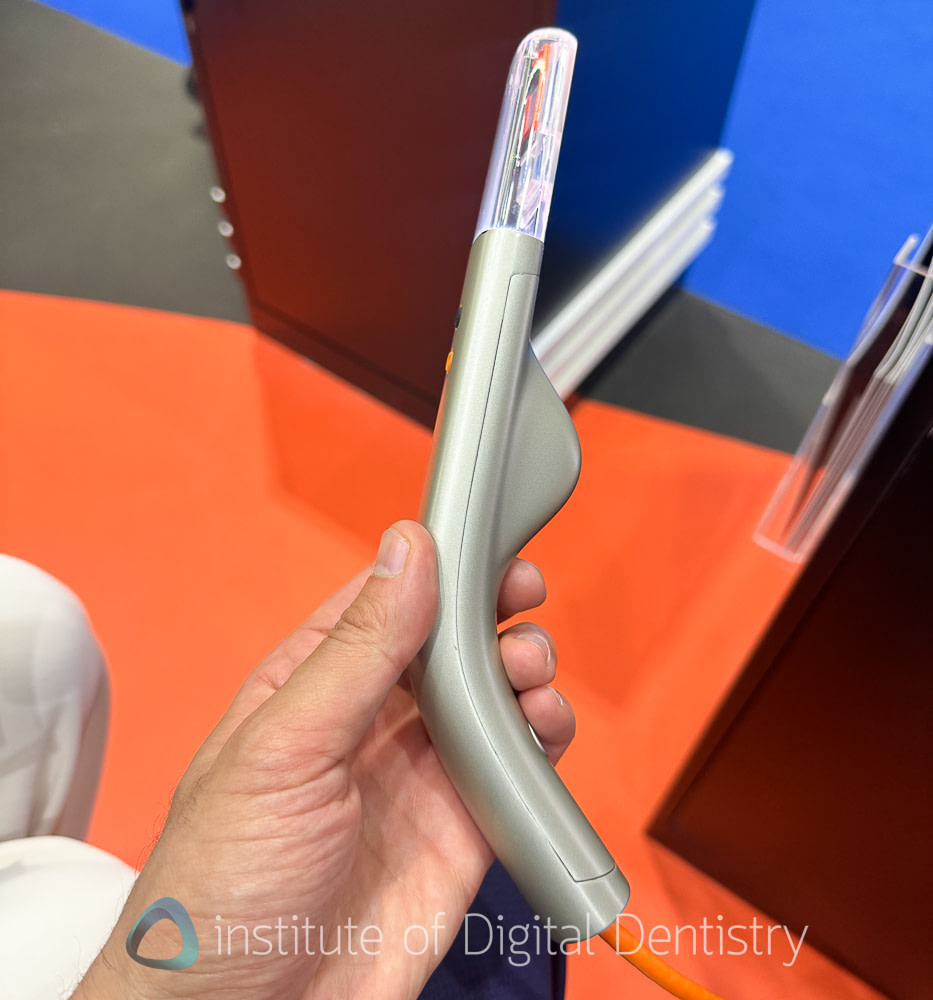
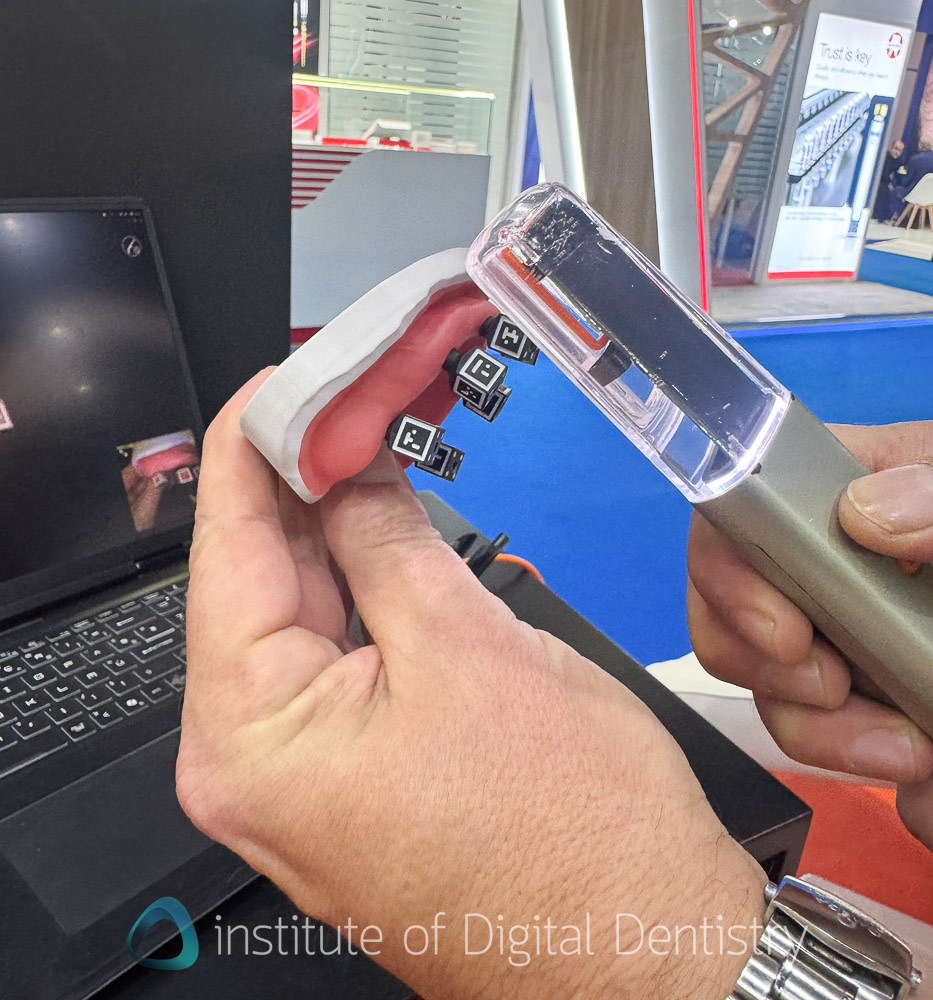
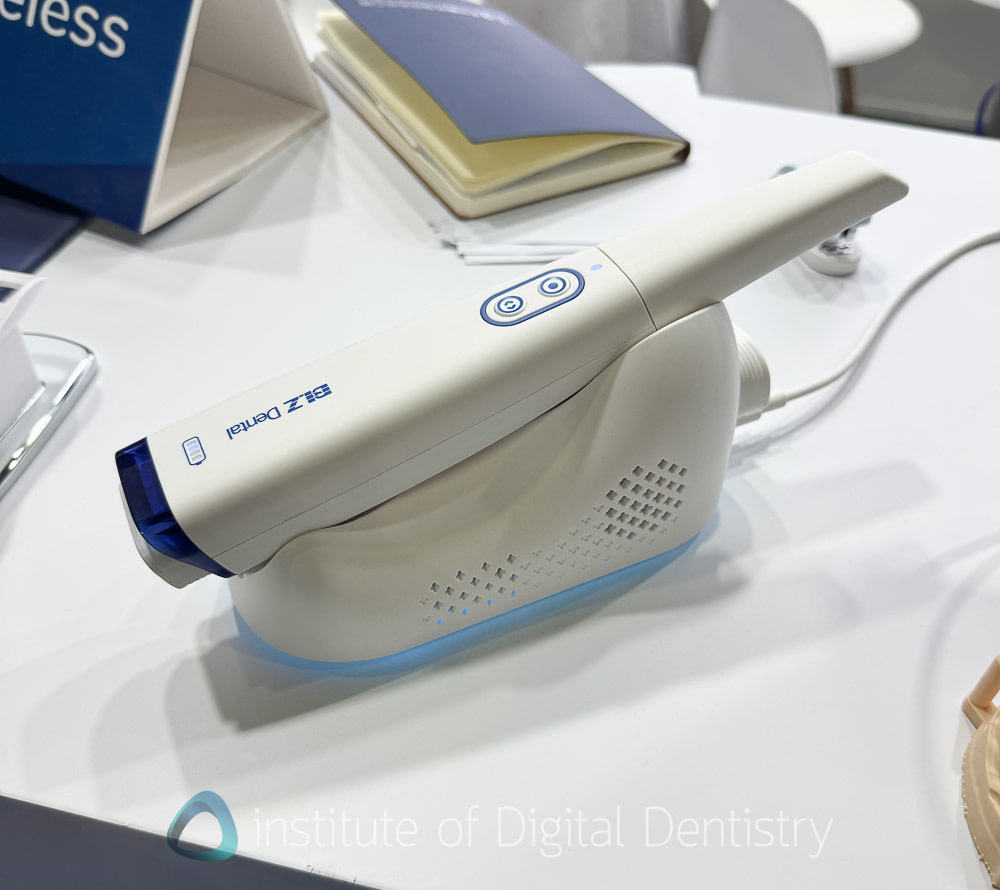
BLZ Dental - Leap 500 Wireless Scanner and DMC Solution
BLZ Dental showcased two significant products at AEEDC 2026: their new Leap 500 Wireless scanner and the DMC Edentulous Digital Scan system - both representing their commitment to comprehensive digital workflow solutions.
The Leap 500 Wireless features a 25mm scan depth and 2-hour battery life, powered by two batteries. The scanner offers three tip sizes: large (17.8mm×16.3mm), medium (14.85mm×14.49mm), and mini (11.75mm×13.5mm). Software functions include cloud platform integration, AI examination reports, measuring tools, crown design, shades measurement, orthodontic simulation, splint design, and a scanbody library.
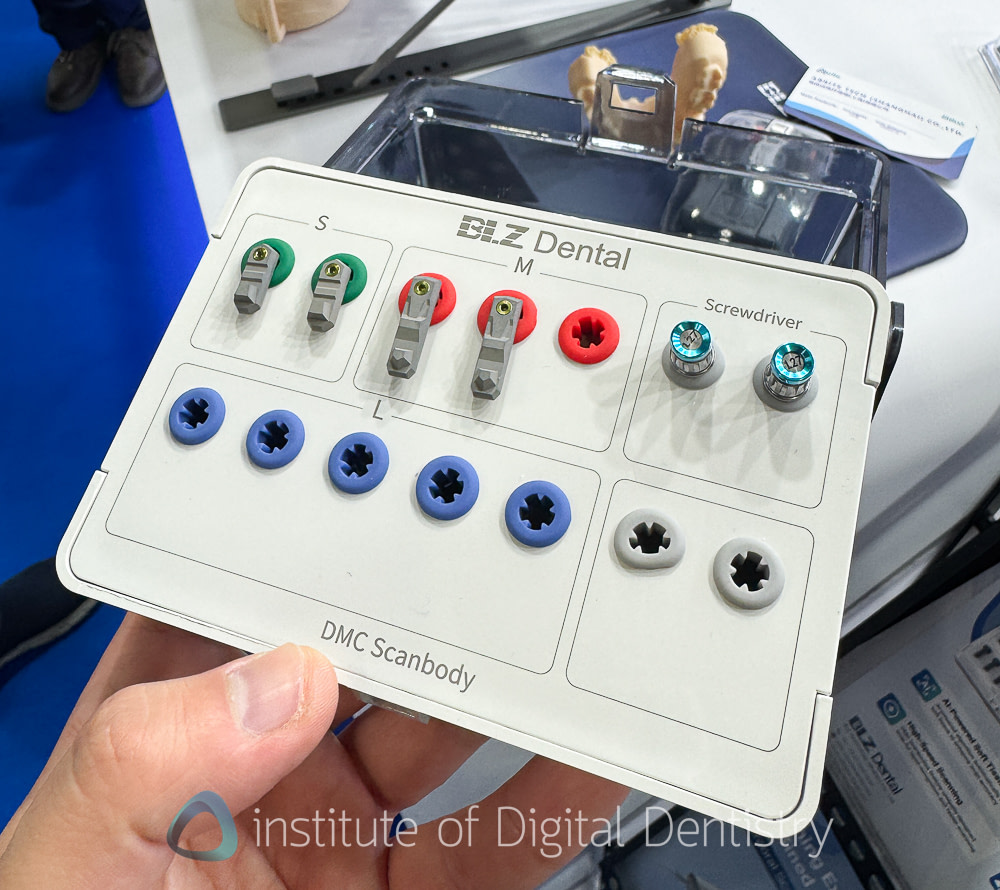
Perhaps more interesting is their DMC Edentulous Digital Scan system - BLZ's entry into the competitive full-arch implant scanning space. Yet another horizontal scan body system.
The DMC Scanbody Kit is compatible with all common implant systems, including Straumann, Dentis, Nobel Biocare, Osstem, and others. The marketing emphasizes AI-powered soft-tissue removal to enhance scan accuracy, high-speed scanning with uniquely designed scanbody ends, minimal cumulative error (only the scanbody head needs scanning), and broad compatibility with implant systems.
BLZ's move into both wireless scanning and full-arch solutions demonstrates their ambition to compete across multiple product categories. However, they face the same challenge confronting all emerging Chinese manufacturers: breaking through in markets increasingly saturated with capable, affordable options while established Western brands command premium positions through software sophistication and brand trust.
Claronav - Navigated Surgery
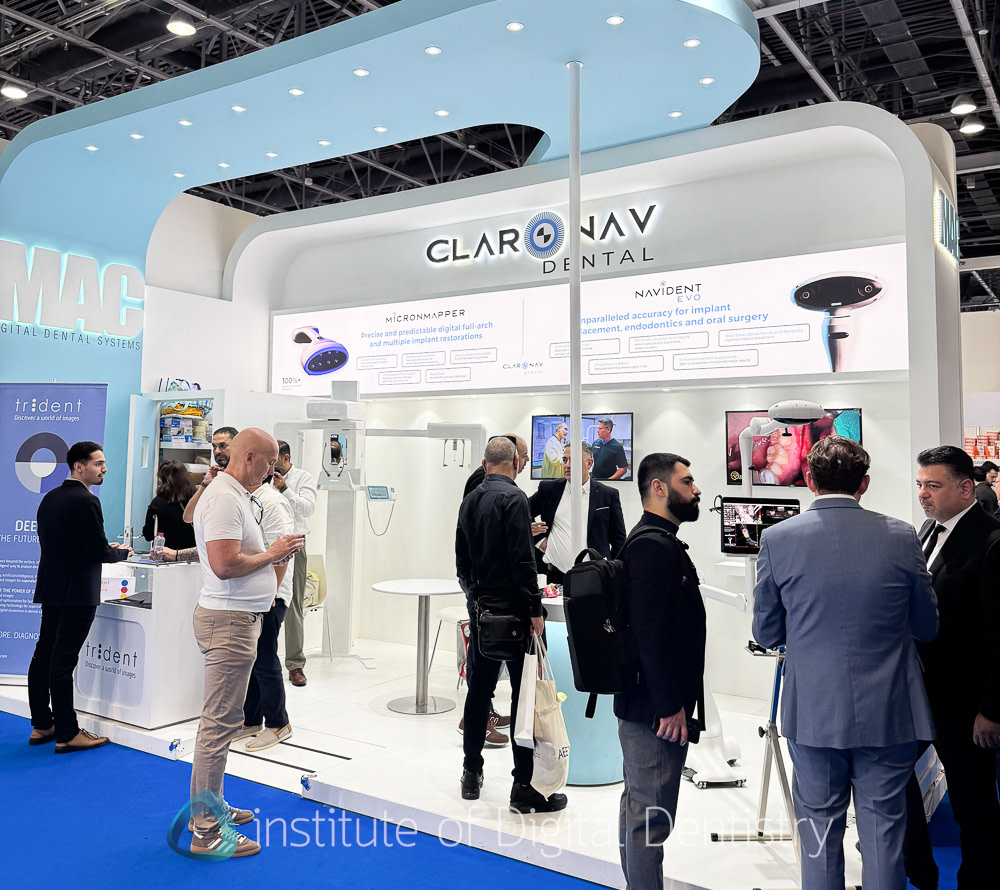
Claronav demonstrated their Navident navigated implant surgery system at AEEDC 2026, representing the continued presence of surgical navigation technology at major dental exhibitions despite limited mainstream adoption. We are seeing more and more of these devices every year.
Overall, it's a nice system. Our team at iDD has written an extensive piece about it here. However, navigated surgery continues to face persistent adoption barriers that haven't changed substantially despite years of development and exhibition.
The advantages are clear. Yet, these systems require additional hardware investment, workflow modifications, and a learning curve. Not being a hater - I just think the main issue is not the systems, as they are nice, but that they compete with established guided surgery protocols that already deliver predictable results. Most practitioners have developed confidence with static surgical guides, which provide adequate accuracy without real-time tracking infrastructure.
COXO - Steady Presence in Economic Scanning
COXO also maintained its presence at AEEDC 2026, showcasing its OEM scanner alongside its well-established endodontic product line. Well-known in the MENA region for their endo equipment, COXO's move into digital scanning through OEM partnerships represents their ongoing diversification strategy.
Their scanner offerings provide a low-cost entry point into digital dentistry for practices in price-sensitive markets. While nothing particularly new emerged from their booth this year, the continued presence demonstrates that budget scanning solutions remain relevant and in demand, particularly in regions where cost considerations significantly influence technology adoption decisions.
COXO's approach - leveraging OEM relationships to enter the digital space rather than developing proprietary technology - illustrates how established dental companies try to expand their portfolios without massive R&D investments.
DentBird - Continued Cloud CAD Development
DentBird's presence at AEEDC 2026 showcased continued developments to its cloud-based CAD platform. Their booth demonstrated refined crown design workflows and software improvements that reflect ongoing platform maturation.
The cloud CAD space continues to evolve rapidly, and DentBird's consistent development efforts demonstrate its commitment to staying competitive. Their platform stands as one of the more mature offerings in this space, with capabilities that extend beyond simple single-unit restorations.
As cloud-based design solutions become increasingly popular in digital dentistry, DentBird's position in this crowded market will depend on its ability to differentiate through workflow efficiency, design accuracy, and seamless integration with scanning platforms. Their continued software refinements suggest they understand that in the cloud CAD space, standing still means falling behind - constant improvement is the price of staying relevant.
While no groundbreaking announcements emerged from their booth, steady platform development and workflow optimization often matter more to practitioners than flashy new features. The real test will be whether their improvements translate into tangible efficiency gains for practices and labs using their system daily.
Dentafab - Consistent Printer Portfolio
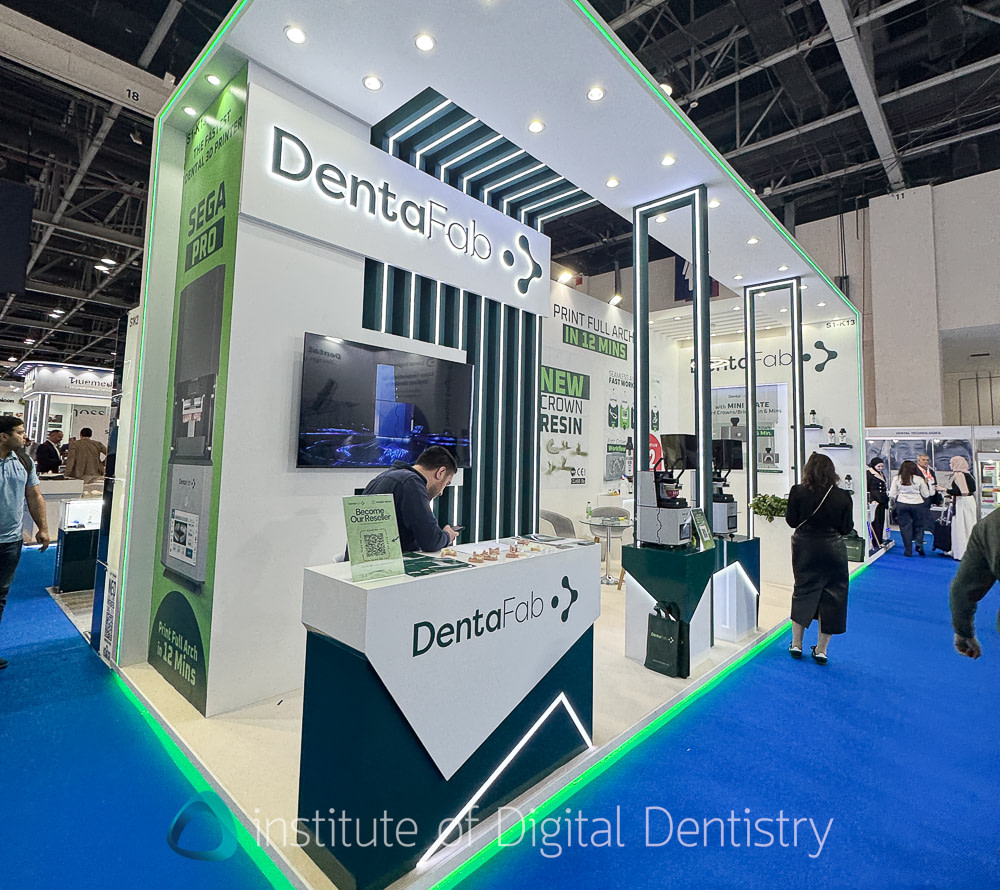
Dentafab maintained its presence at AEEDC 2026 with its established 3D printer lineup, demonstrating the industry shift toward iterative refinement rather than frequent hardware launches. The company's printers have gained traction for combining compact footprints with reliable and fast performance.
Their presence at AEEDC primarily serves to maintain brand visibility in a market where purchasing decisions increasingly depend on established reputation and peer recommendations. Dentafab's printers work well, deliver consistent results, and are popular in this region.
There were some new resins at the booth, in particular a crown resin, as this area of 3D printing continues to gain traction. Otherwise, nothing new to report - another good printer manufacturer.
DG Shape - Milling Consistency
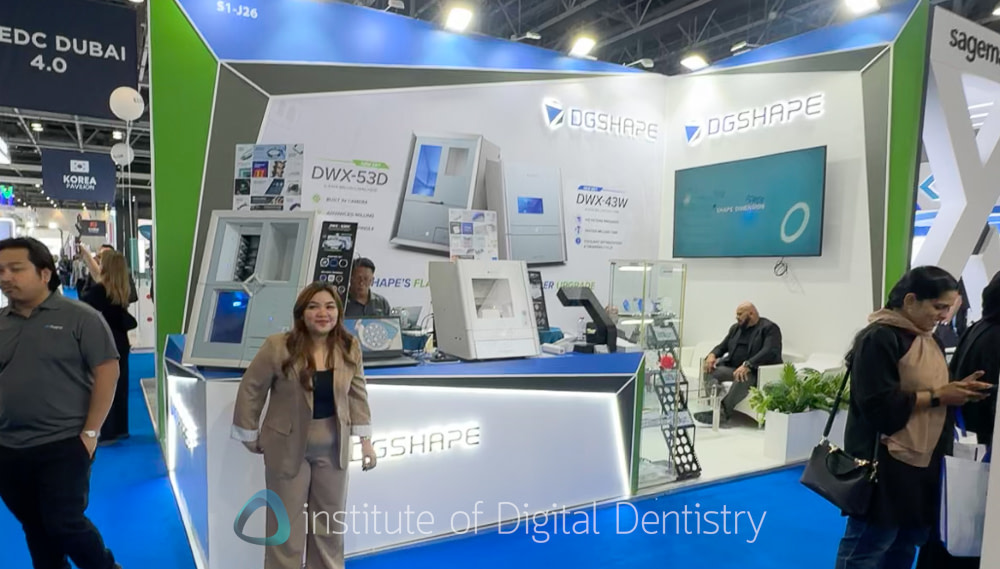
DG Shape's booth at AEEDC 2026 focused on their established line of milling machines, with their comprehensive DWX series taking center stage. The company, known for its reliable dental milling solutions, showcased its range without introducing any major new hardware this year.
Their lineup continues to serve different segments of the market - from compact desktop units like the DWX-52Di Plus for entry-level users to more robust lab systems like the DWX-53DC for high-volume production facilities. The DWX series remains a staple in many dental laboratories worldwide, with its open CAD/CAM system approach that allows flexibility in materials and workflows.
As the industry continues its fascination with 3D printing innovations, DG Shape's focus on milling technology underscores an important reality: subtractive manufacturing remains crucial in digital dentistry. For high-precision restorative work and certain materials - particularly zirconia and other ceramics - milling remains the gold standard that printing has some work to do to match.
DOF - Showcases the Freedom Air
DOF showcased their Freedom Air scanner at AEEDC 2026, positioning it as a specialized scanner for full-arch implant workflows. The scanner features an extra-oral photogrammetry feature with a chin rest for implant position verification - specifications aimed directly at practices performing All-on-X cases.
The Freedom Air's photogrammetry integration and All-on-X focus reflect the dominant theme at AEEDC 2026: full-arch implant solutions have become the primary battleground for scanner differentiation. Nearly every scanner manufacturer showcased photogrammetry capabilities, horizontal scan body compatibility, or All-on-X workflow optimization - signaling industry consensus that accurate implant position capture requires verification beyond scanning alone.
DOF's dedicated positioning in this space, with hardware designed specifically for implant scanning workflows, demonstrates how market demand for full-arch solutions is driving specialized product development across manufacturers of all sizes.
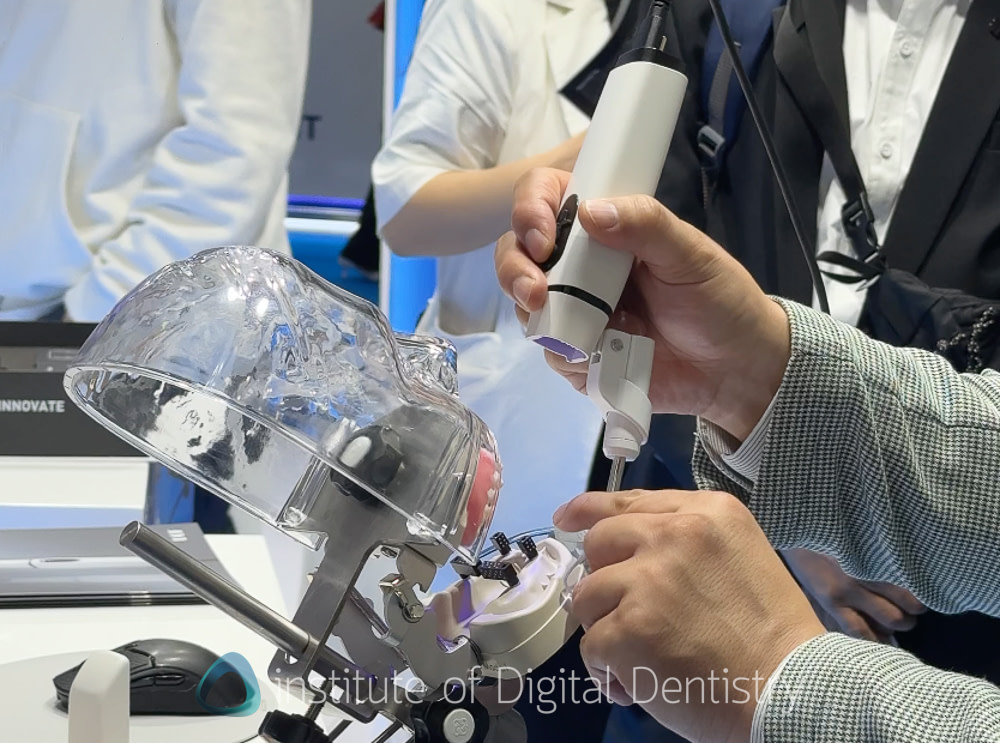
Eighteeth - Orion Horizontal Scan Body Kit
Eighteeth booth showcased just how massive this company has become. Once primarily known for their low-cost endodontic products, they've evolved into a comprehensive digital solutions provider offering everything from CBCT systems to intraoral scanners and now full-arch implant workflows.
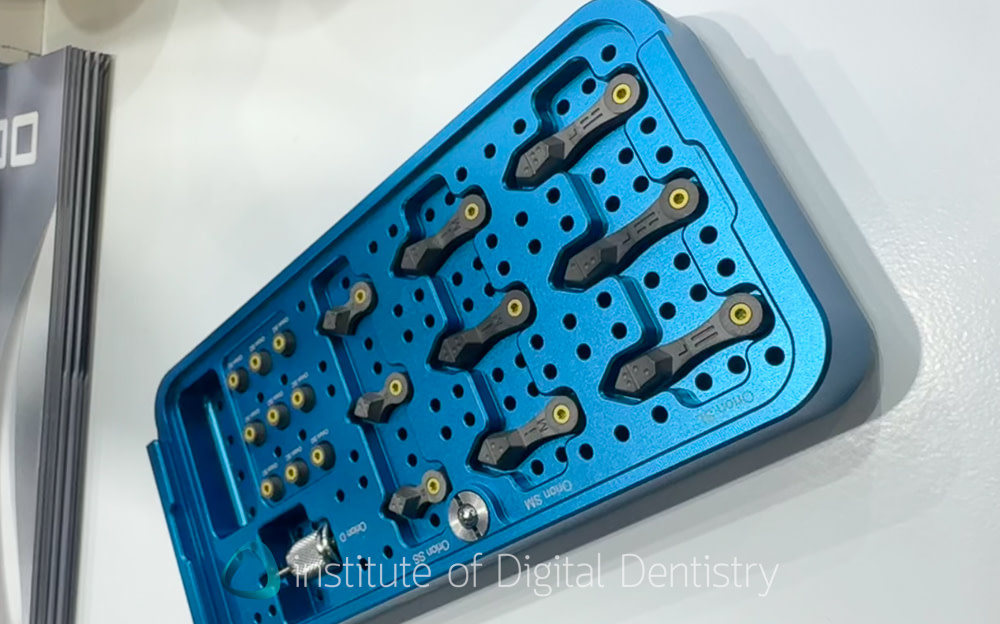
The star of their booth was the newly launched Orion Kit-M1.4 horizontal scan body system - yet another entry in AEEDC 2026's overwhelming full-arch scanning theme. The Orion system features multiple scan body options (S, M, L) designed for different clinical scenarios, and is compatible with major implant systems, including Straumann, Nobel Biocare, Cortex, Osstem, and others.
Their workflow claims accuracy better than 20 microns and promises to complete full-arch scanning in just two steps. The system is engineered for seamless integration with existing digital ecosystems, which matters enormously in a market where practitioners already own various scanner brands and don't want to be locked into proprietary solutions. I will have to thes these claims.
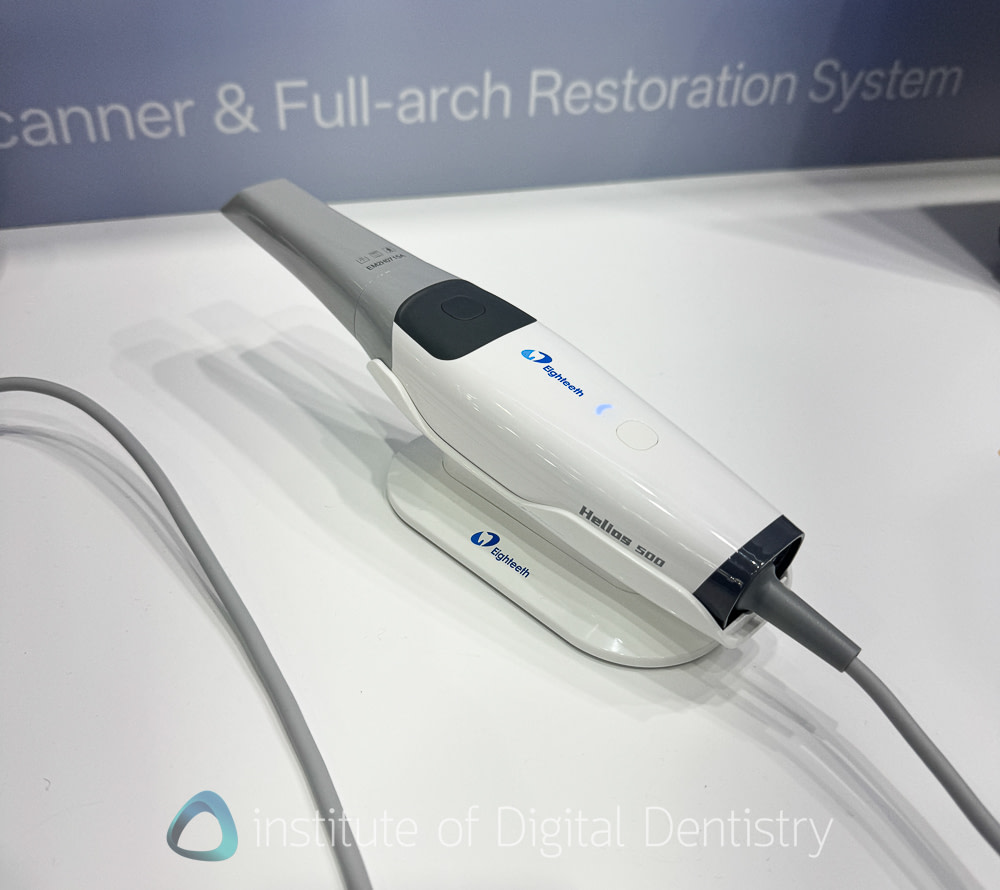
On the scanner side, Eighteeth displayed their Helios lineup without major hardware updates - the entry-level Helios 500, 680, and 700 continue serving practices seeking minimal investment in digital scanning. The company has grown remarkably from its endo roots, though the strategic question remains whether expanding across so many product categories strengthens or dilutes its market position. Their Orion launch demonstrates they're taking the full-arch opportunity seriously, which is nice to see.
Download the iDD Highlights PDF
A summarized version of this blog.
View as a flipbook online or download a copy to read it later.
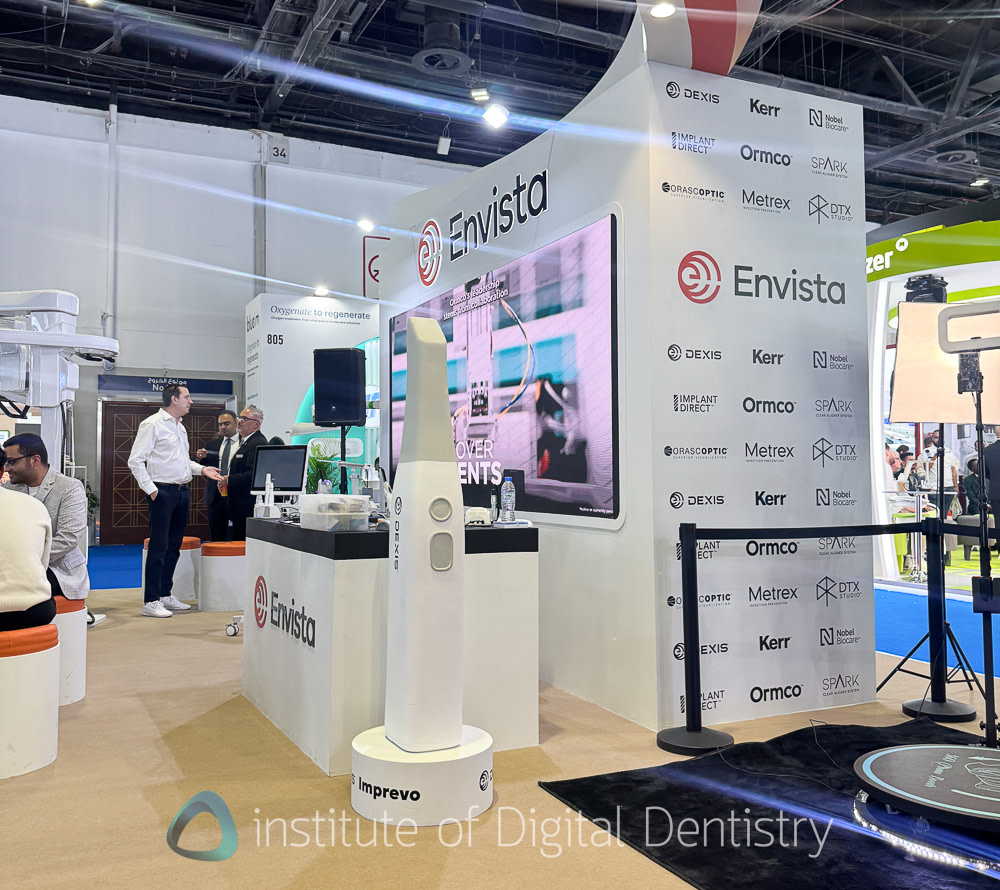
Envista - DEXIS Imprevo Scanner Showcased
Envista showcased the launch of their new DEXIS Imprevo scanner - a fresh addition to their intraoral scanning portfolio that goes beyond their existing software platform.
The Imprevo represents Envista's commitment to evolving its digital scanning offerings with what is a more sophisticated scanner. I have used the scanner in my office for months, and it is a significant upgrade over the previous-generation DEXIS/Carestream Dental scanners.
The more strategic move was their introduction of yet another horizontal scan body solution for full-arch implant workflows. Their horizontal scan body approach joins the growing list of manufacturers racing to provide comprehensive full-arch solutions, recognizing that this capability has become table stakes for any serious scanner platform rather than a differentiating feature.
The question is whether DEXIS brand recognition and Envista's support infrastructure can help Imprevo gain traction in an increasingly crowded scanner market, where Chinese competitors offer aggressive pricing and established players like Medit and 3Shape dominate mindshare.
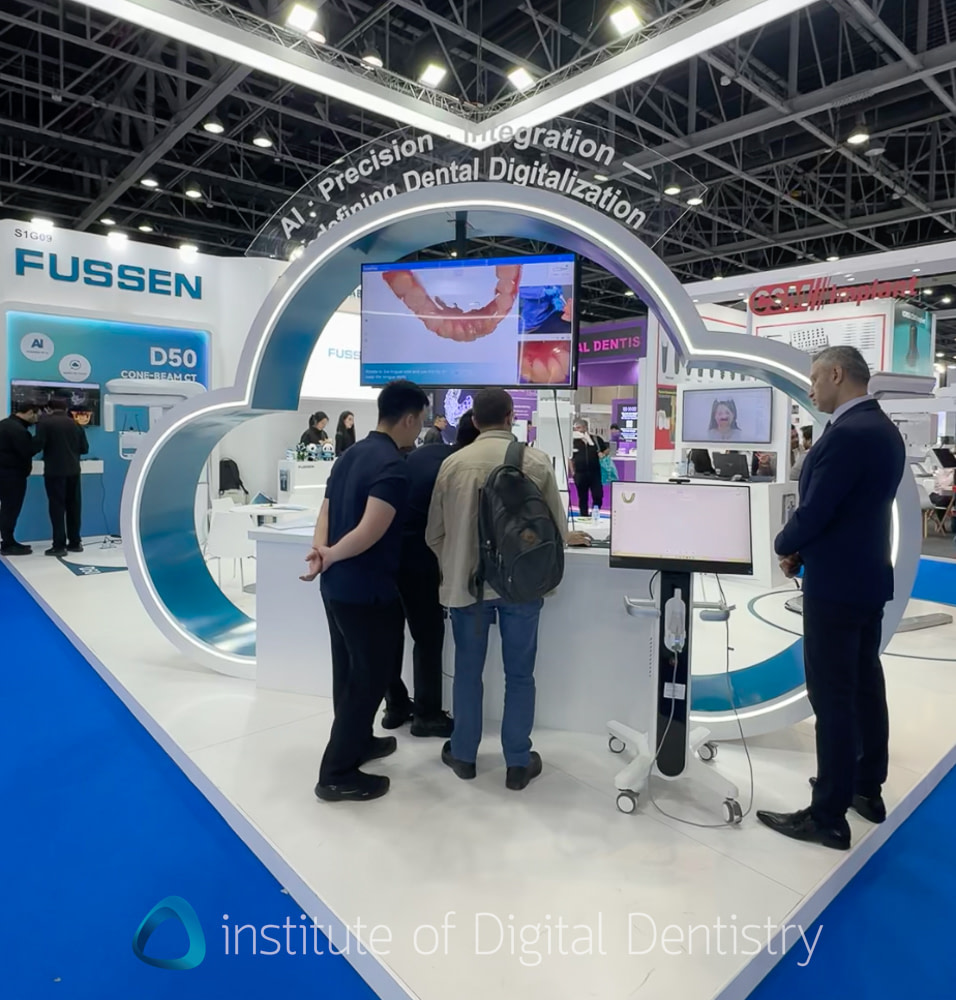
Fussen - Rubik X1 CBCT with AI Features
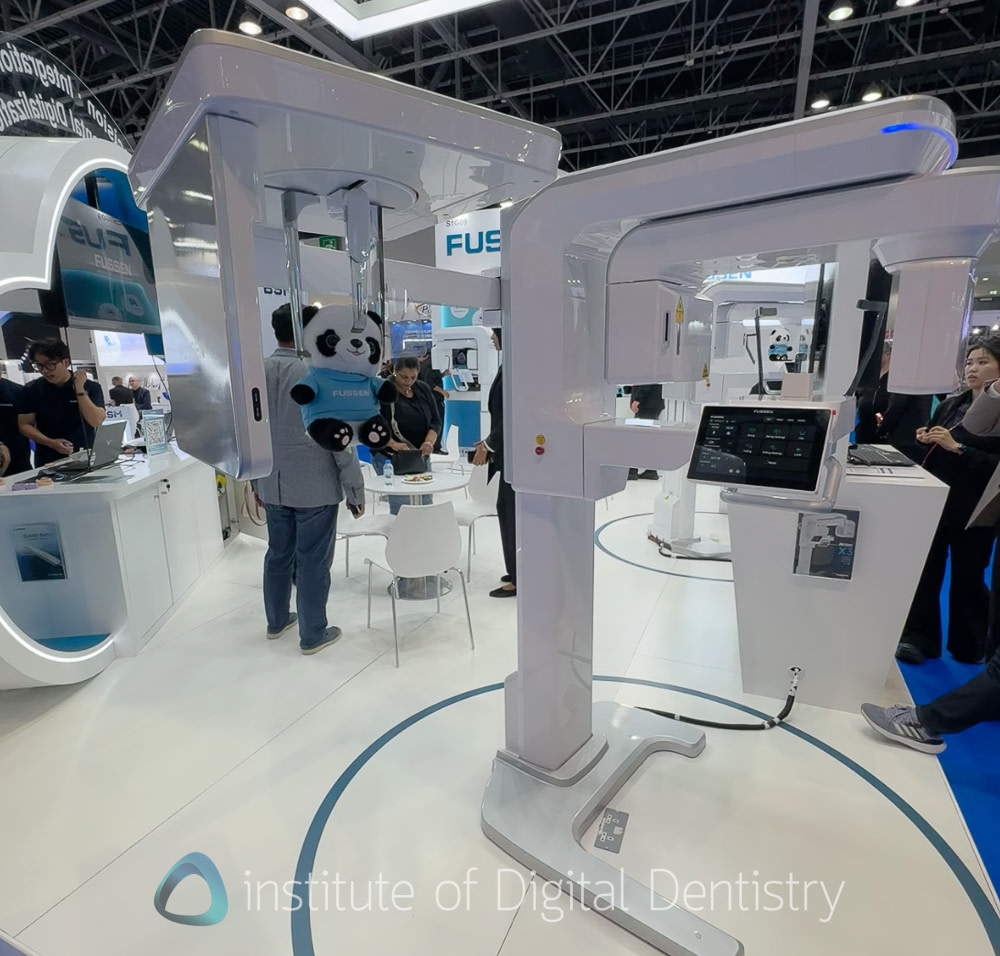
Fussen's booth at AEEDC 2026 showcased its continued evolution into a comprehensive digital imaging provider. While their intraoral scanner lineup remained unchanged from last year's releases, the real focus was their new Rubik X1 CBCT system - positioned as "The Future of All-in-One Dental Imaging."
The Rubik X1 represents Fussen's strategic push into AI-powered diagnostic imaging. The system integrates multiple imaging modalities, including CBCT, panoramic, cephalometric, and face-scanning capabilities, into a single unit. What's particularly noteworthy is the emphasis on AI-driven features throughout the workflow - from advanced orthodontic treatment and analysis to AI-powered diagnostic intelligence, implant treatment planning tools, and automated endodontic analysis.
The marketing materials showcase comprehensive AI capabilities, including TMJ analysis, airway assessment, 3D CT diagnostic assistance, and facial analysis for orthodontic and aesthetic planning. The system promises versatile panoramic workflow modes to meet every clinical need, positioning itself as a multifunctional imaging solution rather than a simple CBCT.
Fussen's strategy is clear: offer comprehensive digital imaging solutions at accessible price points for practices in price-sensitive markets. Their intraoral scanners at 2-3K USD, combined with feature-rich CBCT systems that incorporate the latest AI diagnostic trends, create a complete imaging ecosystem without the premium pricing of Western manufacturers.
The question remains whether these AI features deliver meaningful clinical value or primarily serve as marketing differentiation in an increasingly crowded CBCT market. As with all AI diagnostic tools, real-world clinical validation will determine whether the Rubik X1's comprehensive feature set translates into genuine practice benefits or simply represents checkbox features that sound impressive but see limited actual use.
Graphy - Still Pushing Direct Print Aligners
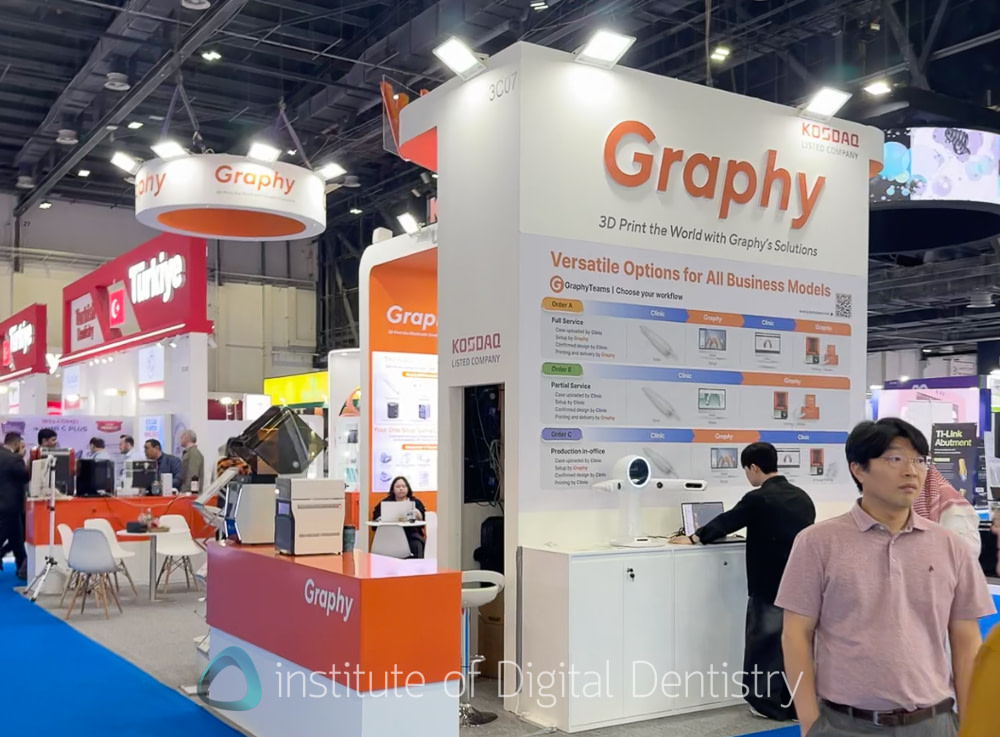
Graphy continued beating the drum for direct-printed aligners at AEEDC 2026, maintaining their focus on specialized aligner resins that can be printed without thermoforming. The company draws significant attention at shows with the promise of simplified aligner production workflows, but the verdict is still very much out on whether this technology is truly "there yet" for mainstream adoption.
I'll be honest - I haven't had much success with direct-printed aligners myself. In our aligner laboratory in New Zealand, we still thermoform, and there are good reasons for that. The fit, retention, material properties, and long-term performance of thermoformed aligners remain the proven standard. I genuinely want to be proven wrong on this - the workflow simplification would be fantastic - but the clinical reality hasn't matched the marketing promises yet for many.
The mixed feedback I continue to hear from clinicians who've actually used direct-print aligner resins reinforces this skepticism. While some early adopters report acceptable results, many others return to thermoforming after experiencing fit issues, material brittleness, or colour stability problems. The technology is improving, certainly, but claiming it's ready to replace thermoforming completely remains to be seen.
I still respect Graphy for pushing the industry in this direction and will keep an eye to see if they can pull it off.
HeyGears - Automation Focus Continues
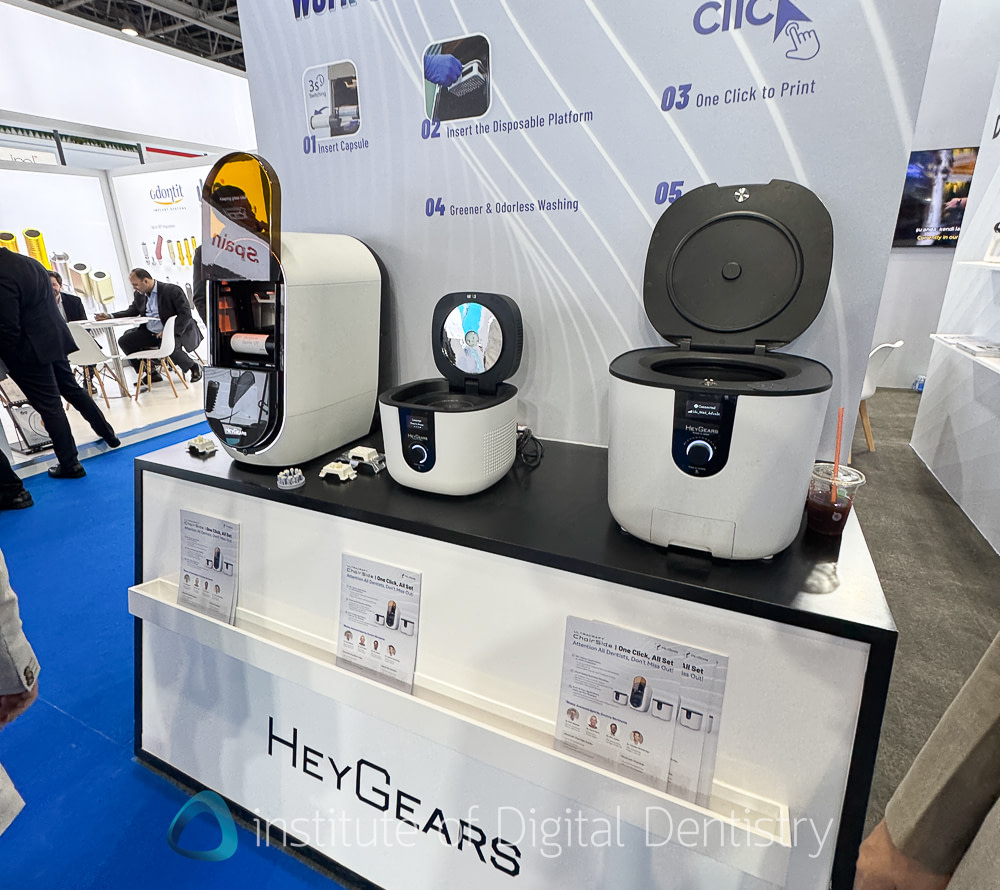
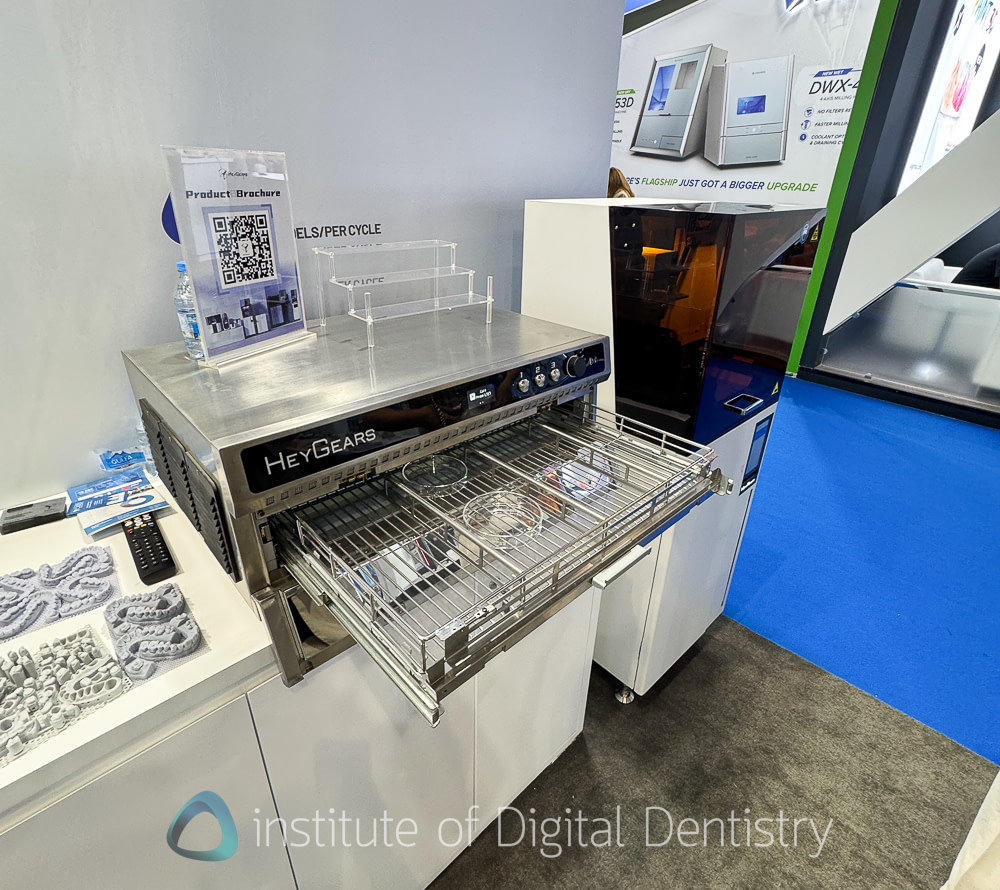
HeyGears' booth at AEEDC 2026 showcased their established printer lineup with a continued focus on high-throughput manufacturing capabilities and automation. Their systems remained popular with laboratories and aligner production facilities seeking scalable production solutions.
The company's automated workflow, which handles everything from print completion to model removal from the build platform, continues to appeal to larger laboratories that require consistent, high-volume output. While post-processing steps like washing and curing still require manual intervention, an automated approach strikes a practical balance between lights-out manufacturing aspirations and current technological realities.
Notably absent from their AEEDC booth was any mention of the multi-color printing technology they previewed at Chicago Lab Day 2025. That "Multimaterial Fusion" demonstration, which showed DLP-printed discs in multiple colors from single resins, generated significant interest at the laboratory show. Whether this technology is still in development, being refined, or will make an appearance at this year's Lab Day remains to be seen.
HeyGears' focus on industrial-scale production rather than chairside solutions continues to differentiate them in the 3D printing market, particularly for laboratories and manufacturers where throughput and reliability matter most.
ITAKA - 3D Articulator and Jaw Motion Capture
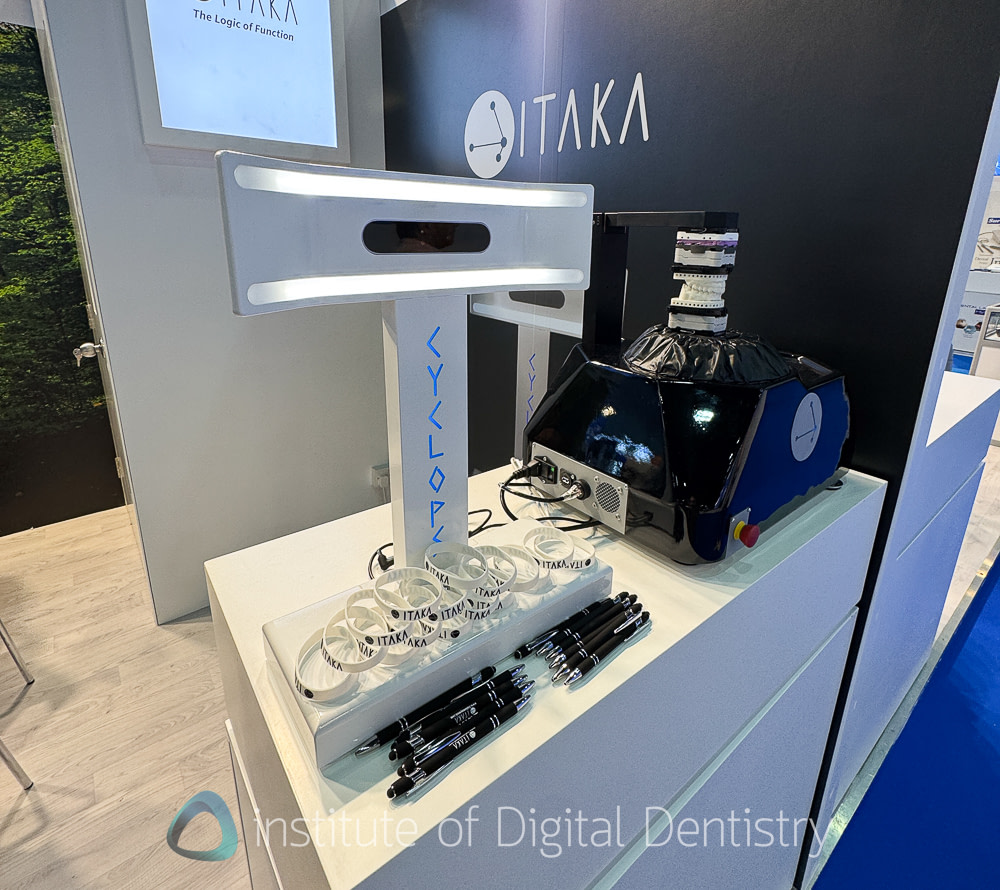
ITAKA demonstrated an integrated face scanning and jaw motion capture system at AEEDC 2026, paired with a 3D articulator that reproduces captured mandibular movements in real-time. The system represents an ambitious attempt to digitize the complete diagnostic workflow from facial aesthetics through functional occlusion.
The technology is genuinely impressive - capturing jaw motion and translating that data into precise articulator movement addresses a legitimate gap in digital dentistry. Traditional articulators require manual programming and assumptions about patient movement patterns, while ITAKA's approach uses actual recorded data to simulate function.
The CYCLOPS viewer provides additional visualization tools including the ITASKAN Face module for facial scanning, condylography module for TMJ analysis, and ARTHUR module for dynamic articulator control.
However, ITAKA chose a closed ecosystem approach. The 3D articulator only accepts motion data from their proprietary jaw tracking device, creating an all-or-nothing adoption scenario. Practices that already own jaw motion capture systems from other manufacturers cannot leverage their existing hardware, and those considering ITAKA must commit to the complete system rather than adopting components incrementally.
The question becomes whether the articulator's capabilities justify exclusive reliance on ITAKA's motion capture. For practices focused on complex full-mouth rehabilitation where precise functional analysis drives treatment planning, the integrated approach might provide sufficient value. For the broader market where jaw motion analysis represents occasional rather than routine diagnostic needs, the closed ecosystem will likely limit adoption to dedicated specialists rather than achieving mainstream acceptance.
IMES-ICORE - German Precision Milling
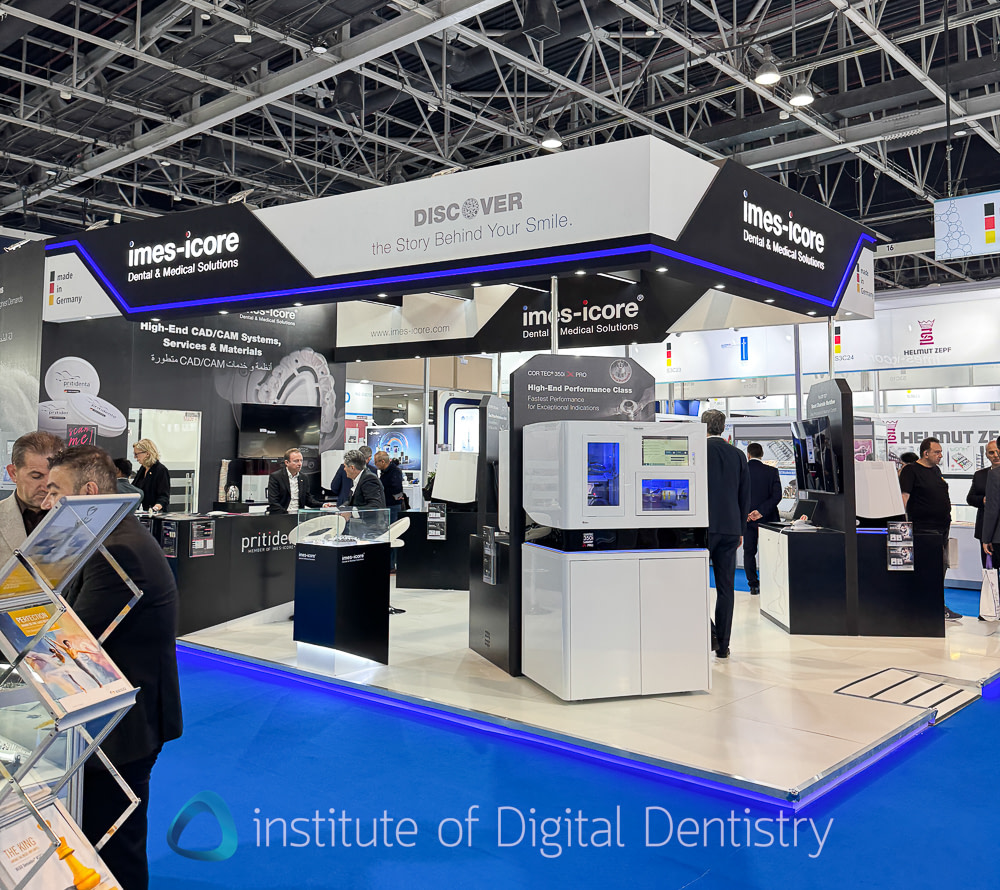
IMES-ICORE's booth at AEEDC 2026 featured its established line of German-engineered industrial milling systems. Without new hardware announcements, their focus remained on their proven high-end milling solutions that continue to serve larger laboratories and milling centers.
Their comprehensive range includes the CORiTEC series - from the compact CORiTEC 250i to the robust CORiTEC 450i PRO and the high-performance CORiTEC 650i PRO. These systems, particularly valued for precision work with titanium and other challenging materials, maintain their strong position in the industrial CAD/CAM segment of digital dentistry.
Nothing too new on the milling front. Mature market.
Download the iDD Highlights PDF
A summarized version of this blog.
View as a flipbook online or download a copy to read it later.
Ivoclar - Materials Excellence Without Major News
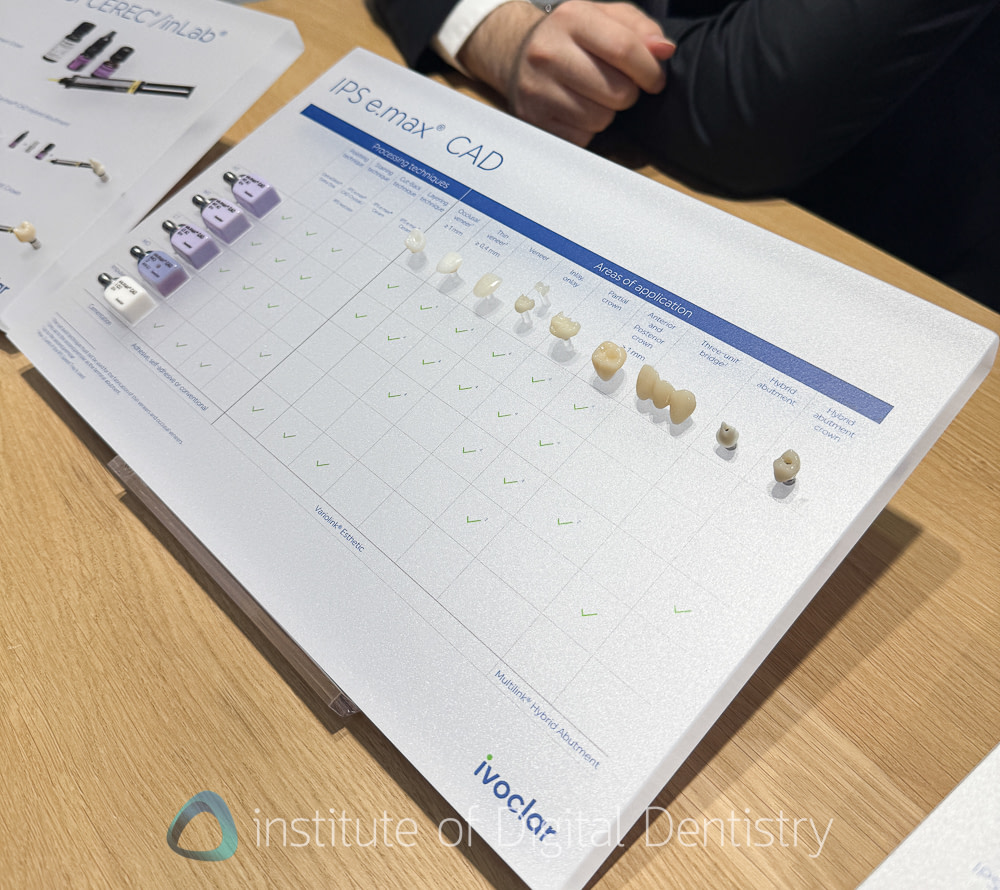
Ivoclar maintained its presence at AEEDC 2026 with a substantial booth, focusing on its comprehensive materials and equipment portfolio. As expected, the VivaScan intraoral scanner was officially gone - the white-labeled Planmeca Emerald scanner experiment has been quietly discontinued, confirming what many in the industry had anticipated.
Their booth showcased their strengths in ceramics, composites, and digital materials - the core segments where Ivoclar has built its reputation over decades. The company remains the gold standard in many material categories, with its line of IPS e.max, IPS ceramic systems, and milling solutions continuing to set benchmarks that competitors aspire to match.
Notably absent were any major announcements from the Ivoclar-SprintRay collaboration that was announced years ago with considerable fanfare. That partnership, which promised to bring Ivoclar's materials expertise to SprintRay's 3D printing platform, appears to have produced limited visible results. Whether this collaboration is still active behind the scenes or has quietly wound down remains unclear, but the lack of tangible outcomes is noteworthy.
Without significant new product launches, Ivoclar's presence at AEEDC reinforced its position as a company built on proven excellence rather than constant flashy announcements. Their materials continue to deliver the quality and reliability that laboratories and clinicians have come to expect, even if the excitement of breakthrough announcements was absent from this year's show.
Just Scan - Workflow-Centric Scanning and Printing
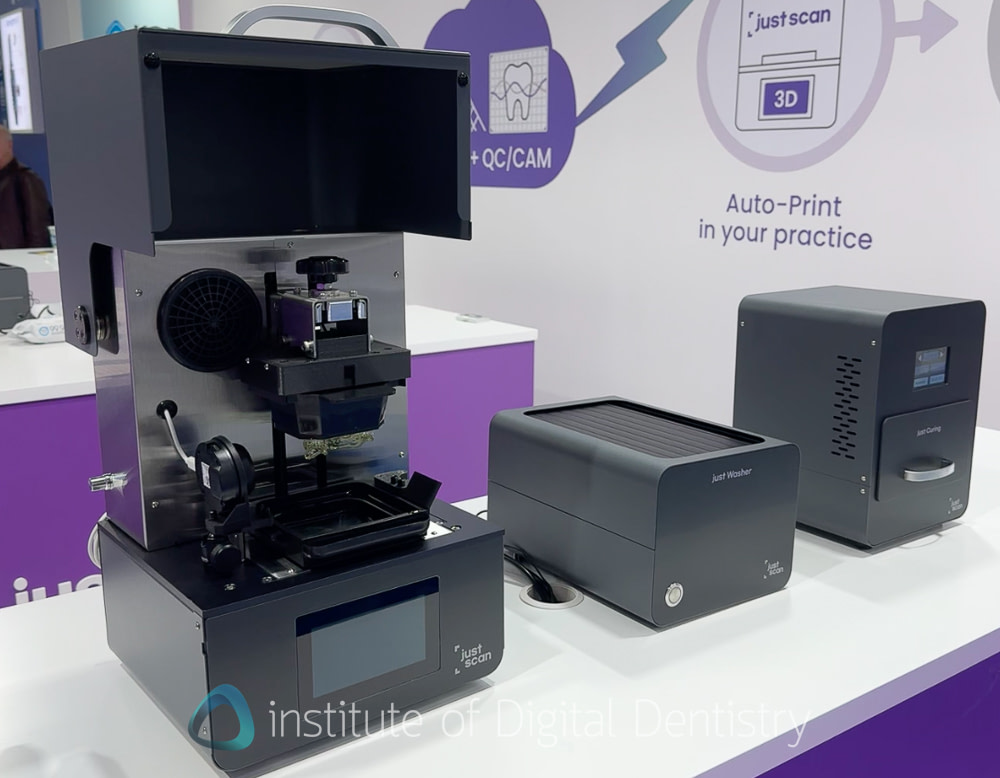
A fascinating company called Just Scan exhibited their Just Print Pro 3D printer at AEEDC 2026, but the company's booth messaging focused less on device specifications and more on complete chairside workflows - marketing "scan to seat in 30 minutes" for provisional crowns and veneers rather than leading with technical capabilities.
This shift in presentation strategy reflects broader changes in how manufacturers position dental technology.
The workflow-first approach signals something interesting - market maturation. When 3D printing and scanning were novel, companies competed on speed, specifications, resolution, and material compatibility. Now that multiple systems deliver adequate performance for clinical applications, differentiation has moved toward demonstrating complete treatment workflows rather than hardware specs.
Just Scan's emphasis on same-day provisionals and integrated scanner-to-printer delivery addresses the practical question practitioners actually ask: "How does this change what I can offer patients today?" This messaging evolution suggests the industry recognizes that adoption barriers aren't primarily technical anymore - they're workflow integration, staff training, and proving tangible practice value.
Whether workflow-centric marketing translates to sales depends on delivering promised efficiency gains, but the shift from device-focused to outcome-focused positioning reflects a sophisticated understanding of what drives purchasing decisions in mature technology categories.
Want more of the latest in dentistry?
Join the RAPID community
and get insights straight to your inbox.
Kivi Technologies - Intraoral and Desktop Scanner Portfolio
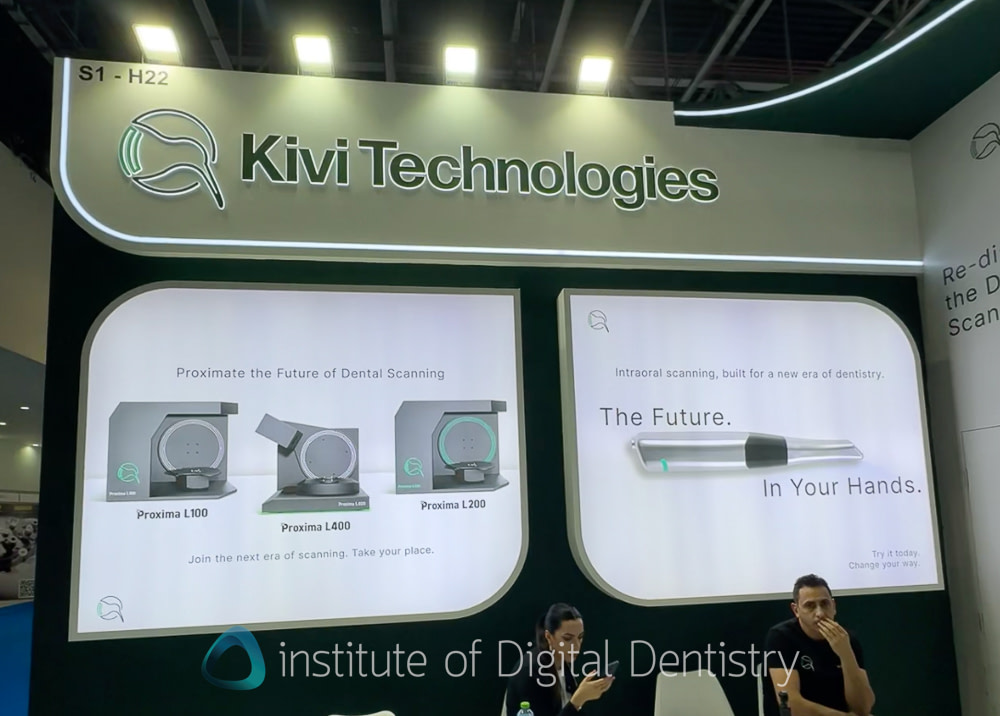
Kivi Technologies exhibited both its desktop scanner lineup and its intraoral scanner at AEEDC 2026, representing the Turkish manufacturer's attempt to compete in both chairside and laboratory scanning segments.
I have not seen this company before, and they position their products as affordable entry points into digital workflows, with specifications comparable to those of established systems.
Kivi faces the brutal reality of entering mature scanner markets dominated by entrenched competitors with proven track records. For intraoral scanners, practitioners prioritize reliability, accuracy, consistency, and software ecosystem integration over marginal specification advantages - factors that require years of clinical validation rather than trade show debuts.
Really nice guys at the booth, and I wish them luck.
Lilivis - OCTiX Scanner Still in Development
Lilivis returned to AEEDC 2026 with their complete digital ecosystem on display, including their dual-spindle chairside milling unit and intraoral scanner. The company continues working to try gain traction in the challenging chairside CAD/CAM market dominated by CEREC's decades of established presence.
The most interesting aspect of their booth remained their prototype OCTiX scanner utilizing Optical Coherence Tomography (OCT) technology - the same innovative system they previewed at IDS 2025. This scanner's ability to visualize through tissues rather than just capturing surface data continues to generate interest, though the technology remains in its early stages of development.
As demonstrated at both the Chicago Midwinter and IDS earlier this year, the OCT scanning approach is a potentially disruptive technology that could address persistent challenges in subgingival margin visualization and subsurface diagnostic capabilities. However, the scanner's practical implementation still faces significant hurdles, particularly around scanning speed and clinical workflow integration.
LuxCreo - Direct-Print Aligner Focus
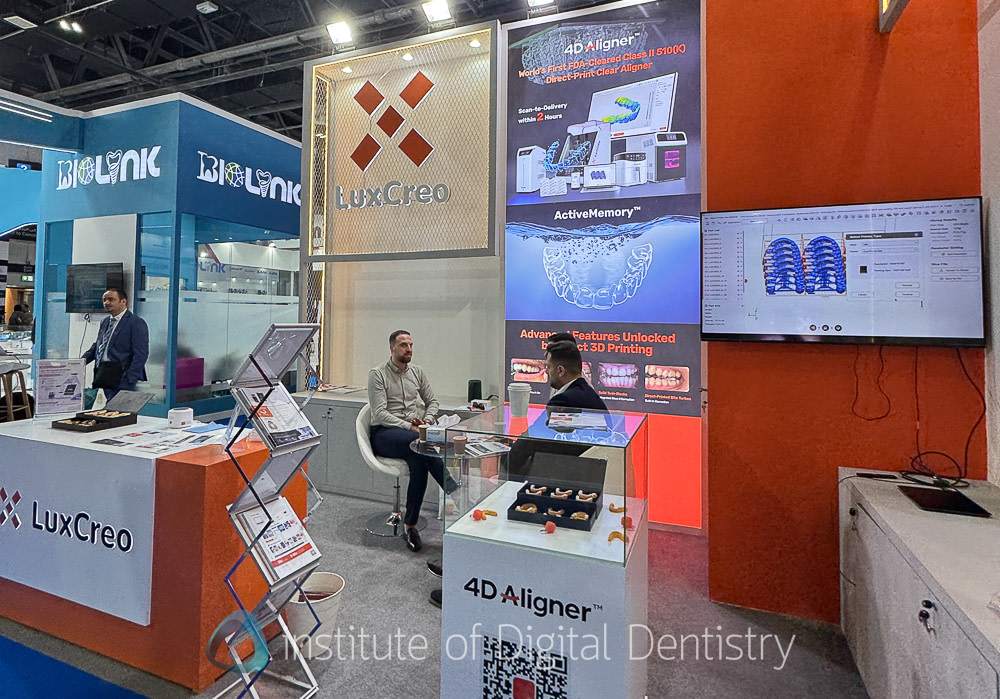
LuxCreo displayed their dental printers and material portfolio at AEEDC 2026, emphasizing their direct-print aligner capabilities marketed as "4D Aligner" technology. The company positions its shape-memory resin chemistry as a differentiation in the growing market for chairside and lab-based aligner production, competing against Graphy and other manufacturers pushing direct-print orthodontic workflows.
The direct-print aligner segment has attracted significant investment and marketing attention, with multiple companies claiming breakthrough materials that eliminate thermoforming steps. However, the clinical validation for these claims - and whether direct-printed aligners deliver outcomes justifying workflow changes for practices already successful with established thermoforming systems - remains an open question.
LuxCreo faces the challenge of converting interest in direct-print efficiency into actual adoption when orthodontists and general practitioners have decades of experience with proven thermoforming materials and protocols.
Medialabtech - iPlant3D Guide Surgery Solution
Medialabtech showcased their AI iPlant3D system at AEEDC 2026, positioning themselves in the increasingly competitive guided surgery and implant planning space with their tagline "plan.design.create" - promising precise, reliable, and safe surgical guidance.
The iPlant3D platform appears to focus on comprehensive implant planning workflows, featuring visualization tools for treatment planning, implant positioning, and surgical guide design. The showcased renderings of dental anatomy with implant planning overlays, bone segmentation capabilities, and what appears to be integrated artificial intelligence for case analysis.
What's interesting is Medialabtech's emphasis on the complete workflow from planning through guide creation, suggesting they're positioning themselves as an end-to-end solution provider. However, breaking into this space requires more than capable technology - it demands building trust with clinicians who are already invested in competing platforms, establishing proven clinical protocols, and demonstrating clear advantages over established alternatives.
Medit - i900 Mobility Takes Center Stage
Medit's booth drew consistent crowds at AEEDC 2026, with their i900 Mobility taking center stage as the main attraction. This iPad-native scanning solution, which I have reviewed, represents something genuinely new in the mainstream intraoral scanner market and generated significant interest throughout the show.
The i900 Mobility's ability to transform an iPad into a complete scanning workstation resonated strongly with practitioners, particularly those seeking flexible, mobile digital workflows that are not tethered to traditional laptop-based systems. The wireless freedom, combined with Medit's exceptional software ecosystem, creates a compelling package.
Their scanner software platform continues to set the benchmark in the industry, with its comprehensive suite of apps and intuitive interface still arguably the best in the market. The continuous development of their software ecosystem, all provided at no additional cost, remains one of Medit's strongest differentiators in an increasingly competitive scanner market.
The steady flow of visitors to their booth indicated that Medit's position in the MENA dental market remains strong, even as they continue navigating their post-acquisition phase. The i900 Mobility demonstrates that Medit hasn't lost its innovative edge despite organizational transitions, and the product's reception at AEEDC suggests it could become a significant part of their portfolio going forward.


Panda Scanner - Another Horizontal Scan Body Kit.
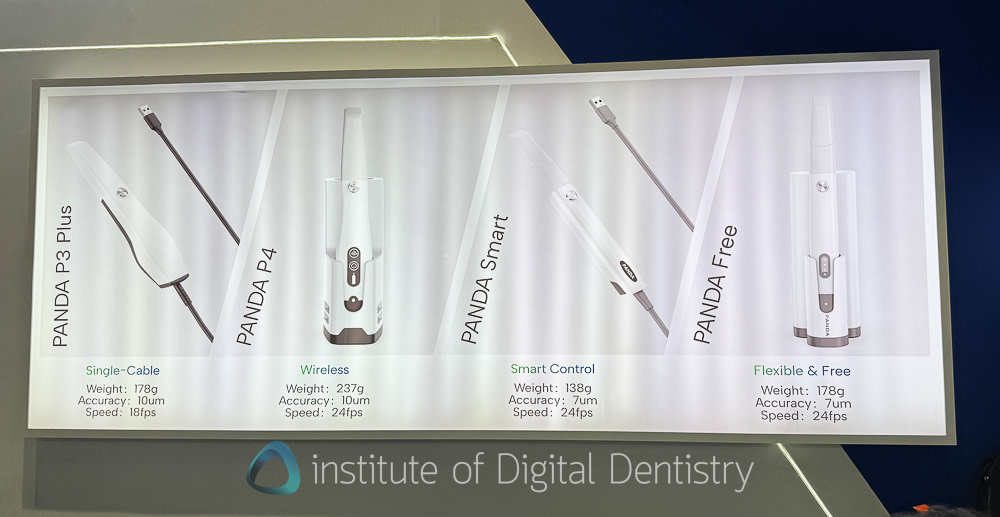
Panda Scanner's booth at AEEDC 2026 focused on its established scanner lineup, showcasing both the Panda Smart IOS and the Panda Free wireless scanner. With no new hardware announcements, the company continues focusing on establishing its position in the mid-range scanner segment of the market.
The Panda Smart IOS remains their primary offering for practices seeking cost-effective entry into digital dentistry, while the Panda Free wireless scanner - launched at IDS 2025 at just 178g - provides a remarkably lightweight wireless option. Their BAMBOO Ultra cart system, also introduced earlier this year, complements these scanners with mobile workstation capabilities.
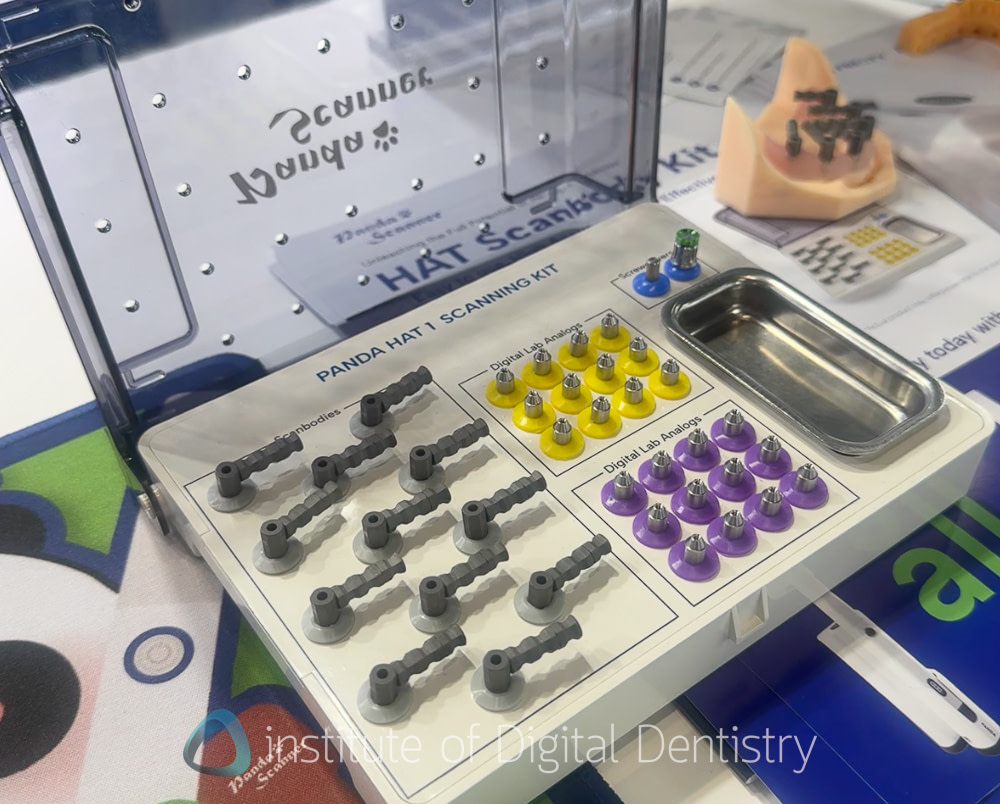
An interesting launch by the company is the addition of a horizontal scan body kit. Yet another company. Yet Panda did not seem to make as much of a fuss about it in their marketing materials - if you walked past the booth you would have missed it, but the kit was there on the desk. The company also mentioned to me that they are working to improve their software, which I think should be a key focus.
While the Smart IOS and Free wireless scanners represent their entry into the digital dentistry space, it will be interesting to see how they evolve their product line moving forward, particularly as the scanner market becomes increasingly competitive with new entrants, dropping price points, and software becoming the primary differentiator rather than hardware specifications alone.
Planmeca - Onyx Scanner Still Missing in Action
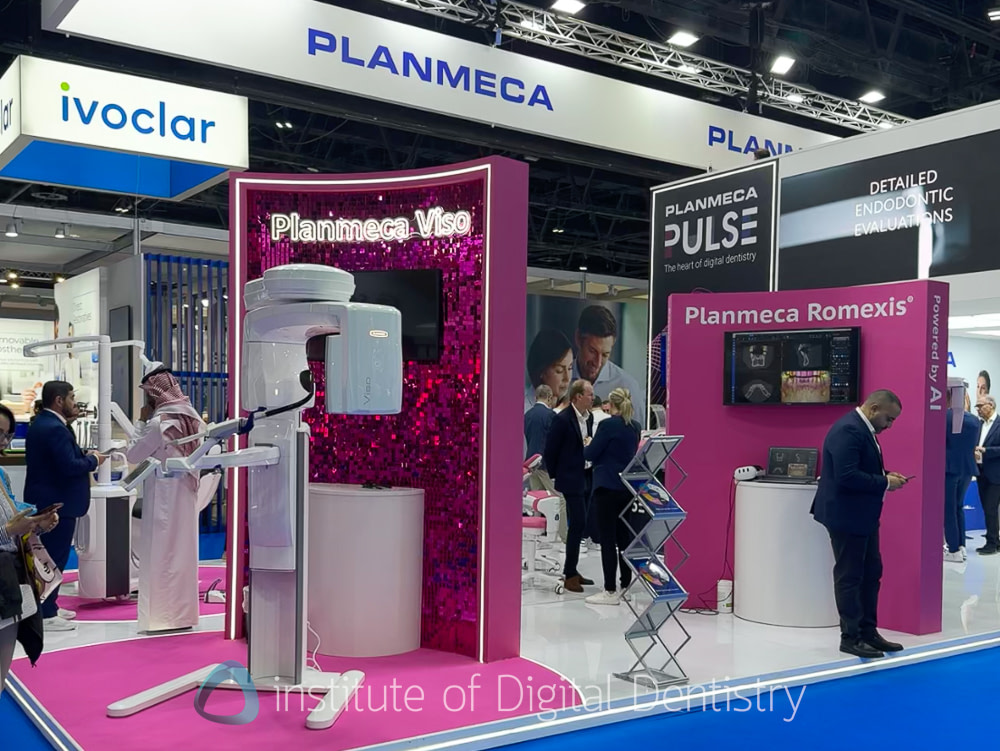
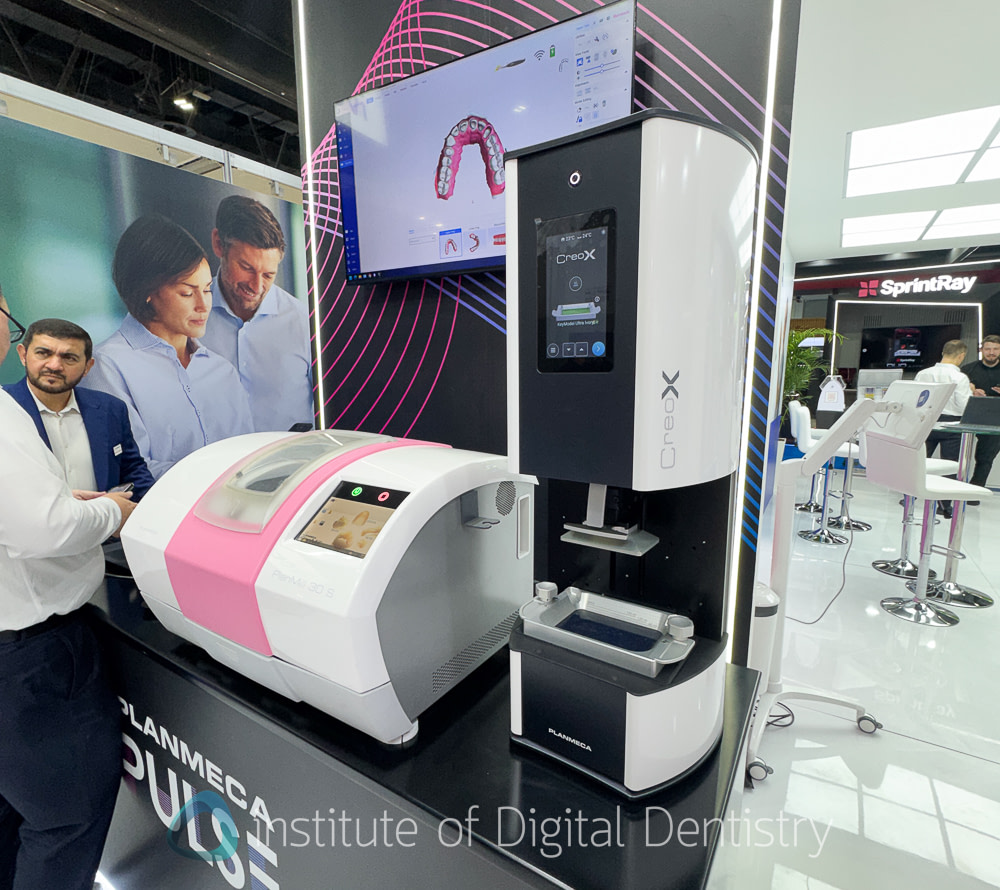
Planmeca's booth at AEEDC 2026 showcased its comprehensive line of digital solutions, including printers, mills, and CBCT systems. Their familiar portfolio of proven technology was on display, with no major announcements.
The most notable aspect of Planmeca's presence was what remained absent: their Onyx intraoral scanner. Tested at IDS 2025 nearly a year ago as the long-awaited successor to the Emerald, the Onyx still has not reached the market. This extended delay is becoming increasingly problematic for a company that had already gone six years between scanner releases, I think.
The competitive landscape hasn't stood still while Planmeca works through whatever technical or production challenges are delaying the Onyx launch. In the past year since its announcement, competitors have released multiple new scanners, software platforms have evolved dramatically, and market expectations have shifted. The risk is that by the time Onyx finally ships, its specifications and capabilities may feel dated compared to what's now available.
For a company with Planmeca's reputation for quality and reliability, this protracted launch timeline is concerning. The scanner market moves quickly, and delays of this magnitude can have lasting impacts on market perception and competitive positioning. Whether the Onyx will arrive too late to make the impact Planmeca needs remains one of the more interesting questions heading into 2026.
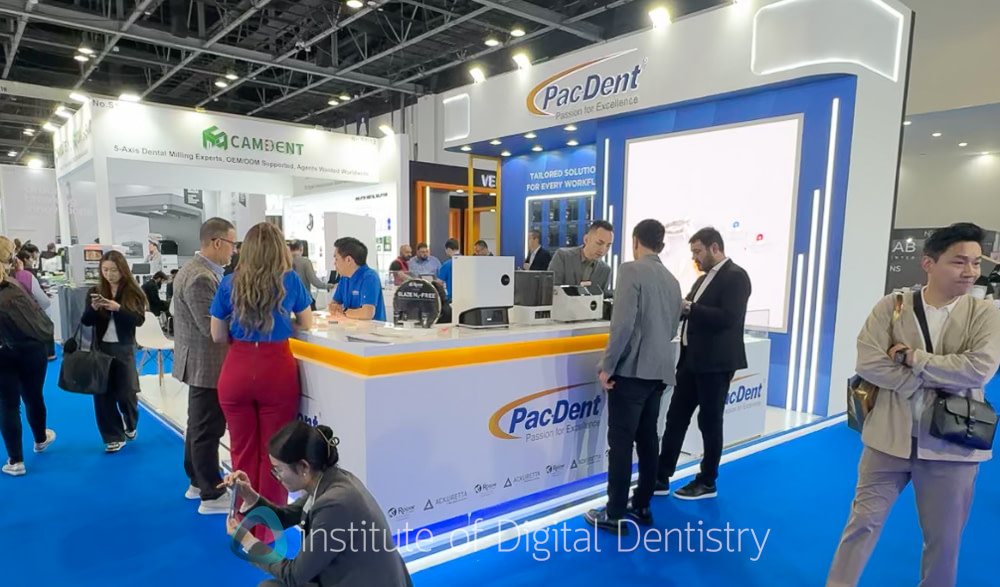
PacDent - Comprehensive Rodin Resin Portfolio
PacDent had a strong presence at AEEDC 2026, showcasing its extensive portfolio of Rodin 3D printing resins, which has established it as a major player in the dental materials space. Their comprehensive range covers virtually every dental application, demonstrating why they've become a go-to materials provider for practices and laboratories worldwide.
Their flagship products were prominently displayed: Titan Resin for high-strength all-on-x restorations, Sculpture 2.0 for crown and bridge applications, RapidCeram for fast-printing ceramic-filled restorations, and Envision One for veneers etc. The booth also featured their complete ecosystem, including model resins, temporary materials, surgical guide resins, orthodontic applications, and denture solutions.
What sets Rodin apart is its open-platform approach: its resins are validated for use across multiple printer brands rather than being locked to proprietary systems. This flexibility has made them particularly popular as the 3D printing market fragments across dozens of printer manufacturers, each with different hardware specifications and workflow requirements.
Rodin's materials have earned respect for delivering consistent performance and reliable clinical outcomes. Their presence at AEEDC reinforced their position as one of the leading independent dental resin manufacturers, competing against both printer manufacturers' proprietary materials and other third-party material providers.
Following the acquisition of Ackuretta, PacDent also showcased the SOL and SOL Plus printers at the booth. It will be interesting to see what comes out of this partnership in the future.
Ray - Doubling Down on the 5D Integration
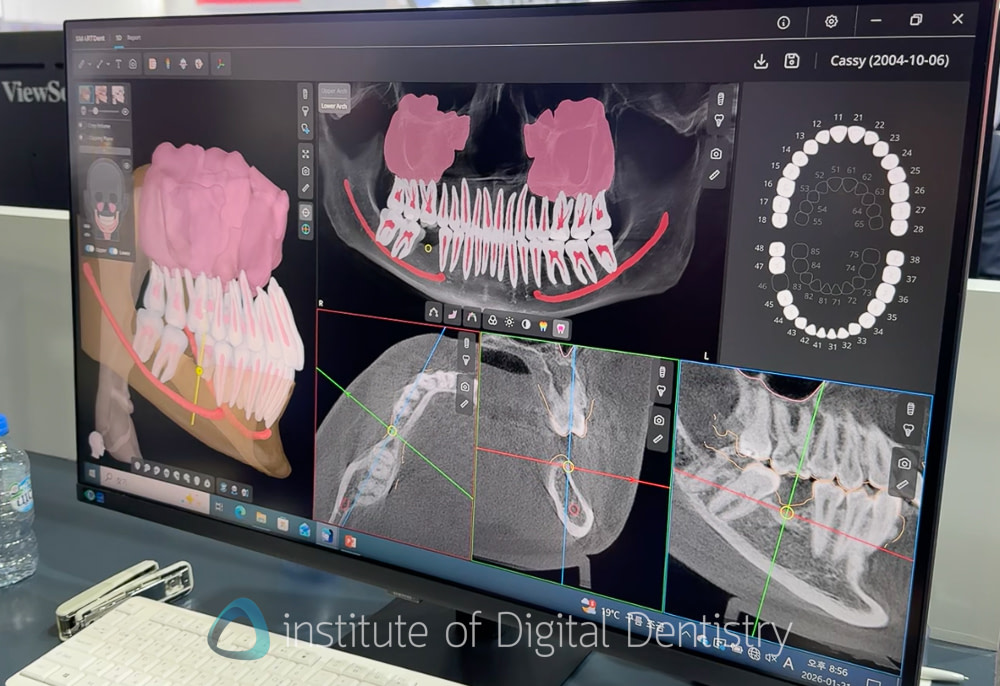
Ray's booth focused entirely on their 5D CBCT system, which integrates CBCT technology with the RayFace scanner attachment in a single unit. After launching this system at IDS 2025 and showcasing it at AEEDC last year, the company appears committed to refining and perfecting this integrated approach rather than chasing new hardware releases.
The software behind this integration remains impressive, automatically aligning CBCT data with facial scans and performing sophisticated automatic segmentation. The AI-powered workflow creates a comprehensive digital patient model combining both internal and external anatomical information without requiring manual alignment - a genuinely valuable time-saver for practices dealing with complex cases.
However, the competitive pressure in facial scanning continues to intensify. With iPhone-based scanning apps becoming increasingly capable, dedicated face scanning hardware from multiple manufacturers, and the general democratization of 3D facial capture technology, Ray's integrated approach faces the challenge of justifying its premium positioning.
Their strategic bet is clear: seamless integration of radiographic and surface data, backed by sophisticated AI, will provide enough value to differentiate them from standalone face-scanning solutions.
Download the iDD Highlights PDF
A summarized version of this blog.
View as a flipbook online or download a copy to read it later.
RayShape - Edge Mini Gains Traction
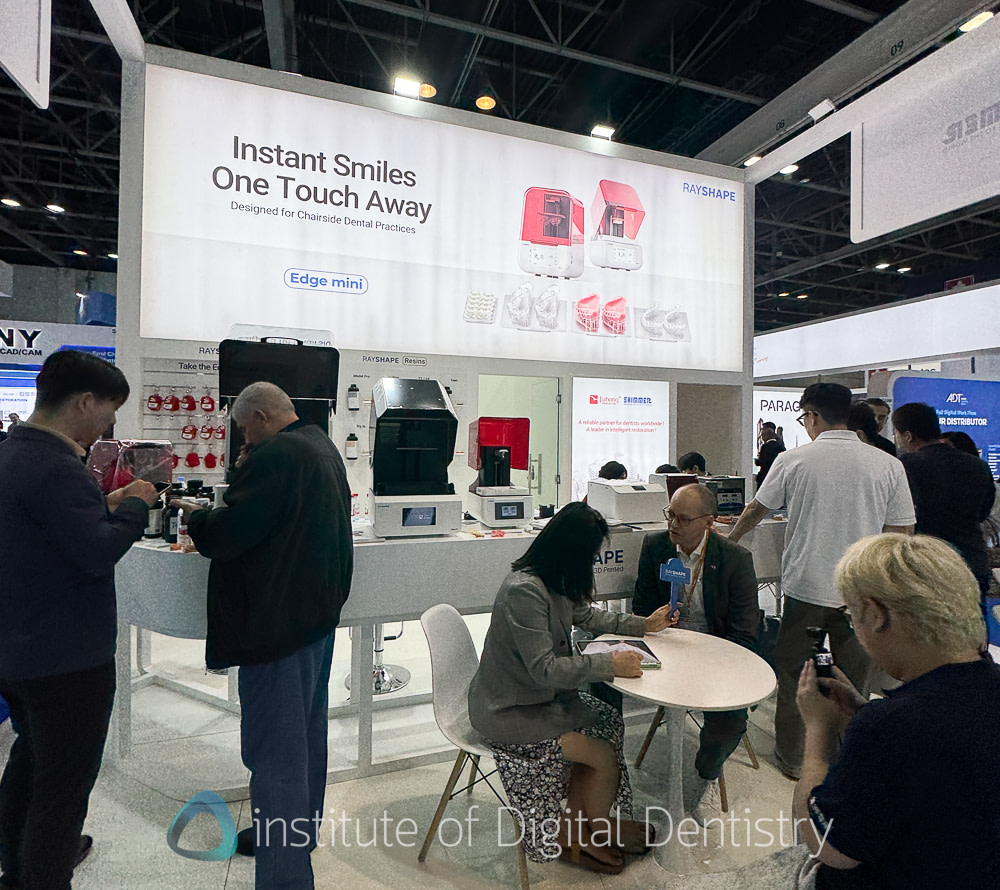
RayShape's booth at AEEDC 2026 highlighted their Edge Mini printer, a compact LCD system that appears to be gaining significant traction in price-sensitive markets. While not a brand-new release - it launched last year - the Edge Mini is proving popular for its combination of capability and accessibility.
The Edge Mini features a 96 × 54 × 130 mm build volume with 4K LCD technology delivering 35-micron XY resolution. Despite its compact footprint, the printer handles core dental applications, including models, surgical guides, splints, and temporary restorations. The system's 8.9-inch monochrome LCD screen and 405nm light source provide reliable performance for practices and small laboratories entering digital manufacturing.
What's making the Edge Mini particularly successful is its positioning - capable enough for real clinical work but priced low enough to remove barriers to entry in markets where budget considerations heavily influence purchasing decisions. The printer's compact size also appeals to practices with limited operatory space who want to experiment with chairside printing without committing significant real estate to manufacturing equipment.
Redon - Turkish Milling Solutions
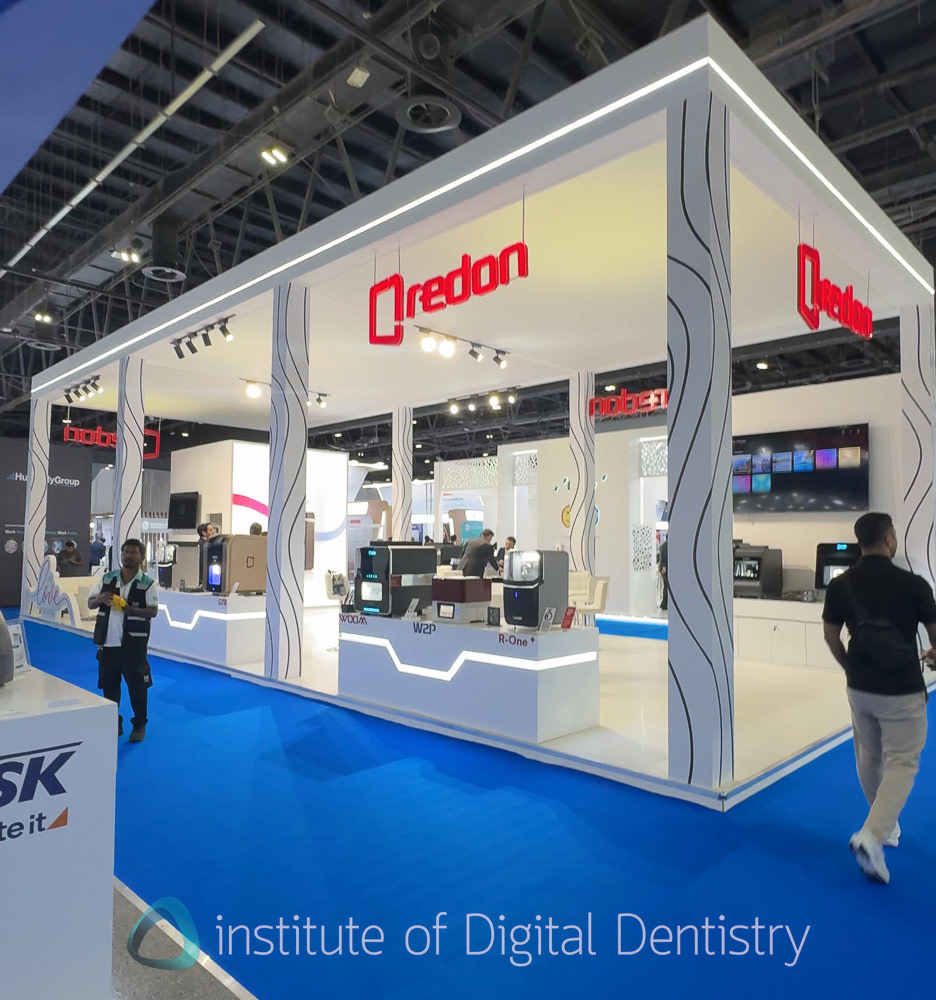
Redon returned to AEEDC 2026 with their expansive booth showcasing their comprehensive range of laboratory-focused milling solutions. As one of the largest milling machine manufacturers in the Middle East, Redon continues to leverage its local manufacturing advantages and established regional distribution networks.
Their booth featured their complete portfolio of dental milling machines, including the Redon 5X Pro and Redon X5 Pro systems for multi-axis milling, along with their range of wet and dry milling solutions. The company's machines handle everything from zirconia and PMMA to wax and other dental materials, serving laboratories requiring reliable production capabilities.
With no new hardware introductions at AEEDC 2026, Redon's substantial presence reflects its strong position in this dental laboratory market. Redon represents an interesting case study in regional dental manufacturing - a company that has built significant market share by understanding local market dynamics, providing responsive support infrastructure, and offering reliable technology at price points that resonate with regional laboratories.
Rixi - Ultra-Budget Scanner Entry
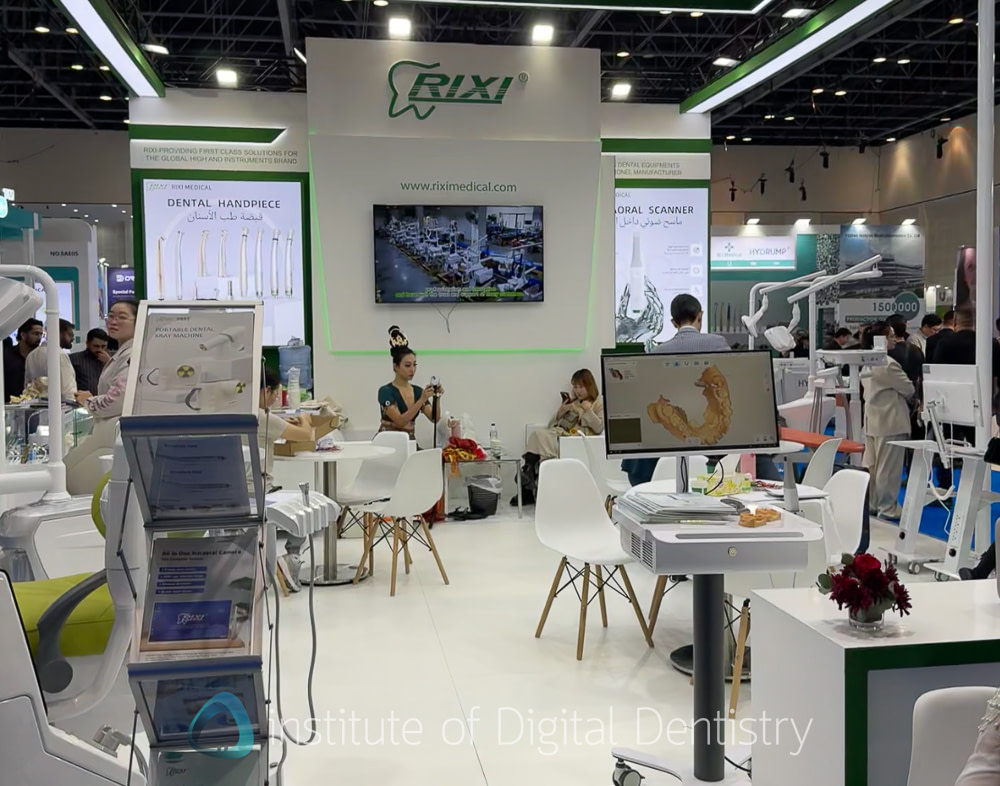
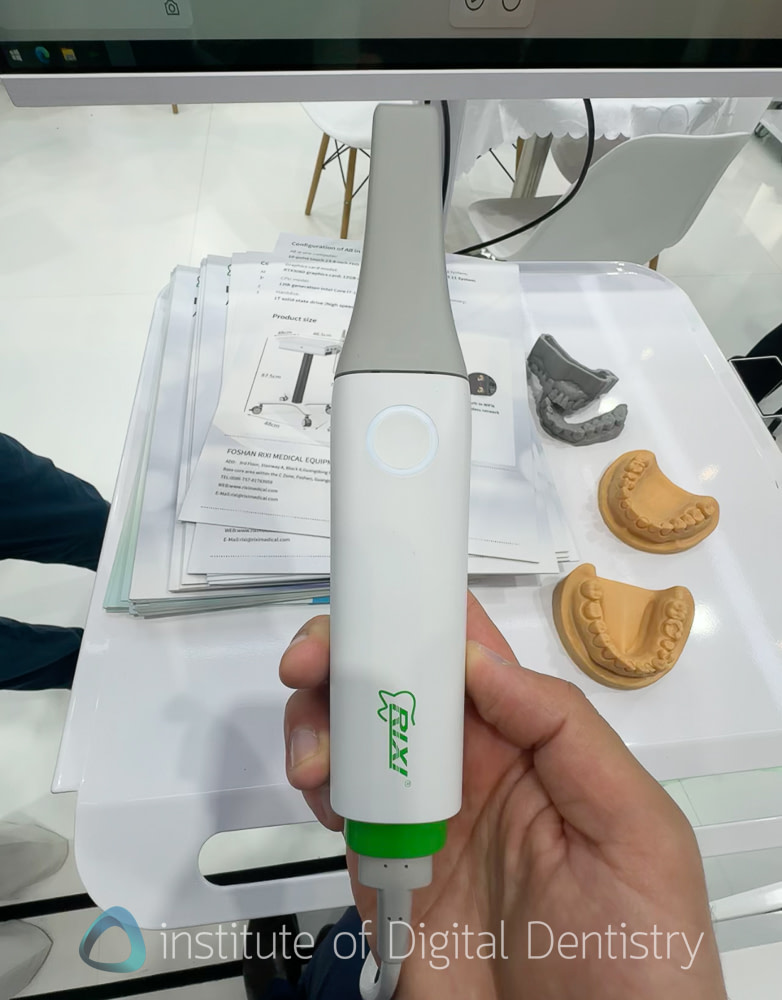
Rixi, a Chinese manufacturer I had not seen before, exhibited its intraoral scanner at AEEDC 2026 with pricing that significantly undercuts established competitors.
The scanner's build quality looks budget-oriented, but it was functionally OK during my trial at the booth, raising the inevitable question: how low can scanner pricing go before it hits the floor?
Rixi's pricing strategy suggests there is room for cost reductions, as Chinese manufacturers leverage domestic component supply chains and manufacturing scale. The prospect of sub-$1,000 scanners - once unthinkable - now appears plausible as companies like Rixi demonstrate that functional scanning hardware can be produced at price points that would have seemed impossible just years ago. This even has a cart option...
Whether ultra-budget scanners gain traction beyond price-sensitive emerging markets depends on practitioners' willingness to accept uncertain long-term support and potential compromises in accuracy for dramatic cost savings.
Rixi's emergence signals continued commoditization pressure on established scanner manufacturers who must justify premium pricing through service, software ecosystems, and brand trust rather than hardware specifications alone.
Runyes - 3-in-1 Face Scanner and Photogrammetry Device
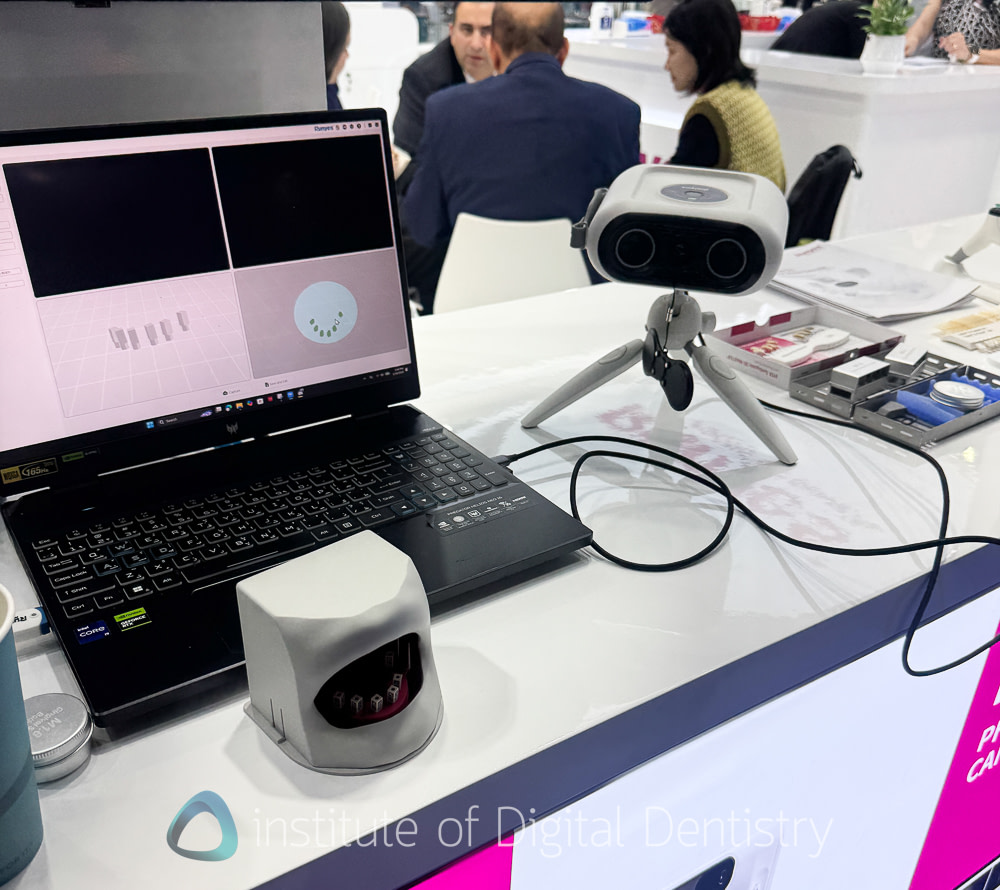
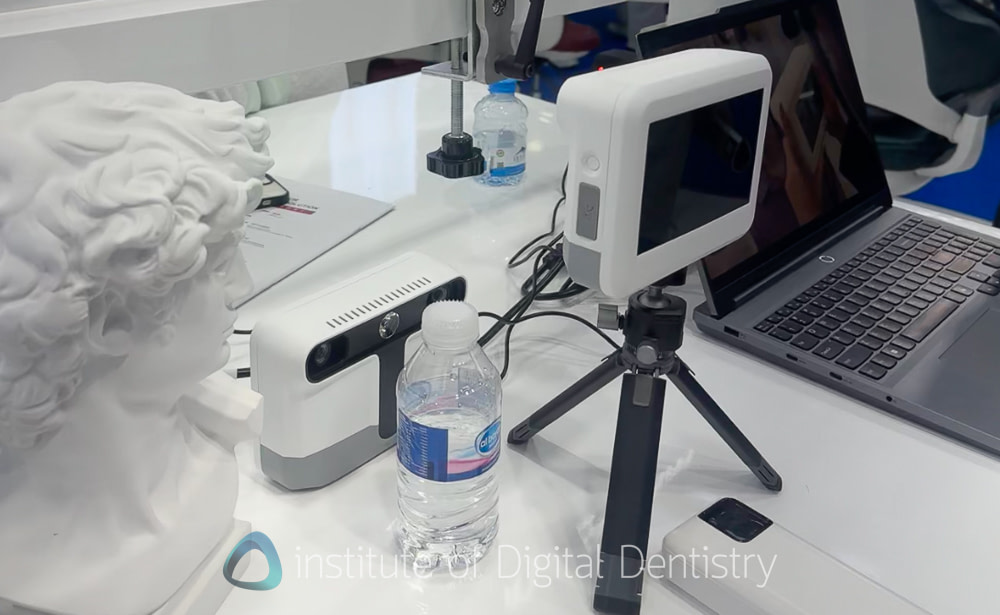
Runyes relentless pace of product development continued at AEEDC 2026, with the company now showcasing an interesting 2-in-1 device that combines face scanning, traditional photogrammetry and jaw motion capture capabilities in a single unit. This represents yet another ambitious expansion for a company that seems determined to compete across every segment of digital dentistry simultaneously.
Adding to their full-arch arsenal, Runyes also showcased its own horizontal-scan body solution, directly competing with the approach popularized by Shining 3D's Elite scanner and now adopted by numerous other manufacturers. This move completes their full-arch workflow offerings, giving them multiple technical approaches to the same clinical challenge.
The rate of development from Chinese manufacturers like Runyes is frankly astonishing. Just a year ago at AEEDC 2025, they previewed a new wireless scanner, face scanner, shade-matching devices, and photogrammetry units. Now they're already iterating with integrated multi-function devices and expanding into horizontal scan bodies. This aggressive development cycle stands in stark contrast to Western manufacturers, who typically take years between major product releases.
Whether Runyes can successfully bring all these technologies to market with the reliability and support infrastructure needed for long-term success remains to be seen, but their ambition and development speed are undeniable.
Saremco - Crown Printing Materials
Saremco returned to AEEDC 2026, showcasing the same established crown-printing resins they've been promoting for years. Without new product announcements or formulation updates, the company continues relying entirely on its legacy materials in an increasingly competitive market.
This presents an interesting dichotomy. On one hand, Saremco's long-standing resins have the advantage of real-world clinical data and research backing - something that newly released materials can't claim. There's genuine value in materials that have been used successfully for years, with documented performance and predictable outcomes. Many practitioners understandably prefer proven solutions to the latest releases that hit the market every few months, which offer limited long-term evidence.
On the other hand, resin technology is advancing rapidly. New formulations emerge regularly with supposedly improved mechanical properties, better aesthetics, and superior wear characteristics. Can resins developed years ago truly compete with cutting-edge materials that leverage the latest advances in polymer science and additive manufacturing? As competitors continually refine their formulations based on clinical feedback and technological advances, standing still may mean falling behind.
Saremco's challenge is clear: their materials have the credibility of time and clinical validation, but they risk appearing outdated in a market that increasingly expects continuous innovation. Whether their research-backed, proven approach will maintain market share against newer, potentially better formulations remains one of the more interesting material science questions in dental 3D printing.
Scedent - Full-Arch Ecosystem Portfolio
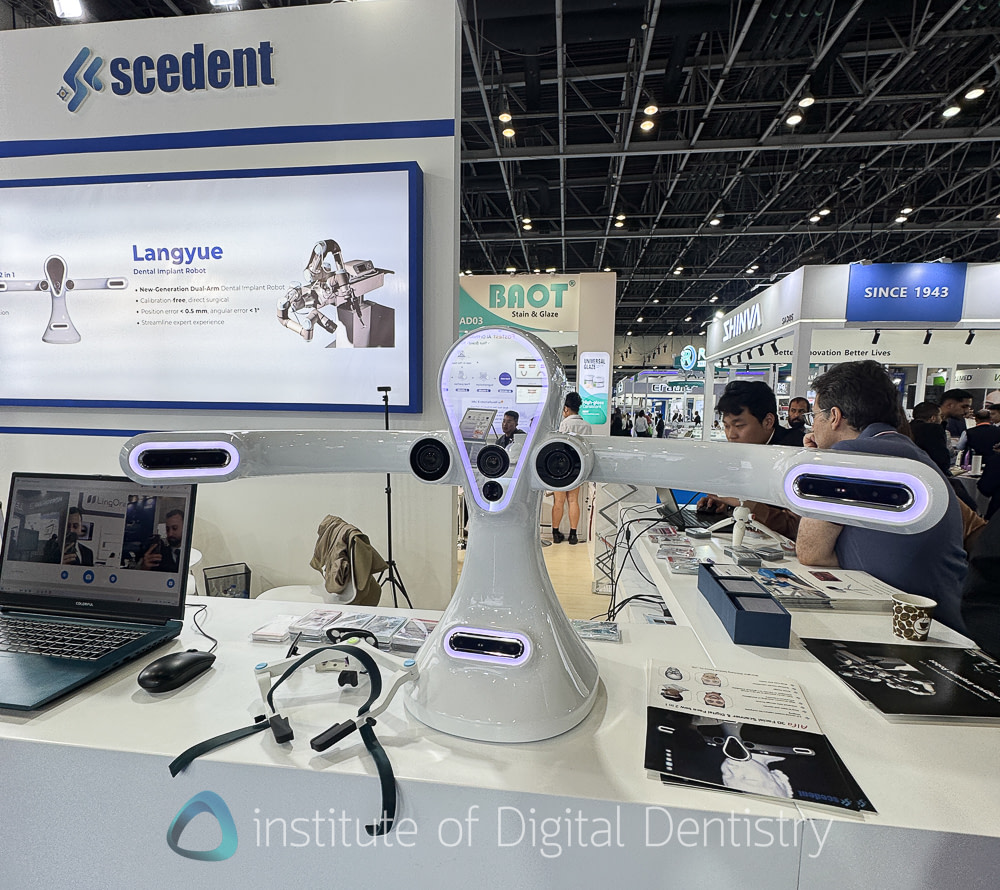
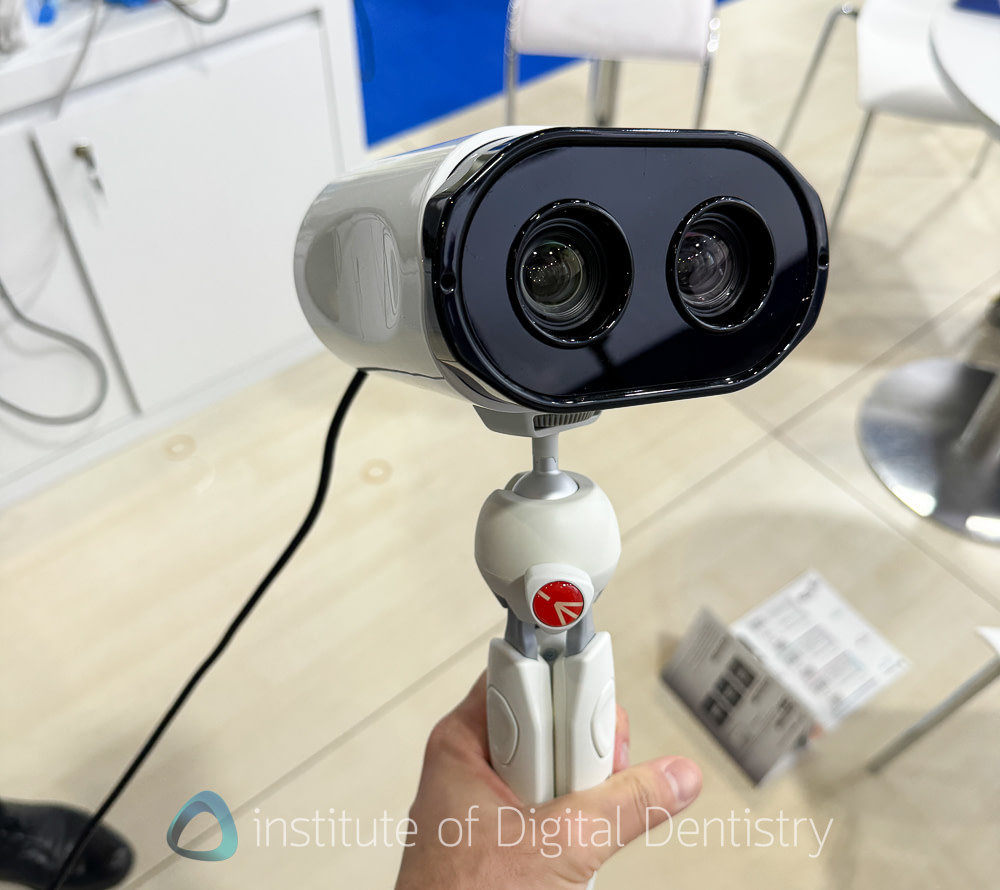
Scedent, a Shanghai-based manufacturer, exhibited a surprising full-arch ecosystem at AEEDC 2026, including its PALM traditional photogrammetry scanner, the Fanyu 3D face scanner with integrated digital facebow functionality, and marketing materials for its Langyue dental implant robot for guided surgery.
Once again, this exhibition reinforced the clear pattern observed across AEEDC 2026: full-arch implant solutions have become a major focus in digital dentistry. Photogrammetry devices, face scanners, and All-on-X-optimized systems appeared at so many booths I lost count, signaling where companies believe future growth exists.
The challenge for Chinese manufacturers entering premium full-arch markets isn't technology capability but establishing clinical credibility. Implant specialists performing complex cases need confidence in long-term support, proven clinical outcomes, and vendor stability - trust factors that take years to build, regardless of how well systems perform in exhibition demonstrations.
Still cool to see a photogrammetry device at a fraction of the cost.
Shining 3D - ELF Scanner Debuts Alongside IPG Updates
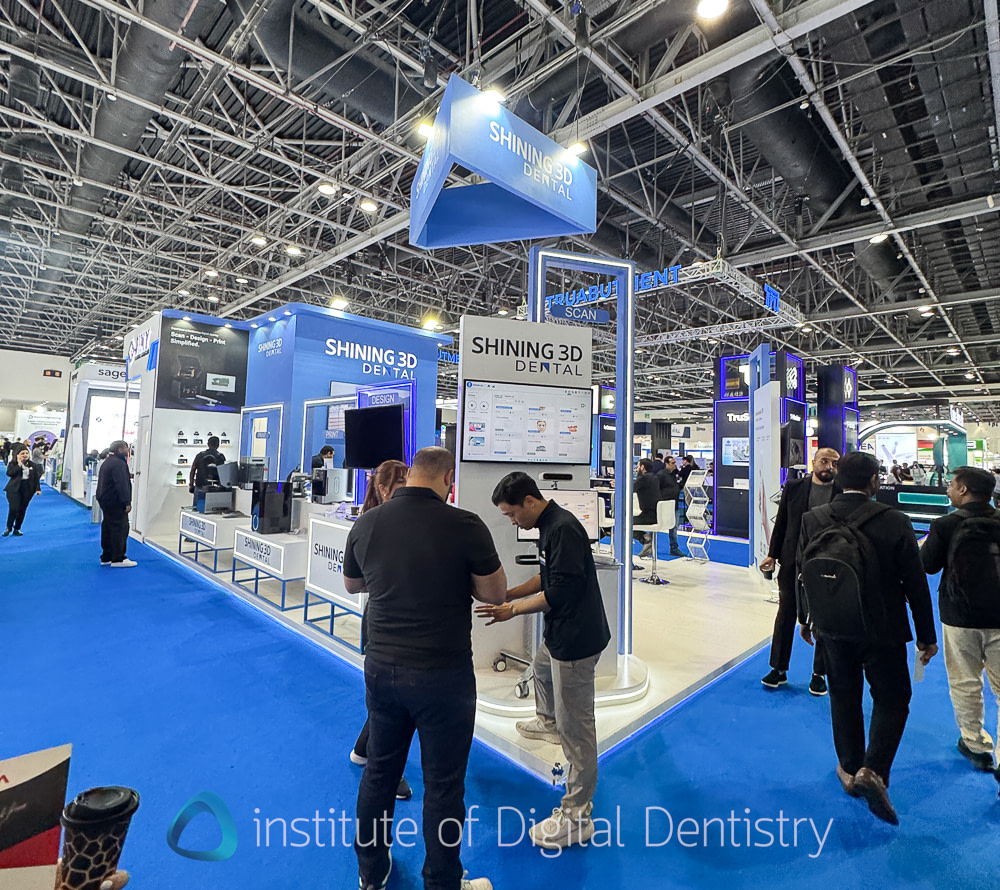
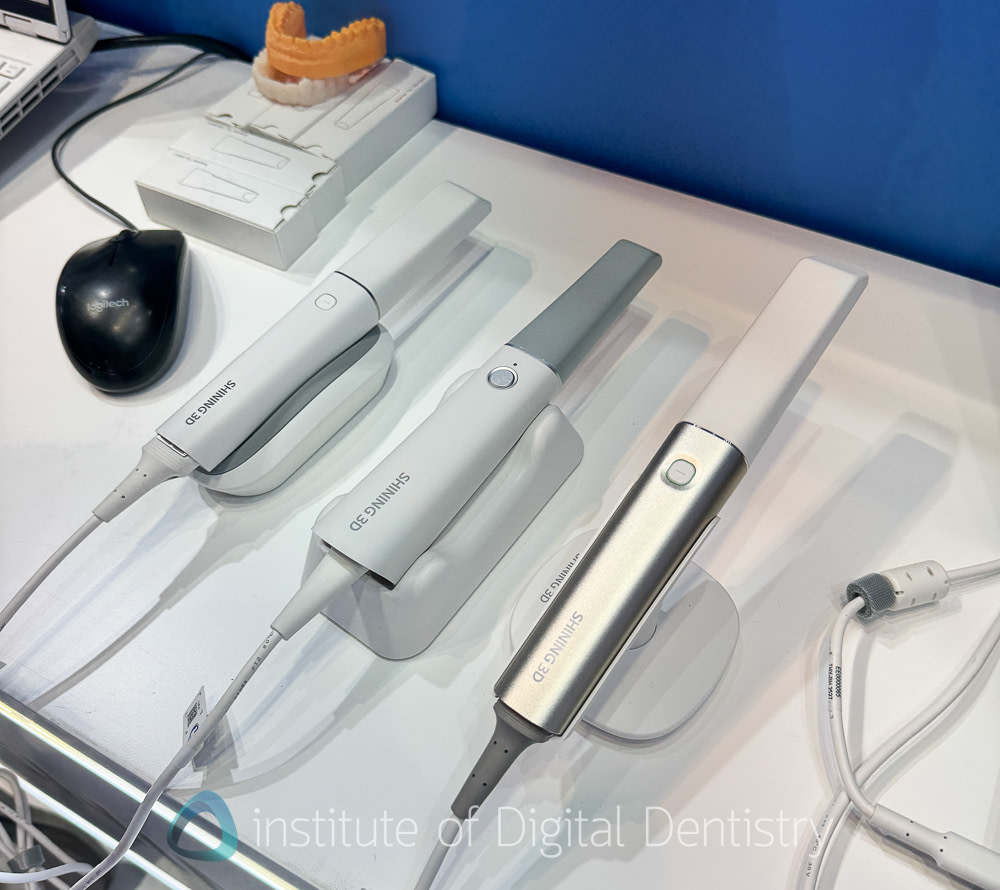
Shining 3D returned to AEEDC 2026 with another commanding presence, building on their killer showing last year. The booth showcased both their widely popular IPG photogrammetry system and the new ELF scanner - continuing the company's remarkable pace of innovation.
The Aoralscan Elite remains a centerpiece, with its revolutionary intraoral photogrammetry continuing to earn praise from dental professionals globally. But Shining 3D hasn't been resting on the Elite's success. The IPG Scanbody System received a significant update, introducing a new screw-detachable design for flexibility in everyday implant workflows. These interchangeable screws (sold separately) make the scanbody compatible with a wide range of implant MUAs, helping practices simplify their portfolio while covering more cases. Instead of buying new IPG kits, you can just replace the screw.
The new Aoralscan ELF scanner is Shining 3D's latest addition to its comprehensive scanner lineup, read more here. Their complete digital workflow was on full display - from facial scanning technology to their range of 3D printers, demonstrating how their various technologies work together for everything from simple restorative cases to complex full-arch rehabilitations.
There are whispers circulating about another major release coming at Chicago Midwinter in just a few weeks. Given Shining 3D's track record of rapid development and consistent innovation, these rumors are worth paying attention to. It is incredible how fast this company continues to develop - they've firmly established themselves as one of the most exciting and innovative forces in digital dentistry right now.
Sprintray - Strong Presence in Chairside Printing
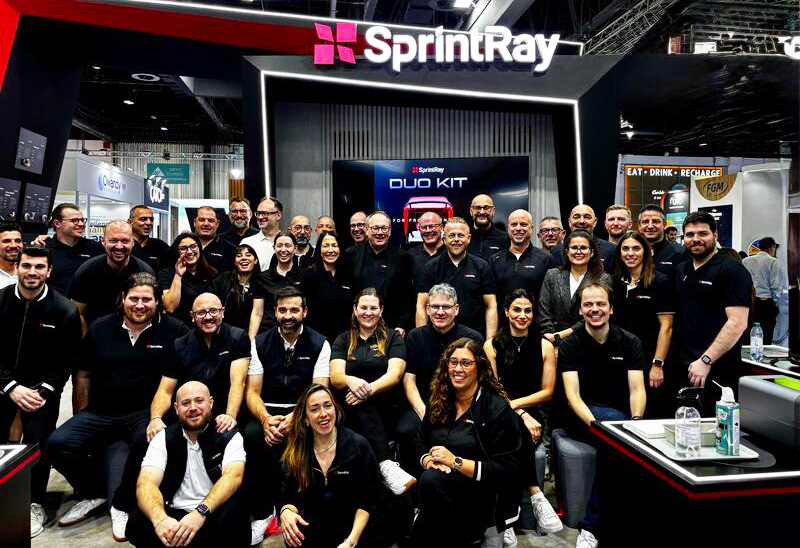
SprintRay returned to AEEDC 2026 with another impressive booth, showcasing its established ecosystem, including the PRO 2 printer and, of course, the MIDAS system, which has become synonymous with chairside 3D printing.
The Dual Kit was prominently displayed, demonstrating their continued commitment to innovation and expanding clinical applications in some very smart ways.
While no hardware or resins were announced at AEEDC, whispers suggest exciting developments coming at Chicago Midwinter in just a few weeks. Something to look forward to in 2 weeks - I will cover it.
Overall, a strong showing. As mentioned, SprintRay is the leader in chairside printing, especially restorative, in many regions of the world, and for good reason: they offer some of the best resins and an end-to-end solution from print, wash, and cure. Notably, one of the few 3D printer companies offers cloud-based CAD software for free to its users, and it has improved significantly over the past 12 months.
However, one crucial aspect became apparent at AEEDC: the business model challenges in emerging markets such as Dubai and Brazil. In these regions where crown fees are charged at a fraction of what practices command in markets like America, the $20-30 USD capsule price creates significant economic friction. When a crown might be billed at $100-150 in some markets, a $25 capsule represents a very different calculation than in the US, where crowns command $1,500+, and the capsule represents just 2-3% of revenue.
It will be fascinating to see how SprintRay navigates this challenge. Will they introduce tiered pricing for different markets? Develop alternative business models? Or accept that their solution is better suited to high-fee regions?
Either way, one of the most exciting companies in digital dentistry right now and a major force in dental 3D printing.
Stratasys - Color PolyJet Production Systems
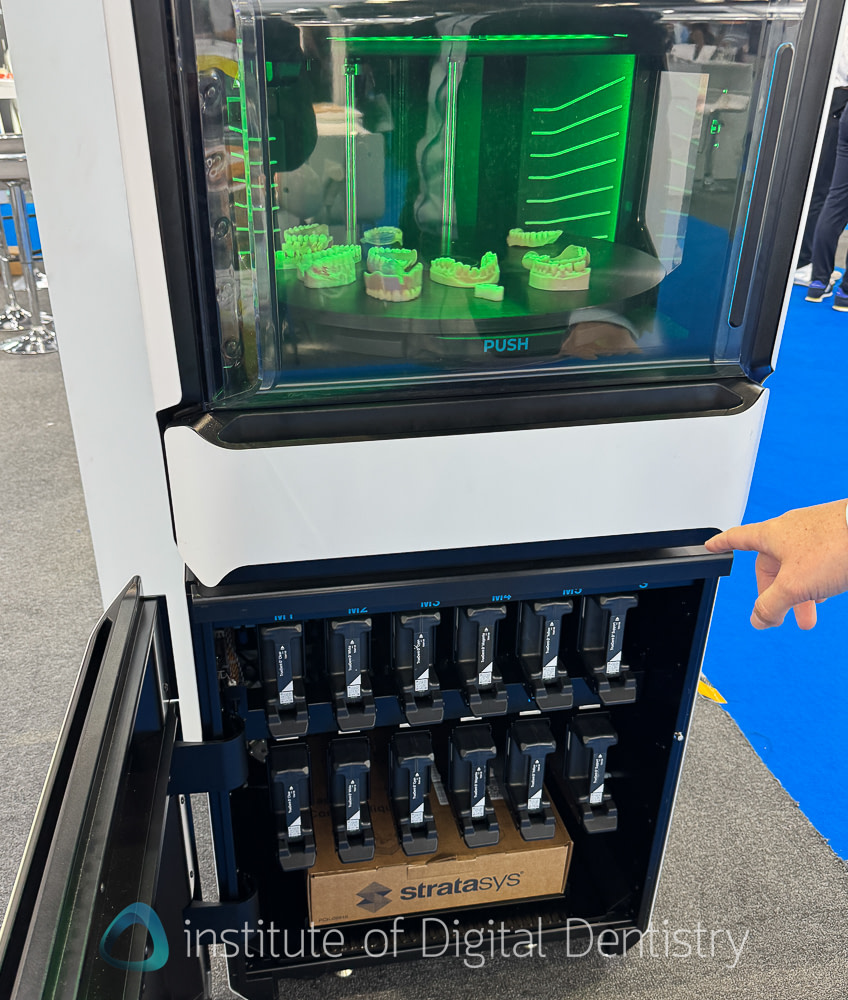
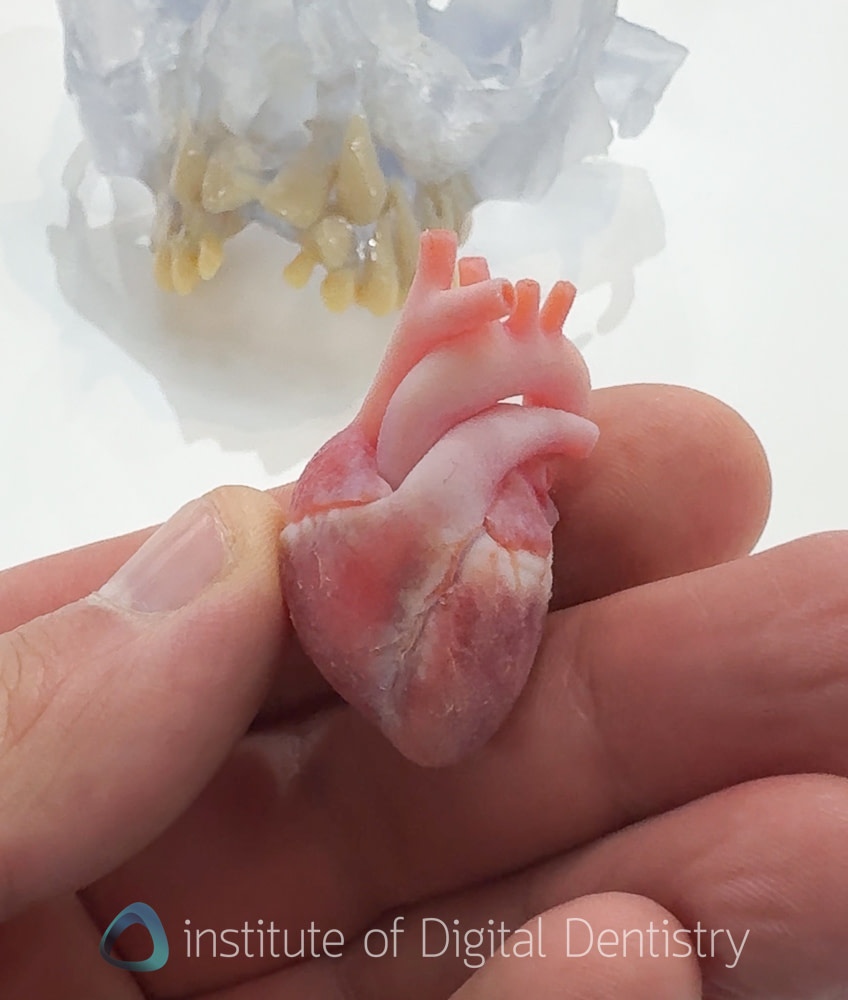
Stratasys showcased its J5 DentaJet and multi-material PolyJet printers at AEEDC 2026, emphasizing its TrueDent resin for monolithic denture production and full-color dental model capabilities.
The company continues to position its PolyJet technology as the premium solution for labs that require simultaneous multi-material printing and realistic color reproduction in a single print job.
The Stratasys booth highlighted its differentiation through color accuracy and multi-material workflows, printing rigid models, flexible gingiva, and surgical guides without material changes or post-processing swaps. Their TrueDent denture resin marks their entry into the removables market, available in five base colors.
However, Stratasys faces the familiar challenge of justifying significantly higher equipment costs compared with DLP and LCD printers, which now dominate adoption in dental 3D printing. While PolyJet technology offers genuine advantages in color reproduction and multi-material capabilities, most labs have concluded that lower-cost systems deliver sufficient quality for routine applications, leaving Stratasys targeting high-end production facilities where its premium capabilities justify premium pricing.
Want more of the latest in dentistry?
Join the RAPID community
and get insights straight to your inbox.
Straumann - Digital Portfolio Expansion
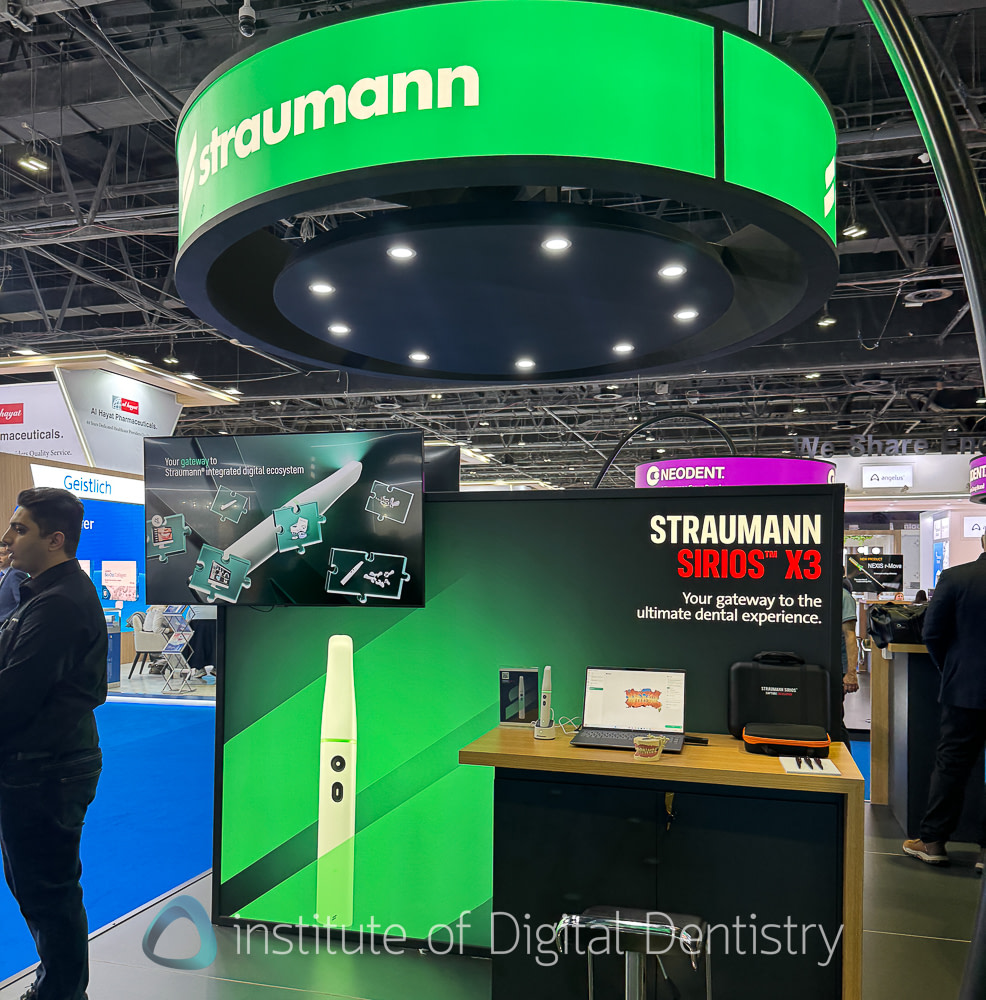
Straumann maintained a significant floor presence at AEEDC 2026, showcasing its comprehensive digital dentistry portfolio across a large booth space. The display emphasized their evolution from an implant manufacturer to a full-spectrum digital solutions provider, with the SIRIOS X3 scanner positioned as the centerpiece of their broader ecosystem offerings.
The SIRIOS X3 represents Straumann's strategic shift away from Alliedstar hardware, marking its move toward proprietary scanning technology. This shift signals Straumann's intent to control more of the digital workflow stack rather than relying on OEM partnerships. The scanner was displayed prominently alongside their established digital offerings, including Smile Cloud, Smile in a Box, and ClearCorrect aligners.
Straumann's booth strategy reflected the platform approach now standard across the industry. Rather than selling individual products, they're positioning an interconnected ecosystem where scanner data flows seamlessly into treatment planning software, connects with Clear Aligner workflows, and integrates with laboratory services. This mirrors the broader shift toward platforms where hardware, software, and consumables function as integrated systems rather than standalone components.
The emphasis on digital portfolio breadth over individual product innovation aligns with AEEDC 2026's overall theme of consolidation and maturation. Straumann wasn't just announcing technology; it was demonstrating how existing components work together across clinical workflows. For practices already invested in Straumann implant systems, this integrated approach offers convenience and compatibility. For those outside the ecosystem, it represents another proprietary platform try to attract your commitment to a single vendor's vision of digital dentistry.
TruAbutment - T-Marker Photogrammetry Finally Launches
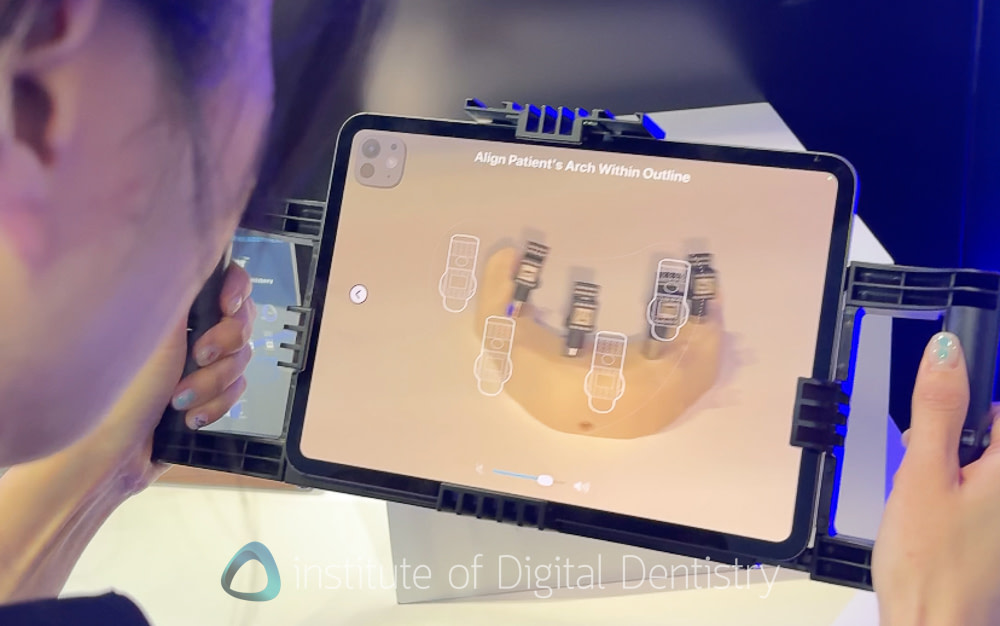
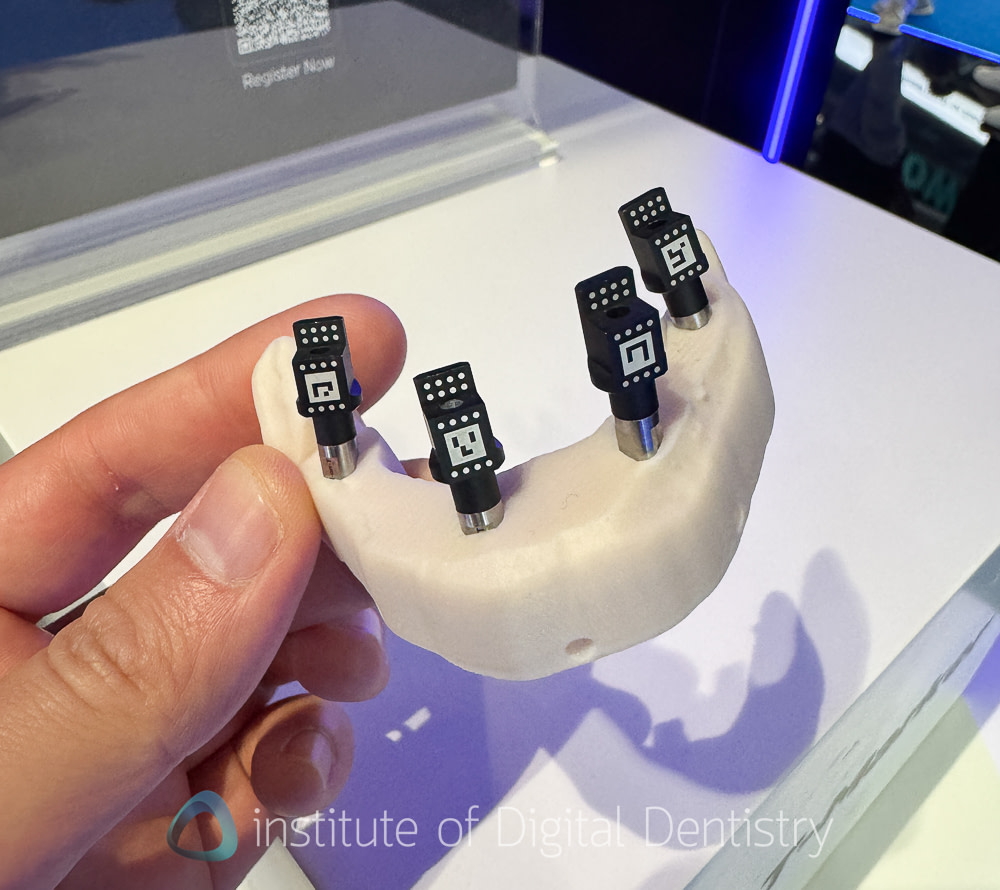
TruAbutment arguably stole the show at AEEDC 2026 with the official launch of their T-Marker iPad/iPhone-based photogrammetry solution - a product that's been teased at exhibitions for over a year and has finally arrived. If they've truly pulled this off, it represents one of the most significant shifts in full-arch implant scanning technology we've seen.
The T-Marker system uses markers similar to traditional photogrammetry dies combined with an iPad or iPhone to capture full-arch implant positions with what the company says is photogrammetry-level accuracy. The promise of bringing photogrammetry capabilities to devices practitioners already own could fundamentally transform full-arch workflows by removing the barrier of expensive dedicated hardware.
Complementing T-Marker, TruAbutment showcased T-Snap - their software app within an iPad that functions like an intraoral scanner, specifically for capturing arch scans for temporary prosthetics in full-arch cases.
Several fascinating trends converge in TruAbutment's launches. First, the industry's obsession with full-arch workflows continues to intensify - nearly every major innovation at AEEDC 2026 relates to this clinical application. Second, the rise of iPad-based solutions, following Medit's i900 Mobility, may be the next major trend in digital dentistry. Third, and perhaps most impressive, is the technical achievement of pulling off accurate photogrammetry on consumer devices that cost a fraction of dedicated hardware.
This was unquestionably one of the biggest launches at AEEDC 2026. TruAbutment has transformed from a component manufacturer into a comprehensive full-arch solutions provider, and if T-Marker delivers on its promised accuracy, it could fundamentally reshape how practices approach full-arch implant digitization.
Vatech - Perfit OVIS One-Visit Zirconia Mill
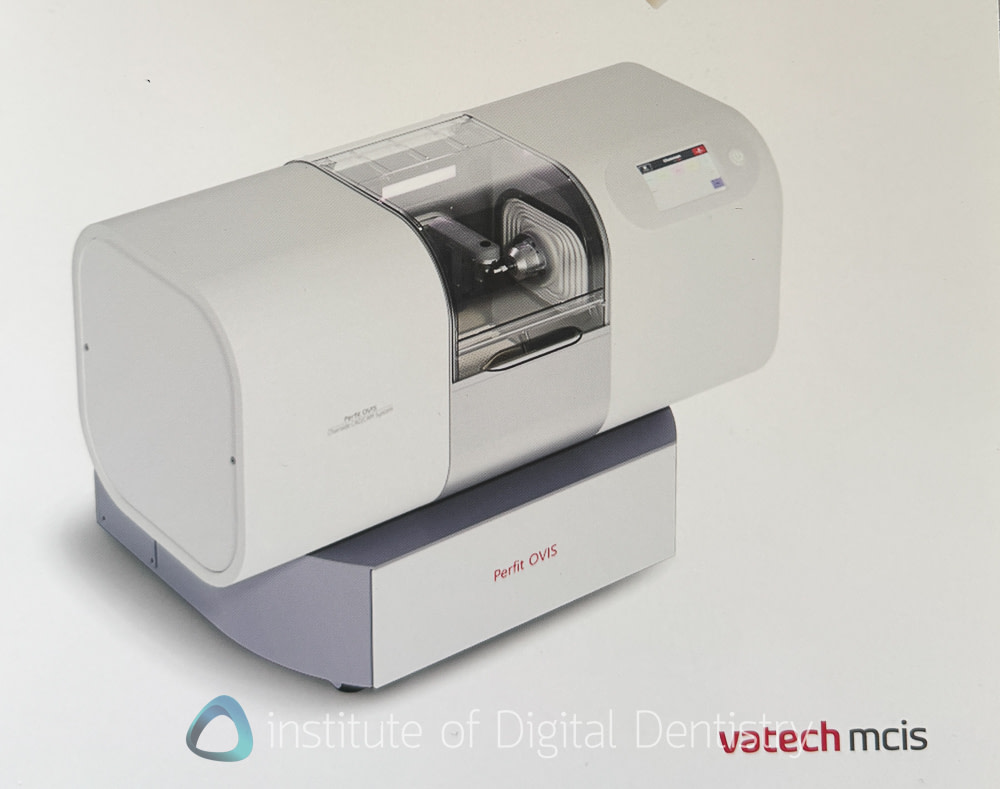
Vatech showcased an intriguing addition to the chairside milling market with its Perfit OVIS system, marketed as a "One-Visit Zirconia Restoration Solution," promising seamless speed and exceptional strength.
The Perfit OVIS represents Vatech's entry into chairside CAD/CAM, featuring the milling unit alongside their Perfit FS (Full Sintered) zirconia blocks in various sizes. The system aims to enable complete zirconia restoration workflows in a single appointment, competing directly with established players such as CEREC.
What's particularly interesting is the focus on fully sintered zirconia blocks rather than pre-sintered materials requiring post-milling sintering. Seen before, but quite hard on milling machines. The Perfit FS blocks come in multiple configurations, including different heights and translucency options (Natural, Medium, High Translucent).
Vatech's chairside mill is noteworthy, given its established position in imaging. However, they face the monumental challenge of competing in a space dominated by CEREC's decades-long head start. The chairside milling market has proven notoriously difficult for new entrants to crack, with multiple companies attempting to gain meaningful traction but struggling to do so.
Whether Vatech's integrated approach and focus on fully sintered zirconia are enough to capture market share remains to be seen, but their entry demonstrates confidence in their vision for complete digital workflows.
VHF - German Milling Excellence
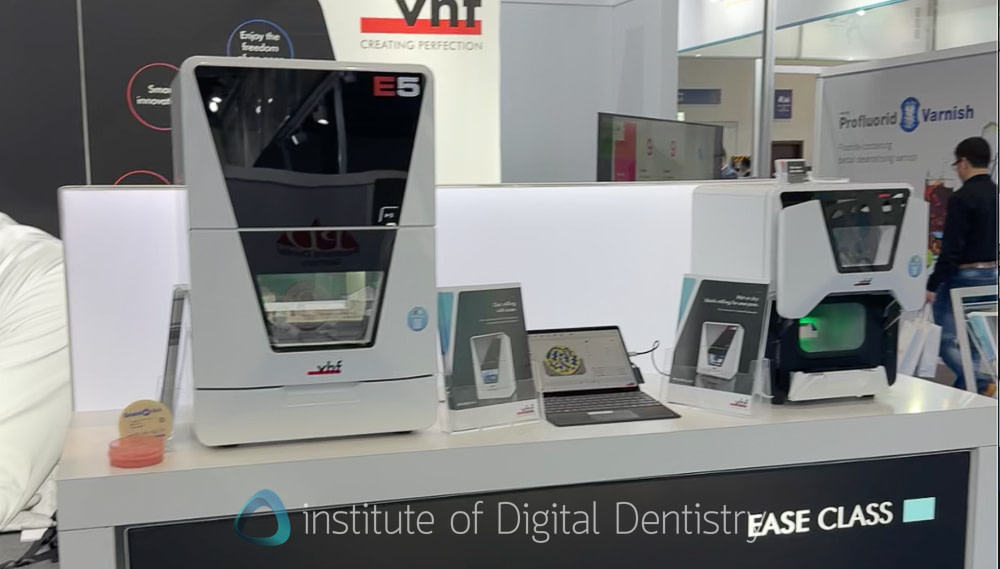
VHF's booth at AEEDC 2026 featured its established line of German-engineered milling machines, with no new hardware announcements. Their comprehensive range includes the K and S series mills, from compact desktop units such as the K4 basic and K5 to robust laboratory systems such as the S2 and S4, along with their aligner trimming solutions.
The company maintains its position through a reputation for reliability and precision engineering. While VHF introduced a comprehensive software revamp at IDS 2025, featuring a completely redesigned CAM platform with a modern interface and simplified workflows, AEEDC saw no major announcements.
In an industry increasingly dominated by 3D printing headlines and AI-powered workflows, VHF represents the quieter side of digital dentistry - companies providing proven subtractive manufacturing solutions that simply work.
UNIZ - High Speed Printing
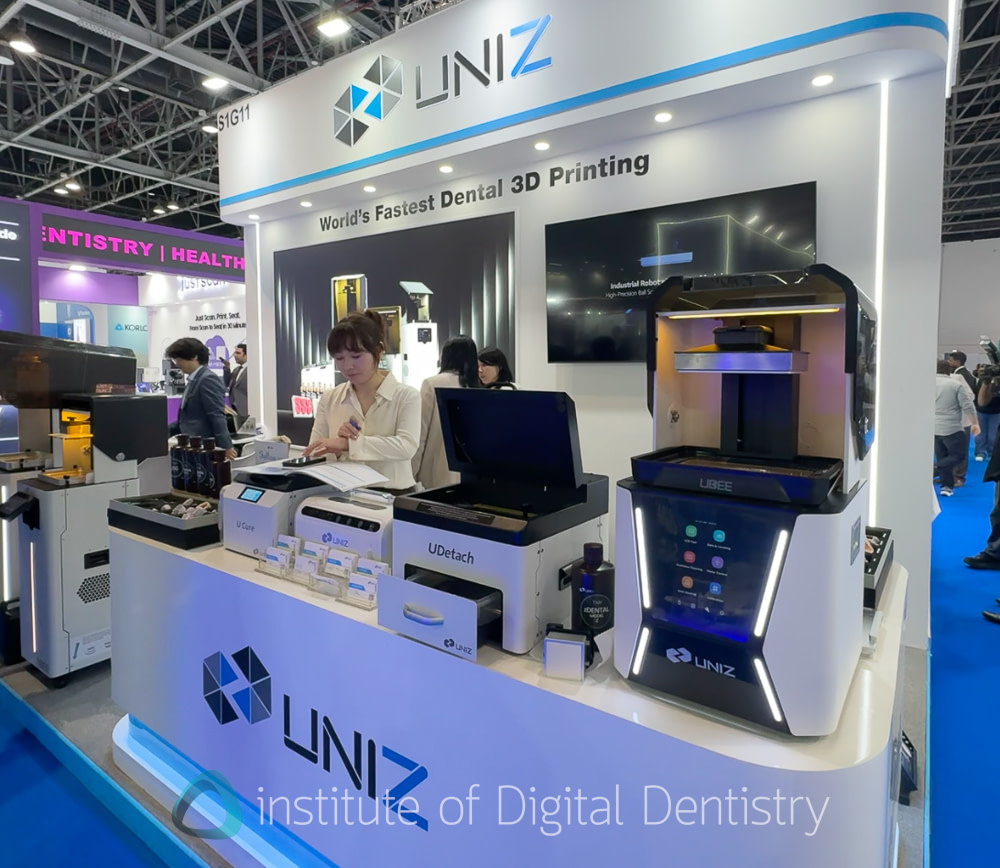
UNIZ showcased its comprehensive 3D printing ecosystem at AEEDC 2026, positioning itself as the "World's Fastest Dental 3D Printing Solutions" with an emphasis on end-to-end workflow integration.
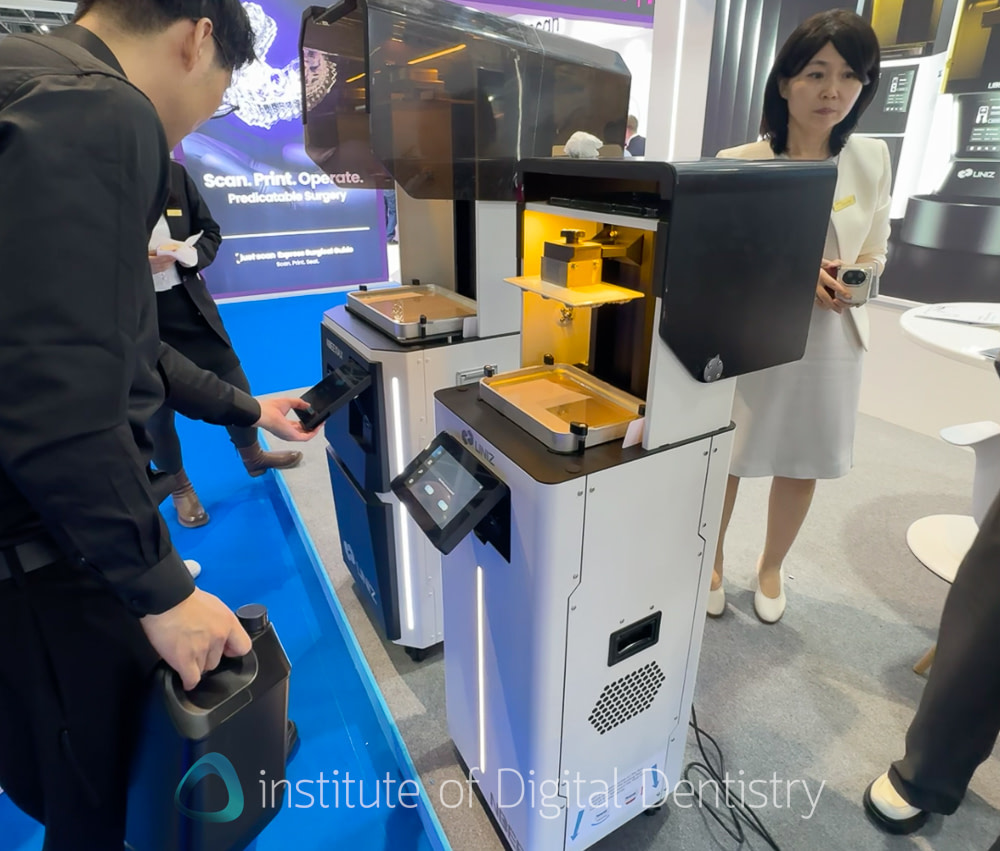
The major announcement was the NBEE MAX, described as the high-volume lab version of their UBEE printer. This represents UNIZ's push into production-scale environments, targeting laboratories requiring maximum daily throughput. Alongside the printer launch, UNIZ demonstrated their complete post-processing solution, including UCure (automated curing with material-specific protocols), UWash 2.0 (ultrasonic cleaning system), and UDetach (automated build plate removal).
The marketing emphasized their material portfolio with "Trusted Materials for Every Workflow" - covering model resins, surgical guide materials, denture bases, casting resins, and orthodontic applications. UNIZ displayed the entire production workflow from scan input through 3D fabrication to final detaching and washing, presenting a single-vendor solution for the complete digital manufacturing process.
UNIZ continues to differentiate primarily on speed, but the NBEE MAX launch signals an evolution beyond that single metric. The integration of post-processing equipment addresses legitimate pain points - managing multiple vendors and protocols creates workflow friction that slows adoption. However, the "fastest" positioning raises questions about whether speed alone drives purchasing decisions when accuracy, reliability, and material properties remain the primary clinical concerns.
Velmeni - AI Diagnostics
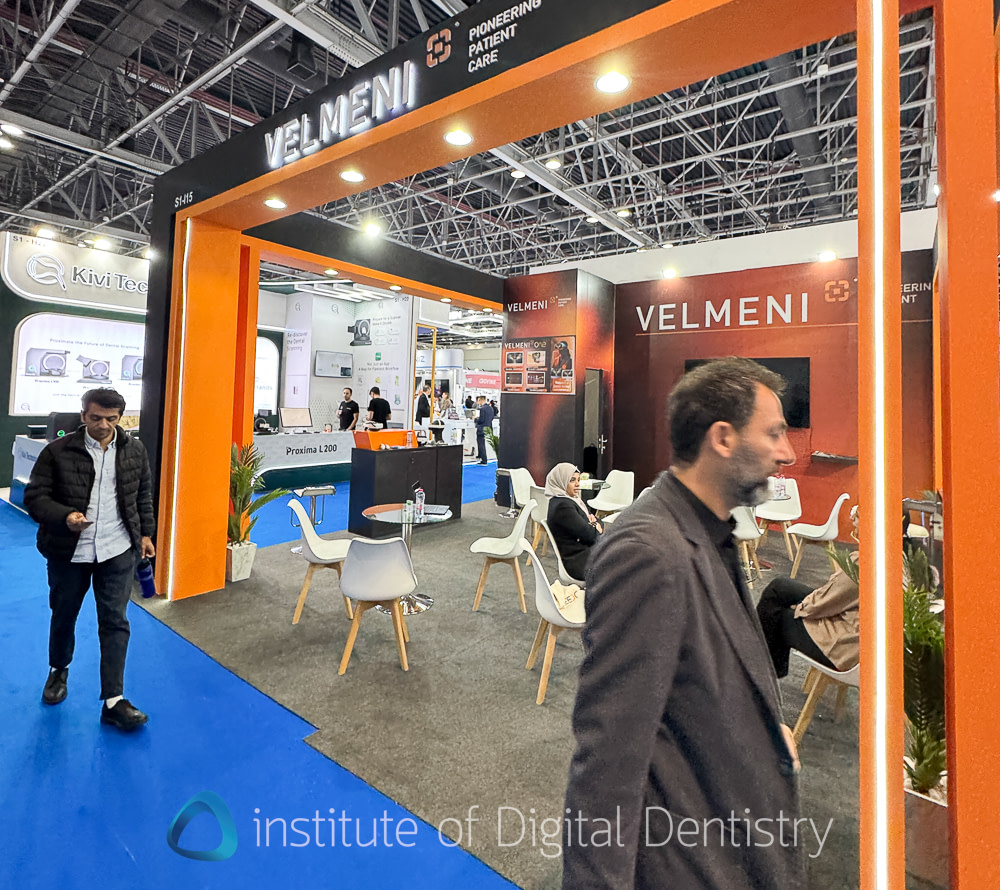
Velmeni showcased their FDA-cleared AI diagnostic platform at AEEDC 2026, positioning themselves in the increasingly crowded dental AI analysis space. The system analyzes panoramic, bitewing, and periapical radiographs to identify pathologies, generate visual reports, and facilitate treatment presentation - addressing both clinical detection and patient communication workflows.
The dental AI diagnostic market has exploded over the past few years, with multiple companies offering similar automated pathology detection tools. Velmeni's FDA clearance provides regulatory credibility, but the real question remains whether AI analysis tools fundamentally change clinical outcomes or primarily serve as marketing differentiators and patient communication aids.
I personally believe AI diagnostics will be the standard of care in the future; it's a matter of which provider can capture market share and which will integrate best with PMS, X-rays, etc.
Nice to see the company here, whereas other seemingly USA-focused AI diagnostic providers, such as Pearl and Overjet, were not present at the event.
Vulcan Dental - Metal 3D Printing
Vulcan Dental showcased its VENEA VDESK1 Pro metal 3D printer at AEEDC 2026, marking its place in the dental metal additive manufacturing space.
The VDESK1 Pro is designed for producing metal dental frameworks, partial denture structures, and other metal prosthetic components via additive manufacturing. The marketing highlights advantages such as high-precision pattern design, zero metal waste, better fit, precise metal distribution, and shorter production time compared to traditional casting methods.
Metal 3D printing in dentistry has long promised to revolutionize how laboratories produce frameworks and partial dentures, eliminating casting processes and material waste while improving accuracy. However, adoption has remained limited due to high equipment and material costs, the complexity of post-processing, and the established reliability of traditional metal workflows.
Vulcan Dental's entry into this space, with what appears to be a more accessible metal-printing solution, could be of interest to laboratories seeking alternatives to casting. However, metal 3D printing faces significant adoption hurdles: laboratories have decades of expertise in casting, the technology requires substantial training, and the cost-benefit analysis often favors traditional methods for all but the highest-volume operations. Whether VENEA can overcome these barriers with competitive pricing and proven clinical results remains to be seen.
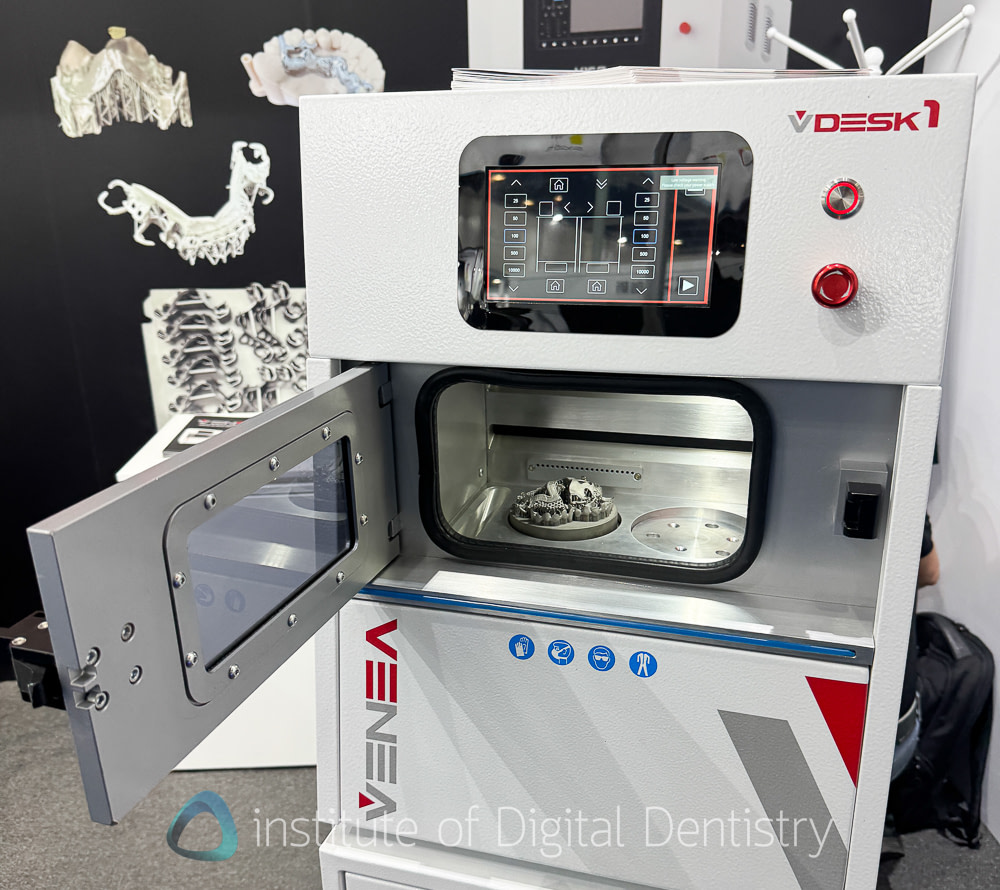
Yucera - Zirconia Materials Portfolio
Yucera displayed its zirconia materials lineup at AEEDC 2026, representing the continued presence of specialized material manufacturers at major dental exhibitions. As laboratories increasingly adopt in-house milling workflows, material selection has become a more visible part of the digital dentistry conversation.
The zirconia market has commoditized significantly over the past several years, with numerous manufacturers offering materials across the translucency spectrum from high-strength opaque options for posterior restorations to highly translucent variants for anterior esthetics. Yucera's presence at AEEDC positions them within this competitive landscape where differentiation increasingly depends on consistent quality, reliable supply chains, and competitive pricing rather than dramatic material property advantages.
Whether Yucera gains significant market share depends less on their material formulations - which likely perform comparably to established competitors - and more on their distribution networks, pricing strategies for price-sensitive markets, and ability to provide consistent supply to laboratories requiring reliable material availability for production workflows.
Zahndent - Comprehensive Digital Ecosystem
Zahndent showcased a comprehensive digital dentistry portfolio at AEEDC 2026, positioning itself as a complete solution provider offering everything from scanning to final restoration manufacturing. Their product catalog revealed a strategic approach built on strategic OEM partnerships across multiple product categories.
Their lineup includes intraoral scanners (featuring both white-labeled versions of Runyes and Panda scanners), dental 3D scanners, zirconia sintering furnaces, and 5-axis milling machines (ZAHN-S2 and ZAHN-S1 Pro models). The milling machines feature Panasonic servo power systems and handle multiple materials, including zirconia, wax, PMMA, PEEK, titanium, and more, with dry/wet milling capabilities depending on the model.
Their comprehensive portfolio of zirconia materials spans multiple translucency levels and sizes, completing the digital workflow from scan through final restoration. Zahndent represents the growing trend of companies positioning themselves as ecosystem providers rather than specialized manufacturers.
3Dify - New Scanner Showcased
3Dify's booth at AEEDC 2026 showcased its new intraoral scanner, JM01, moving beyond the prototype stage from last year's show. The scanner represents the company's continued evolution in the digital dentistry space as they work to establish itself in the increasingly crowded scanner market.
The company's comprehensive portfolio now spans intraoral, face, and lab scanning solutions, positioning it as a multi-category digital provider rather than a single-product company.
However, 3Dify faces the challenge that confronts all emerging scanner brands: breaking through in a market dominated by established players with proven track records and extensive support networks. With Chinese manufacturers flooding the market with capable, affordable options and Western brands commanding premium positions through software sophistication and brand trust, the middle ground where many newer entrants position themselves is becoming increasingly competitive.
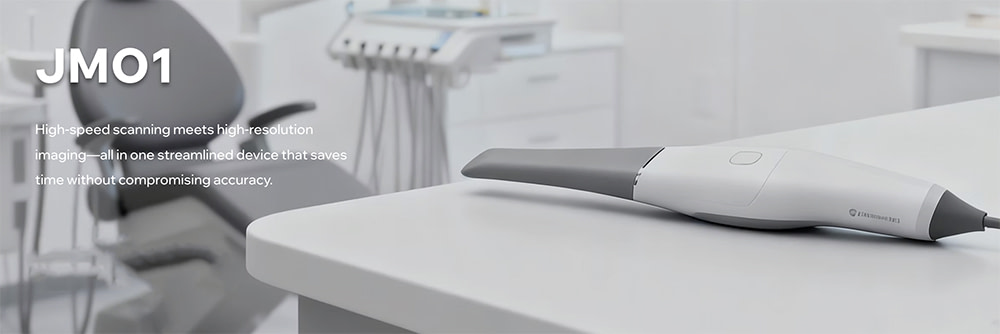
3DISC - OVO3 Scanner with Scan&Tell AI
3DISC showcased their OVO³ scanner at AEEDC 2026, emphasizing its "Clinically Proven Speed" with the bold claim of "210s from Start to Send to Lab".
The OVO³ features their Scan&Tell AI technology, which automatically selects 2D images from 3D scans to create instant treatment plans for patient presentation. This AI-driven approach aims to streamline the communication workflow by generating visual aids directly from scan data without requiring manual image selection or additional photography.
Beyond Scan&Tell, the scanner includes additional AI features for guided pop-up workflow assistance, a streamlined user interface, and visual guidance. The marketing emphasizes "personalized orthodontics" capabilities alongside standard restorative applications, with AI algorithms designed to optimize scanning efficiency and to visualize treatment plans.
3DISC's strategy focuses heavily on speed and AI-powered workflow enhancements rather than competing purely on hardware specifications. In a crowded scanner market where hardware capabilities have largely commoditized, their emphasis on reducing total workflow time - from initial scan through lab communication - represents a pragmatic differentiation strategy. Whether these AI features provide sufficient value to compete against established players with more comprehensive software ecosystems remains the competitive challenge for this French manufacturer trying to gain traction in a mature market.
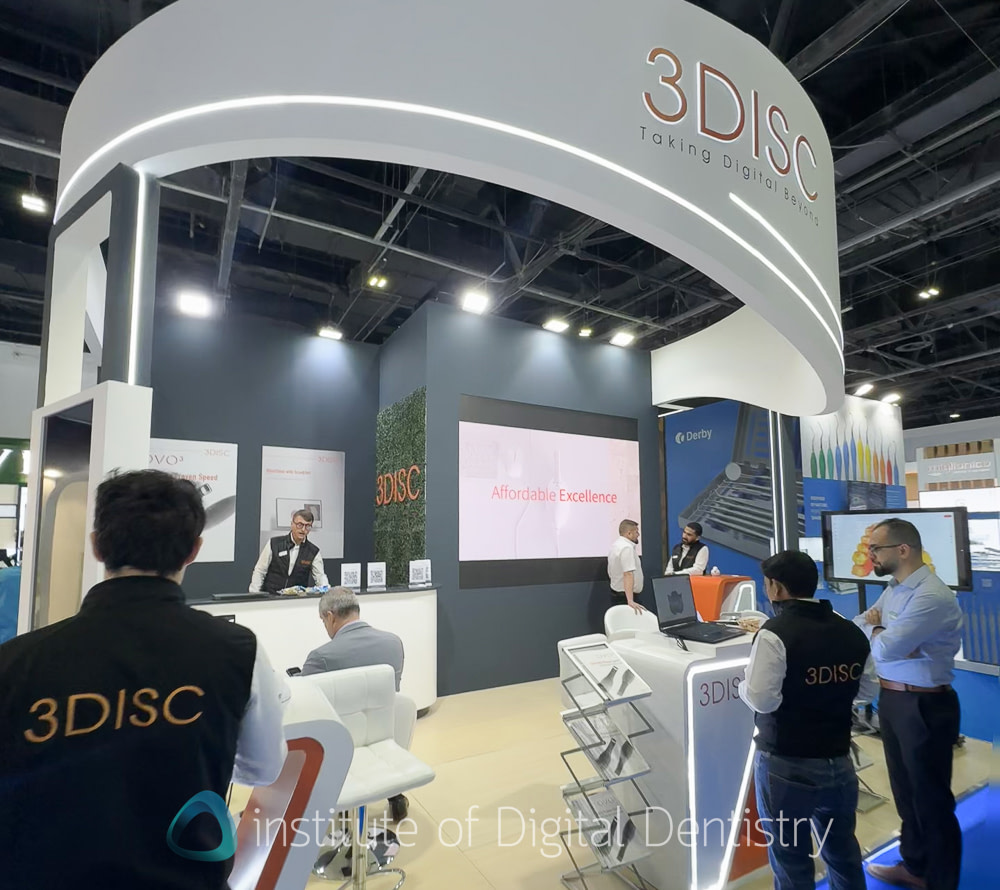
3Shape - TRIOS 6 Makes Regional Debut
3Shape made a significant return to AEEDC 2026 after being notably absent last year, with a large booth showcasing its flagship TRIOS 6 scanner and the Dx+ platform for AI diagnostics. This substantial presence signals 3Shape's renewed commitment to the MENA region.
The TRIOS 6, which I reviewed comprehensively following its IDS 2025 launch, represents 3Shape's strategic pivot toward transforming the intraoral scanner into a comprehensive diagnostic platform. The scanner's hyperspectral imaging system enables five AI diagnostic capabilities - occlusal caries detection, quantitative tooth wear measurement, gingival recession tracking, plaque visualization, and proximal caries assessment - all from a single standard scan.
However, significant questions remain about TRIOS 6's positioning in price-sensitive markets like the Middle East. At $27,900 USD, the scanner commands a substantial premium over competitors' models, and its AI diagnostic features require ongoing subscription fees.
The fundamental question is whether the AI diagnostic capabilities justify the premium in markets where many practices prioritize basic scanning functionality over advanced features. 3Shape's substantial presence at AEEDC suggests they're committed to making the case.
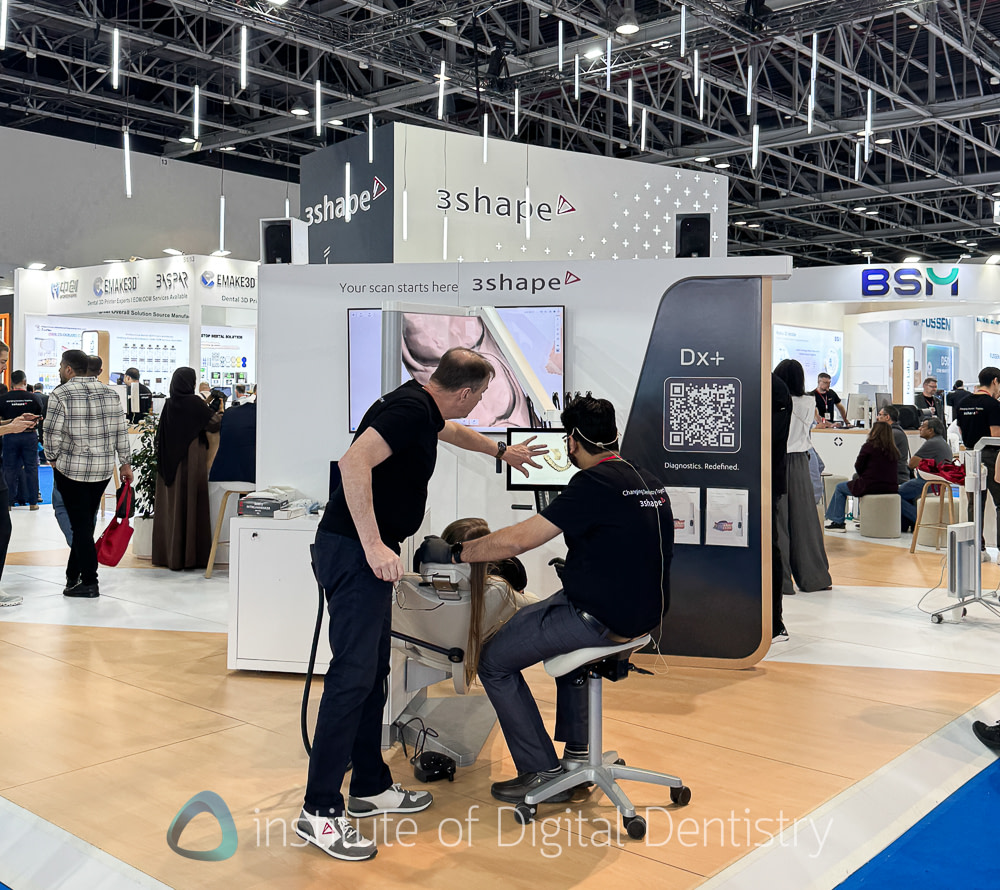
Final thoughts
AEEDC 2026 revealed that the digital dentistry industry is entering a distinct phase of maturation and consolidation. After years of explosive innovation and constant hardware releases, this year's show felt notably different - fewer groundbreaking announcements, more refinement of existing technologies, and a palpable sense that the industry is taking a collective breath before whatever comes next.
The absence of major scanner launches was noteworthy. Beyond Arcreal's official debut and Envista's DEXIS Imprevo, most manufacturers showcased existing portfolios with incremental improvements. This stands in sharp contrast to previous years, where every major show brought multiple new scanner releases. The question lingers: are companies holding back for IDS 2027, or have we reached a saturation point where hardware differentiation matters less than software ecosystems?
What dominated was the industry's singular obsession with full-arch implant workflows. TruAbutment's T-Marker iPad photogrammetry launch arguably stole the show, demonstrating that innovation hasn't stopped; it's simply focused on solving specific, high-value clinical challenges rather than introducing entirely new product categories. Nearly every scanner booth featured some variation of horizontal-scanning bodies, photogrammetry solutions, or full-arch scanning capabilities, confirming that this remains the primary battleground for competitive differentiation.
The Chinese manufacturing dominance was impossible to ignore. From comprehensive ecosystems to innovative approaches, Chinese manufacturers commanded enormous exhibition space and demonstrated increasingly sophisticated technology. The rate of development from companies like Shining 3D, Runyes, and others continues to outpace Western competitors, raising important questions about the future competitive landscape. I don't even want to mention the huge number of OEM products on the exhibition floor....
At any rate, it's clear the platform era for digital dentistry has truly arrived. Every major manufacturer now emphasizes their workflows, cloud ecosystem, or AI solutions over individual device capabilities. The winner in digital dentistry will be determined not by who makes the best scanner or printer, but by who builds the most seamless, integrated ecosystem that reduces friction across the entire clinical workflow.
Looking ahead, AEEDC 2026 felt less like a showcase of revolutionary change and more like a period of consolidation - companies refining proven technologies, building out ecosystems, and preparing for what comes next. Whether that next phase arrives at IDS 2027 or evolves gradually over the coming years, this show made clear that digital dentistry has moved from its innovative adolescence into a more mature phase focused on practical implementation, economic viability, and comprehensive solutions rather than isolated technological breakthroughs.
The digital revolution continues, but AEEDC 2026 suggests it's entering a new chapter - one defined less by constant hardware innovation and more by thoughtful integration, accessible pricing, and solving the complex clinical and economic challenges that determine whether technologies succeed in the real world.
Thanks for reading.
Congratulations, I liked how you describe the market and your perspective on digital dentistry.
Thank you for the kind words! Means a lot.
Thanks for another thorough and comprehensive review! It’s always great to read your insight on the latest trends.
Can’t wait to see what Shining is waiting to release this weekend in Chicago (fingers crossed it’s a desktop face scanner, ha!). What a time to be a dentist!!!
Cheers and have a great week!
Thank you so! I really appreciate that! It means a lot to hear that you’re enjoying the reviews and insights.
And yes… Chicago should be interesting 👀 It’s incredible how fast everything is moving right now, truly an exciting time to be in dentistry.
Looking forward to seeing what they unveil. I’ll be sure to share any highlights.
Do BLZ, Alliedstar, and Adite use photogrammetry technology?
I find the way it’s presented in the software quite similar to Elite.
None of these use photogrammetry technology. They are all horizontal scan body work flows.
You need at least 2 cameras that use triangulation for photogrammetry. Elite does not do it either.
Its more like great software, very accurate scan body matching and unique STLs for each kit. Does the job.