TLDR - The Episode in 30 Seconds
- Fadi argues that GPs moving into implants should first master flap design and soft tissue handling around natural teeth.
- He treats recession case by case, considering crowding, keratinized tissue width, symptoms, and bone levels before deciding whether to graft or monitor.
- He prioritizes tissue thickness and quality, with root coverage as a bonus rather than a promise.
- He prefers autogenous grafts in the mandible, uses allografts where the phenotype is thicker, and reserves tuberosity grafts mainly for implant sites.
- He protects every palatal donor site, with one option being a scanned and printed stent, which he says keeps most patients on over-the-counter pain relief.
- He puts about 75% of his practice in soft tissue work, which he sees as a low-overhead gap in most general practices.
Who Is Dr. Fadi Hasan?
Fadi graduated from the University of Colorado in Denver, completed his surgical residency at Virginia Commonwealth University in 2015, and has practiced perio for 11 years. He still teaches, including oral surgery residents, and continues to take CE himself.

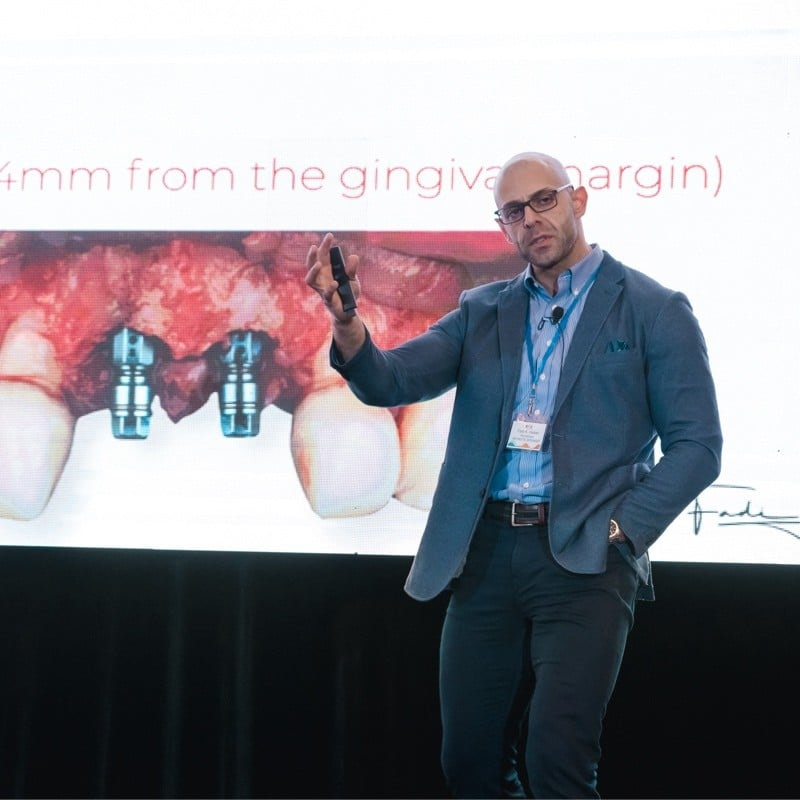
What struck me in this conversation is how much he sees perio and restorative as one discipline.
"Over the years, I see there's more of a relationship between the perio side and the restorative and prosthetic side that, unfortunately, we did not get that much experience of during the residency periods."
He even says he wishes he had done a combined perio-pros program, because so much of his day now sits in that overlap.
Soft Tissue Before Implants
I asked Fadi what GPs are missing most when it comes to perio. His answer was blunt. Most dentists who take his courses want implants, and often All-on-X straight away.
"And I think about it as, like, can you even reflect a flap? Can you manage soft tissue properly? And that's the, the basics of the basics."
He says the same problem shows up with oral surgeons, periodontists, and surgical prosthodontists in his courses. Recession on implants and thin tissue over implants come back to soft tissue management.
His teaching sequence starts on natural teeth, then applies the same incision and flap designs to existing implants with soft tissue deficiencies, and finally to immediate placements with missing buccal plates. The idea is that you only move to the advanced case once you can manage a flap properly.
The finesse is real, too. Fadi talks about suturing with 6-0, 7-0, and sometimes 8-0 sutures. Speaking as someone who has done a couple of graft cases since his course, I can tell you the first one is humbling. You don't pick it up in a weekend.
When to Treat Gingival Recession
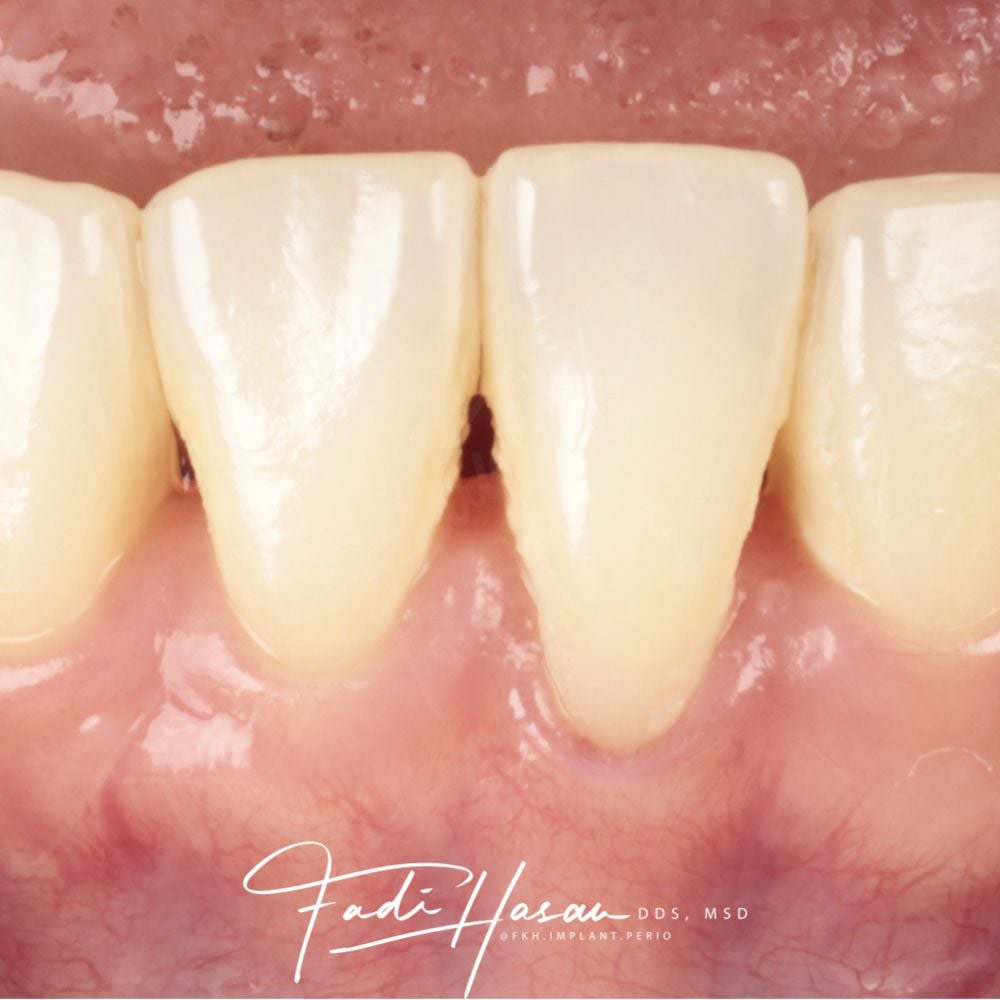
This is the question I get most from GPs. Almost everyone has some recession on the lower anteriors, so when do you act and when do you refer?
He first looks at crowding, since a proclined tooth can lose facial bone, and the gum follows the bone. Then he looks at how much keratinized tissue remains. He acknowledges the literature is split on whether 2 mm is the minimum, and his practical test is the patient.
"The way I see it is, if my patients, they're telling me, "Um, I feel like my gums are hurting me every time I brush it, and I'm avoiding it because I'm too scared," that's the most common thing I get to see." That avoidance leads to plaque, calculus, and eventually bone loss, turning what could have been a simple graft into a regeneration case.
On when to treat, Fadi cites a study by Serino suggesting that 3 mm of recession progresses 67% of the time and 4 mm progresses 98% of the time. With 1 to 2 mm, he generally monitors unless there are symptoms such as sensitivity, pain on brushing, or bleeding.
Bone levels set expectations. High bony peaks give a good chance of complete coverage. Low bony peaks might mean 80 to 90%, and Fadi explains to patients that 90% of 4 mm leaves less than half a millimeter exposed.
"Let's thicken the gum. Let's improve the phenotype. That way, we can hopefully at least stop it from getting worse, and I'll cover whatever root I can. If I get a hundred percent root coverage, I'm a bloody hero, in other words, okay?"
I think that framing is the most useful takeaway for GPs, even if you never pick up a blade. Promise thickness and stability, not complete coverage. Fadi also says he will sometimes switch from a root coverage procedure to a free gingival graft once he numbs and sees how little tissue there is, then come back about eight weeks later to advance the tissue.
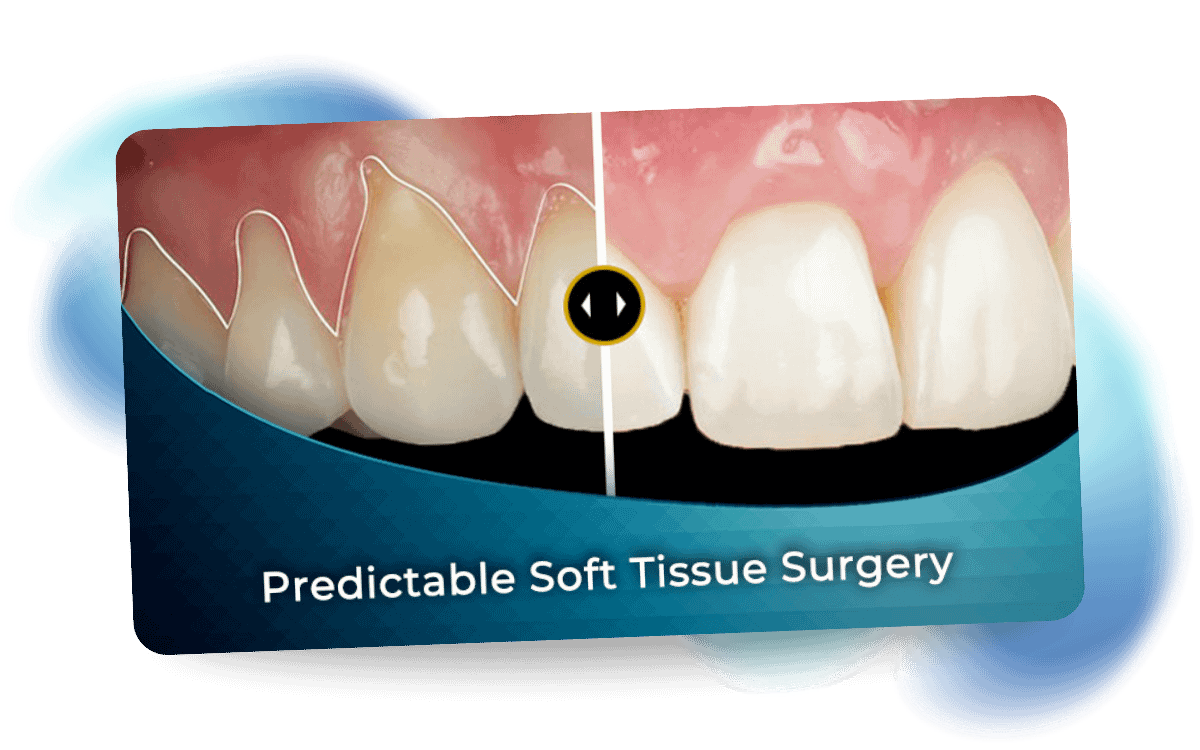
Do you want to Master Predictable Soft Tissue Surgery Techniques?
Master Multiple Techniques Through Learning Loops – The Science-Backed Alternative to Weekend Intensives
Choosing a Gum Graft - Autogenous, Allograft or Collagen
The options are autogenous tissue (palate or tuberosity), allograft (human donor tissue), porcine dermal matrix, and collagen matrices such as Geistlich Fibro-Gide.
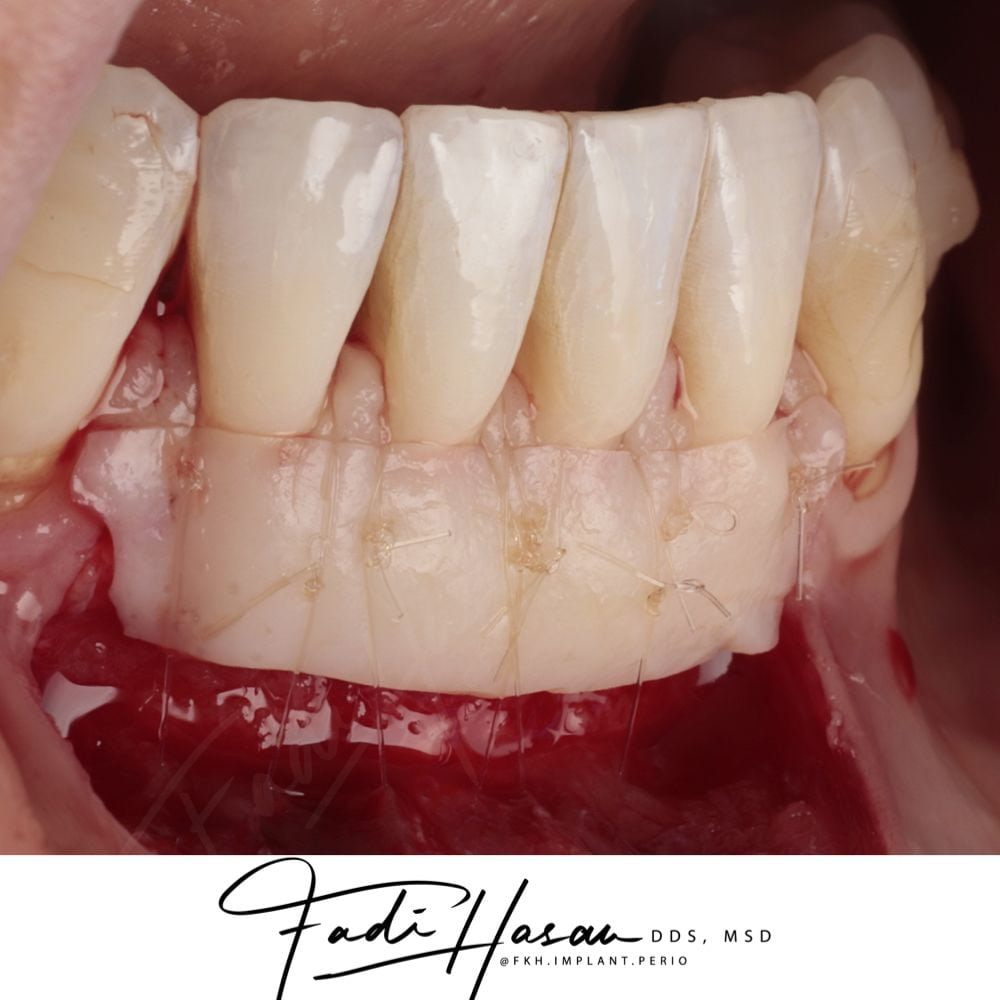
The fear with autogenous is the palate. Fadi agrees that an unprotected donor site is miserable for the first ten days, and his fix is simple. Scan the upper arch and print a protective palatal stent, or vacuum-form one. With that in place, he says, most of his patients need nothing more than ibuprofen and acetaminophen.
His preferences, in short.
- In the mandible, he uses autogenous tissue because of muscle pull from the mentalis muscle and gravity is a factor.
- In the maxilla, with 3 to 4 mm of keratinized tissue and a thicker phenotype, he says allograft performs well and keeps surgery short.
- With 0 to 1 mm of keratinized tissue, he goes autogenous, because of what happens if the graft is exposed.
"Autogenous, if it gets exposed, what's going to happen? It's going to keratinize. Great. I have now more KT than I started with. Allograft gets exposed. It's not very friendly. It will get infected."
For single implant sites with thin tissue, and for immediate placements through a small vestibular incision, he has been using collagen matrices more often. He puts the cost of these materials at roughly $150 to $300, depending on size.
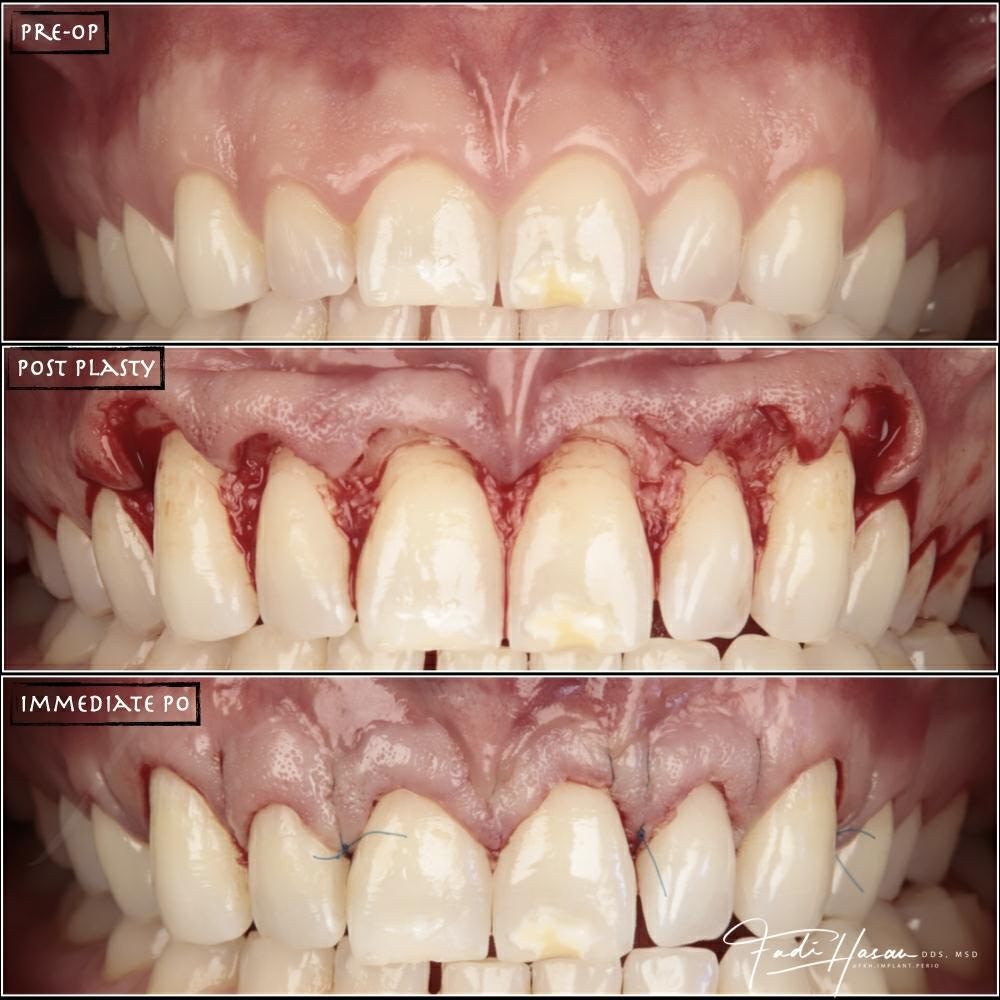
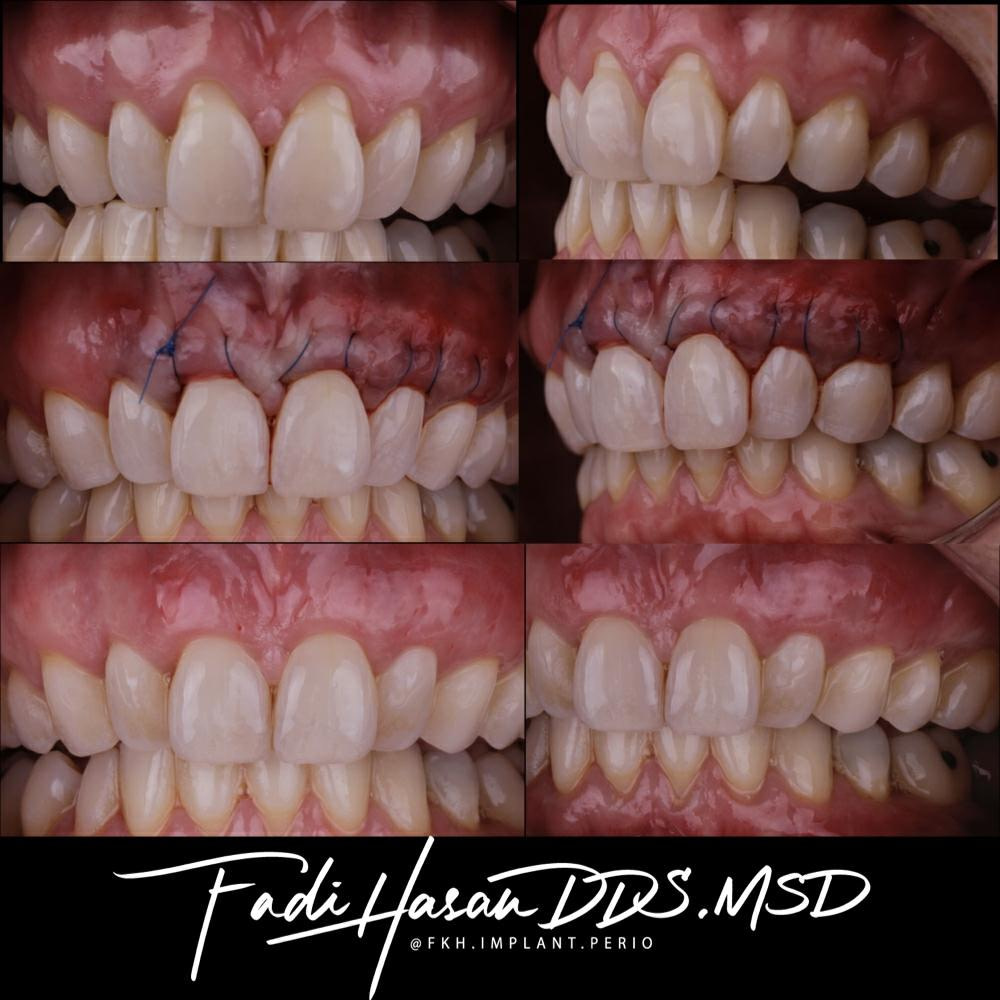
Within autogenous grafts, Fadi credits Giovanni Zucchelli for popularizing the de-epithelialized free gingival graft. You harvest a standard FGG and remove the epithelium, which gives denser connective tissue with less fat and glandular tissue than the older subepithelial harvest, and less shrinkage. He uses the full FGG for the mandibular anterior with no keratinized tissue or a high frenum, and increasingly around mandibular All-on-X, where mucosa tends to ride up within a few months.
He reserves tuberosity grafts mainly for implants, including recession, thin facial tissue, a grey show-through, and papilla development. He describes a hyperplastic response that makes the tissue fuller over time, and quotes figures of 72% dense connective tissue for tuberosity versus about 52% for palatal subepithelial tissue.
Where Digital Fits in Perio Surgery
Most people think digital in perio means implant guides. Fadi uses it in a few more places.
He uses his scanners to compare pre- and post-grafting scans, which he says helps patients see what changed and helps close cases. We mainly use the same patient monitoring tools for wear cases, so it was interesting to hear them used for gingival levels.
He also mentioned digital wax-ups for pontic site development, lab coordination, guided gingivectomy and osseous surgery for crown lengthening, and printed guides for harvesting and fixing block grafts.
"So that cuts down our surgical time and less guessing of, well, how much, how much should I harvest from the ramus, for example?"
He has also seen guides used for apicoectomies and lateral window sinus lifts. His caveat is that all of this depends on having a good lab or technician who can turn your plan into something physical.
We also went on a short tangent about photogrammetry. My take, for those weighing it up, is that traditional photogrammetry still works but prices out too many people; horizontal scan bodies are accurate if you scan properly; and the new phone apps come with a monthly subscription that I am not sold on yet. I would not be surprised if we eventually see intraoral scanning on phones one day.
Know what’s next in dentistry. Before everyone else.
The innovations, clinical insights, and digital trends that matter - curated by iDD and delivered straight to your inbox every week.
Specialists, GPs and Sharing Knowledge
I have to say, it is refreshing to hear a specialist talk like this. Fadi admits he used to be against GPs doing implants.
"But honestly, I've seen some general dentists do implant work and bone grafting work more than better than 90% of the specialists."
He teaches oral surgery residents about soft tissue grafting, learns from colleagues overseas, and sees no reason to hide knowledge. I agree completely. In saying that, if you are a GP moving into specialist work, hold yourself to a specialist standard. Get the training, the tools, and the CE, because a poorly done case reflects on all of us.
He also shared a few recent cases, including a young patient with a dark root showing through her gum before her engagement party, and a patient whose failed implants left no keratinized tissue.
"But I'm, I'm not going to build bone when I have no gum to close."
That sequencing point, soft tissue first and vertical bone second, is one I think many implant clinicians would benefit from.
Fadi says roughly 75% of his practice is soft tissue work, and he argues that it is the most overlooked opportunity in general practice because the overhead is low compared with implant therapy. I would add one balance point. Gum surgery is technically demanding, and the revenue only follows if the results are good. Start with training, start with straightforward cases, and know when to refer.
What's Next
Fadi spent a lot of time recording cases for our new perio course with him on iDD, using hands-on models you can follow along with, and he hinted at more projects together down the track. If gum grafting is something you want to add to your practice, that is the place to start. Otherwise, listen to the full episode for the details behind each graft choice.
Check out the course here. If you have any questions, please leave them below.