

Formlabs Goes Fully Open and What It Means for Dental 3D Printing
If you have been following the 3D printing space in dentistry, you will know that one of the most common complaints about Formlabs Dental printers has always been the same: great printer, but it is closed.
That has now changed.
I recently sat down with Georgio Haddad, Head of Strategic Partnerships and Marketing at Formlabs Dental, who has been with the company for eight years. We covered a lot of ground, from the open platform shift to where 3D printing actually stands as a clinical tool in 2026, and what the data really shows about what dentists are printing.
This one is worth listening to or reading if you are thinking about 3D printing in your practice.
The Big Shift - Formlabs Is Now Open Out of the Box
Since January 2026, all Form 4B and Form 4BL dental printers will ship completely open by default.
This is a significant change. Back in 2024, Formlabs introduced what they called an "open material mode," which allowed users to print with third-party resins, but it required opting in and paying an additional fee.
Adoption was restricted, creating a bit of a catch-22. Formlabs made the call to remove that friction entirely.
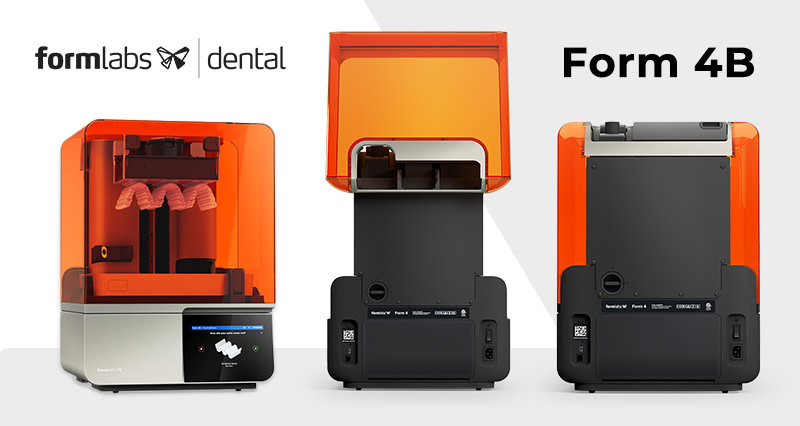
The result? More than 50 third-party dental resins have now been validated on the Form 4B, with more coming for the Form 4BL. Validated manufacturers include Keystone Industries (including their popular Keysplint Soft in clear and tinted), Dentsply Sirona, VITA, Detax, Pac-Dent, and a growing number of Asia-Pacific manufacturers such as Graphy.
Georgio told me that at the Chicago show, they were getting people saying, "I never considered Formlabs before, but now I am buying one on the show floor." That is a meaningful signal about how much the closed system was holding them back.
What Does Open Actually Mean for Workflow?
It is worth being clear about what "open" looks like in practice, because there is still a difference between using Formlabs resins and third-party resins on the same printer.
With Formlabs' own resins, you slide a cartridge in the back of the printer, and it automatically dispenses into the tank, with the printer recognizing the cartridge. It is a seamless, mess-free operation.
With third-party resins, you pour the resin into the tank yourself. It works, but you lose that automated convenience.
So Formlabs maintains a meaningful workflow advantage with their own materials, while still giving you the freedom to use whatever else is validated on the platform. It is a sensible balance.
On the topic of pricing, Formlabs model resin is currently around $79 USD per liter, and Georgio mentioned their Precision Model Resin recently dropped to roughly that level as well, down from $129 USD. That is genuinely competitive pricing for the quality you are getting.
It is also worth noting that the new out-of-the-box pricing reflects what the old open material mode add-on used to cost, so there has been a slight price adjustment for the hardware. Keep that in mind when comparing to previous pricing.

Know what’s next in dentistry. Before everyone else.
The innovations, clinical insights, and digital trends that matter - curated by iDD and delivered straight to your inbox every week.
Is Open the Future of Dental 3D Printing?
I asked Georgio directly: Is the future open? Do closed systems survive long-term?
His answer was honest. He pointed to milling machines as a historical comparison. Back in the day, companies like Zirkonzahn and Amann Girrbach ran fully closed systems requiring you to buy their materials exclusively. That eventually changed, driven by users simply refusing to buy products that locked them in.
Dentsply Sirona with CEREC is another example. They have gradually opened their block compatibility. Not fully open, but heading in that direction.
His take is that it is fundamentally about customer psychology, and I think he is right. He made a comparison to electric vehicle range anxiety. Most people would never drive more than 200 kilometers on a single charge, but they still want a car that can go 800 kilometers. The same logic applies to open resin compatibility. Most users will probably use only one or two third-party resins over the life of a printer, but they want the peace of mind that the option is available.
I have been saying something similar for years about scanner apps. The statistics suggest fewer than 10% of dentists actually use the app ecosystems on their scanners. But try selling a scanner without apps today.
From a competitive standpoint, I do think this puts Formlabs in an interesting position relative to SprintRay, which continues to run a largely closed ecosystem on the chairside. SprintRay has done an impressive job with resin quality, and that has been a big draw for their printers. But I am genuinely curious to see how much longer a closed model is sustainable as more of the market wakes up to openness as a baseline expectation.
What Are People Actually Printing?
This was one of the most interesting parts of the conversation.
We talk a lot in dentistry about aligners, crowns, and dentures. There is constant excitement on forums and social media about restorative 3D printing. But when Georgio shared what the actual Formlabs utilization data shows, the picture is quite different.
In dental practices, roughly 60% of printing volume is still models. Models.
Nobody talks about models. Nobody posts about printing a model. But that is what the majority of people are actually printing.
After models, the second most common application is now splints, which have recently overtaken surgical guides. And further down the list, you find denture bases and teeth, and then temporaries and final restorations at the tail end.
Georgio was clear that this is not just a Formlabs finding. It is consistent with what third-party resin manufacturers are also seeing across their own data.
This matters because it tells you something important about where the real-world value of chairside 3D printing currently lies. It is not in printed crowns or in-house aligners, at least not yet. It is in models and splints.
The Honest State of 3D-Printed Crowns
I want to spend a moment on this because I think it is an area where there is a genuine gap between what is being marketed and what is happening in clinical practice.
Georgio shared that when you look at the seriously science-driven practices, very few are placing 3D-printed resins as final restorations. And the reason is straightforward: most practitioners cannot yet say that a printed crown is clinically equivalent to zirconia or e.max. The hesitation is rational.
I have to be honest here, and this is a bit of a shift for me. I was one of the early critics of 3D-printed crowns, for obvious reasons. But I am slowly starting to come around.
Many of the printed crowns I placed two years ago are now coming back in for recalls, and they are not looking as bad as I expected. If they are properly post-processed, properly polished, and glazed, they seem to hold up better than my initial skepticism suggested. I genuinely expected worse.
Is it e.max? No. Is it zirconia? No. But the question Georgio asked is the right one: what is "good enough"? And that bar may be closer than we think.
Georgio drew an analogy I thought was well put. Implants faced massive skepticism when they first appeared. So did zirconia. So did e.max. All of those took years to gain clinical acceptance before becoming mainstream. We may be in a similar waiting period for restorative 3D printing.
Direct Print Aligners - Not There Yet
I will keep this section short because the honest answer is: the technology is not quite ready for widespread clinical adoption.
Georgio's view is that more clinical evidence is still needed, and the workflow needs significant simplification.
The pitch you often hear, where you scan a patient and send them home with their first two or three aligners while the lab fabricates the rest, is interesting in theory. But who is designing those aligners? Most GPs are not set up for that workflow. Orthodontists, who have historically had small in-house lab setups, are more positioned to explore this.
Formlabs estimates that around 15% of US dental practices currently have a 3D printer. Compare that to what they believe is well over 50% of US orthodontic practices. The gap is significant, and it reflects a real difference in readiness and workflow integration - again, most likely due to orthodontic models.
On the broader question of aligner printing, the barrier remains the same one that has existed for some time. Printed aligner material needs to perform better than thermoformed aligner material, not just as well, to justify the enormous switching costs for major aligner companies. And it needs to be manufacturable at scale, at a competitive cost. That equation has not been solved yet.
Detax has recently announced a new aligner resin they are validating on the Form 4B, which is worth keeping an eye on. And Invisalign has started to publicly acknowledge this space, which will likely accelerate interest across the whole sector. Georgio's point was that when a brand like Invisalign starts talking about something, the rest of the industry races to follow.
Know what’s next in dentistry. Before everyone else.
The innovations, clinical insights, and digital trends that matter - curated by iDD and delivered straight to your inbox every week.
The Unlock for Wider Adoption
If 3D printing is used in only about 15% of dental practices in North America, what will change that?
Georgio identified three things.
First, post-processing needs to improve significantly. It is still technique-sensitive, and calling it mess-free would be generous. The cognitive load on dentists managing the workflow after a print is done remains a real barrier.
Second, someone needs to own the full workflow from scanner to final appliance. No single company has done this properly yet. The closest attempt has been Dentsply Sirona with CEREC, but that system is cost-prohibitive and not designed for chairside use at scale.
Third, costs need to come down to enable mass adoption. Formlabs makes the point that their scale across general professional 3D printing, not just dental, gives them an advantage here. They claim to produce and sell more professional desktop 3D printers than any other company in the world. That volume creates economies of scale that smaller dental-only manufacturers cannot easily replicate.
I do think there is something to the idea of a consolidated end-to-end workflow. If a company that already has a scanner were to acquire or partner closely with a 3D printing company and genuinely own the process from scan to chairside, that could accelerate adoption in the same way CEREC did for milling. CEREC never achieved widespread adoption in the dental chair, but it went further than standalone milling machines because it controlled the workflow.
3D printing that is as simple as CEREC? That is probably what it would take to get the broader market moving.
Pod Printing - Here to Stay, But Not in Its Current Form
We briefly touched on pod printing, which is worth a mention.
My honest view is that pod printers for crown printing are here to stay. The appeal is obvious: no resin handling, predictable output, simplified workflow. For dentists who value ease of use over cost, it makes sense.
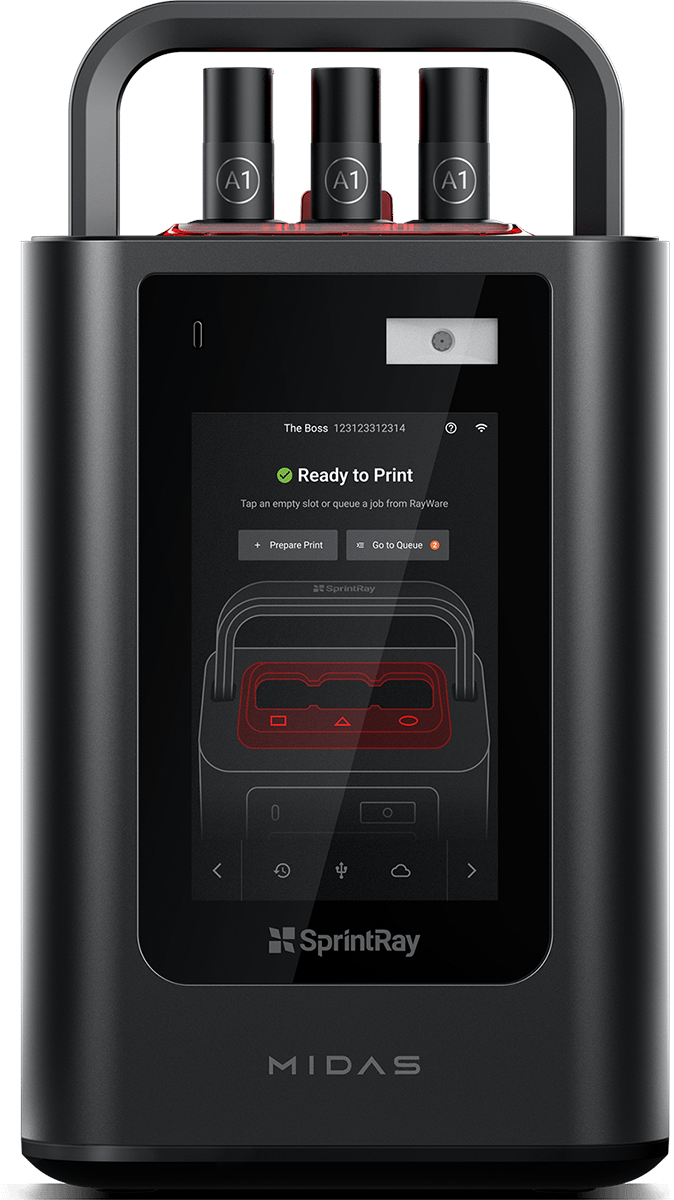
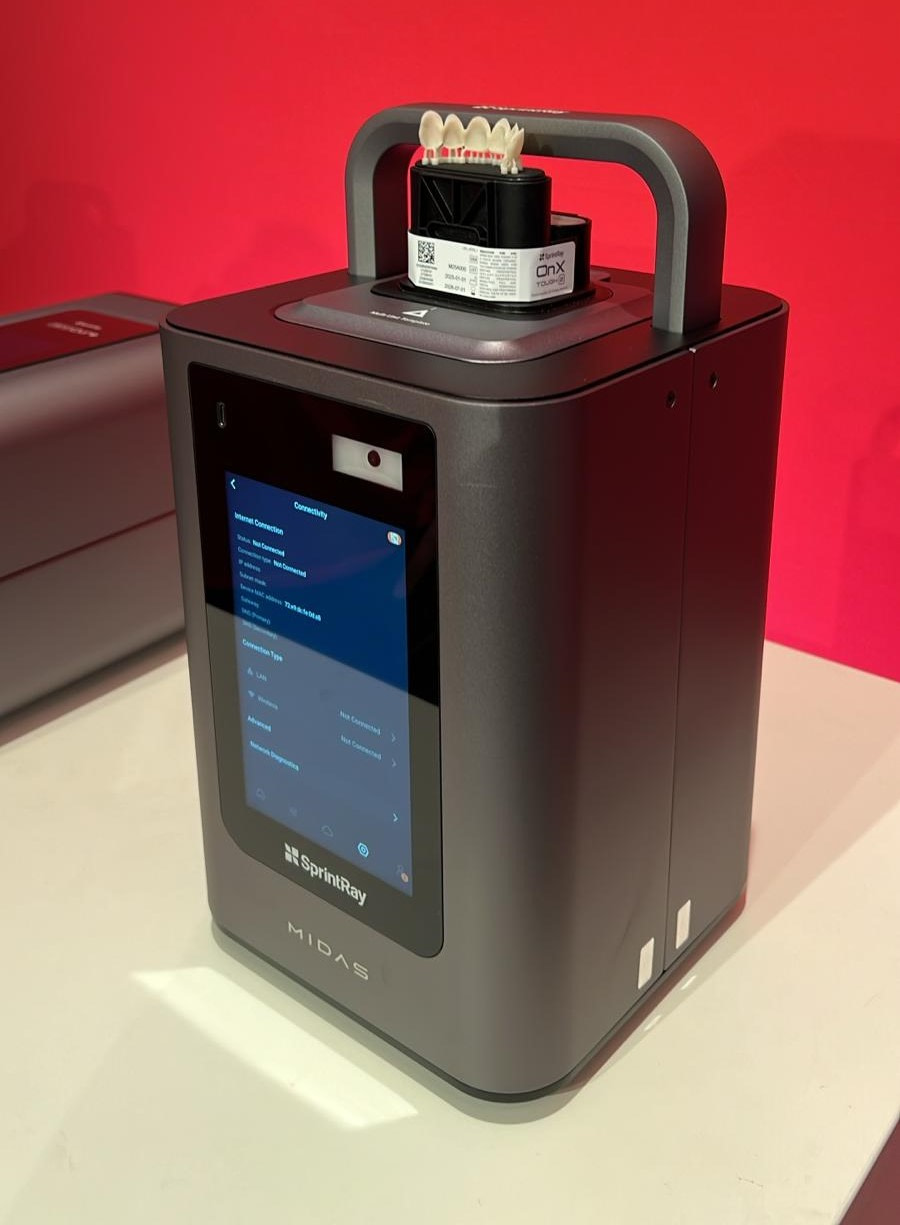
But the current limitation is real. SprintRay's Midas, for example, is essentially limited to restorative work. If you want to print models or splints as well, you are probably looking at buying a second printer. That is a significant consideration for any clinic evaluating the investment.
Asiga has taken a different approach, allowing their existing printers to be retrofitted with pod-style accessories. Pac-Dent is exploring multi-resin pod configurations. The final form of this technology is probably not what we are seeing today, but the direction of travel is clear.
The Broader Picture - Formlabs as a "Sleeper" in Dental
One thing I wanted to make clear is this: I think Formlabs is genuinely underappreciated in the dental 3D printing market.
They do not release new products every three to six months. They do not chase every trend. When multiple build platform systems became a big talking point, Formlabs largely sat it out. Georgio was candid about this, explaining that they try to assess whether a trend adds real value to users or just generates marketing noise.
That measured approach has occasionally left them out of headlines. But the underlying product is excellent. The Form 4B is reliable, easy to use, and now priced competitively with an open material system. The Flex Build Platform, in my view, is one of the most practically useful innovations in the space. It genuinely solves the post-print removal problem in a simple, clinical way.
And for context on the scale of the company: Formlabs serves industries well beyond dental, including automotive, aerospace, and defense. They have invested in an R&D office in Shenzhen to better position themselves around the manufacturing and engineering talent there. This is not a dental startup. This is a large engineering company that also makes excellent dental printers.
The open out-of-the-box shift removes what was, in my view, the single biggest objection most dentists had to buying a Formlabs printer. It will be interesting to see how market share shifts over the next 12 to 24 months as a result.
If you have any questions about Formlabs printers or 3D printing in your practice, leave them in the comments below.
Thanks for reading and supporting our podcast.

I have Formlabs 3B printers. Resins are a bit pricey…used to be able to buy direct from them but now have to go through a third party seller. Kind of a pain in the butt and no discounts.
Nice thing about their system is (right now) don’t have to pay a yearly subscription for software.
Think they would crush the market if they had design software for a reasonable price.
I agree. Formlabs printers are great and we use ours a lot too.
I find a constraint with them is that the dental aspect of their company does not feel like the primary force in the entire organisational decision making.
They are great printers. The company is great to work with. Super easy to use. Software is simple and intuitive.
But for example, still no smaller build tanks, plates etc. It is a fast moving industry and I would love to see more releases from them.