
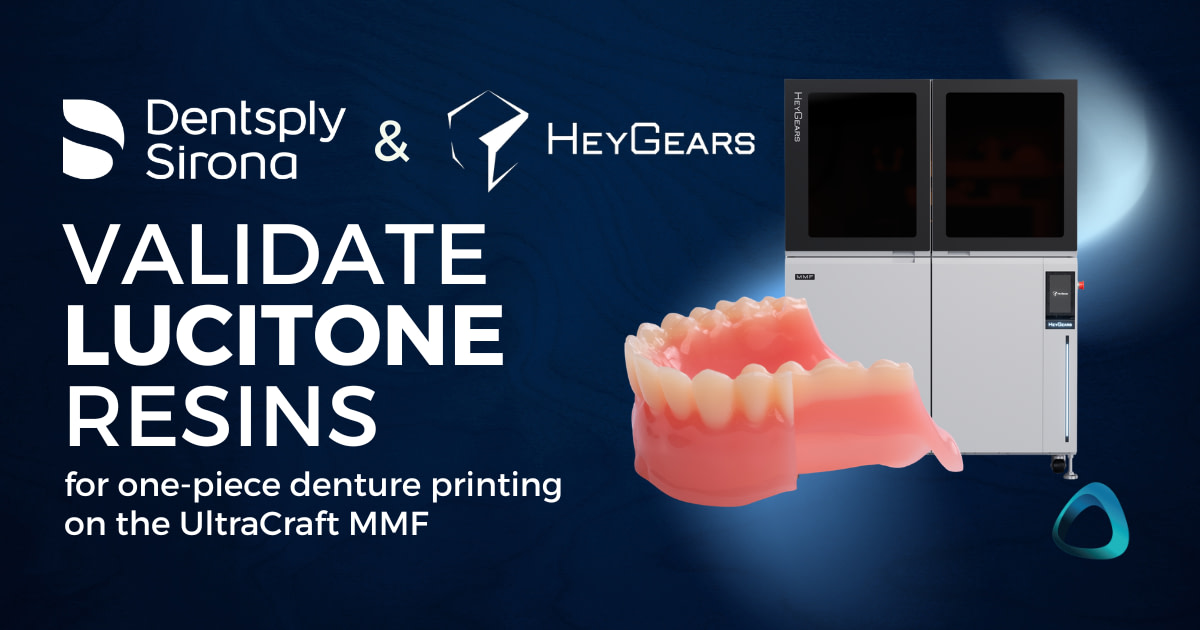

Interesting news last week - Dentsply Sirona and HeyGears have confirmed that the Lucitone Digital Print Denture resins are now validated for one-piece denture production on the new HeyGears UltraCraft Multi-Material Fusion (MMF) DLP 3D printer. The validation extends the partnership between the two companies, which began in late 2024.
The 3D printing advancements don't seem to stop coming this year... The headline is the workflow change, not the materials. The Lucitone resins themselves are unchanged. What is new is that those same resins can now be used to print a complete denture as a single monolithic part, eliminating the manual step of bonding Lucitone Digital IPN denture teeth to a Lucitone Digital Print 3D Denture Base. Also, it is interesting that Dentsply Sirona continues to ‘open up’ its Lucitone resin to an increasing number of printers outside of PrimePrint, Asiga and Carbon.

How this builds on the 2024 validation
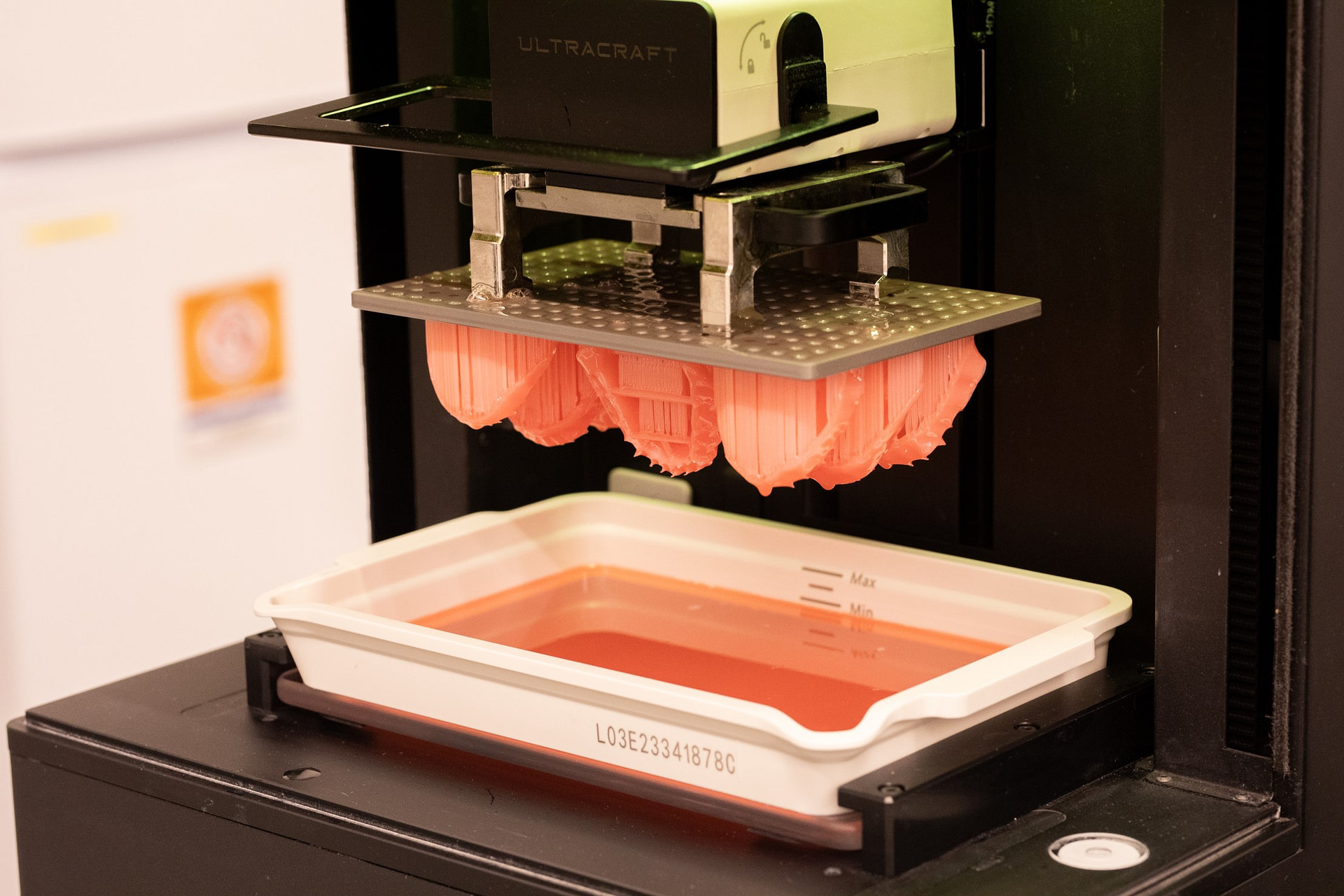
Dentsply Sirona and HeyGears first announced a Lucitone validation in December 2024. That earlier validation covered the HeyGears UltraCraft A2D and UltraCraft A2D 4K printers, as well as the traditional two-piece workflow, in which the base and teeth are printed separately and then bonded together using Lucitone Digital Fuse.
This new June 2026 validation is a separate workflow on a separate printer. Same Lucitone Digital Print 3D Denture Base. Same Lucitone Digital IPN 3D Premium Tooth resin. Different printer (the new UltraCraft MMF), different workflow ("monolithic", no manual bonding).
In practical terms, labs that already trust the Lucitone material system now have a route to producing those same dentures as one-piece appliances, provided they invest in the MMF hardware. For those that have a HeyGears UltraCraft A2D or are considering investing in it, this is a big win, I would say.
What one-piece denture printing actually does
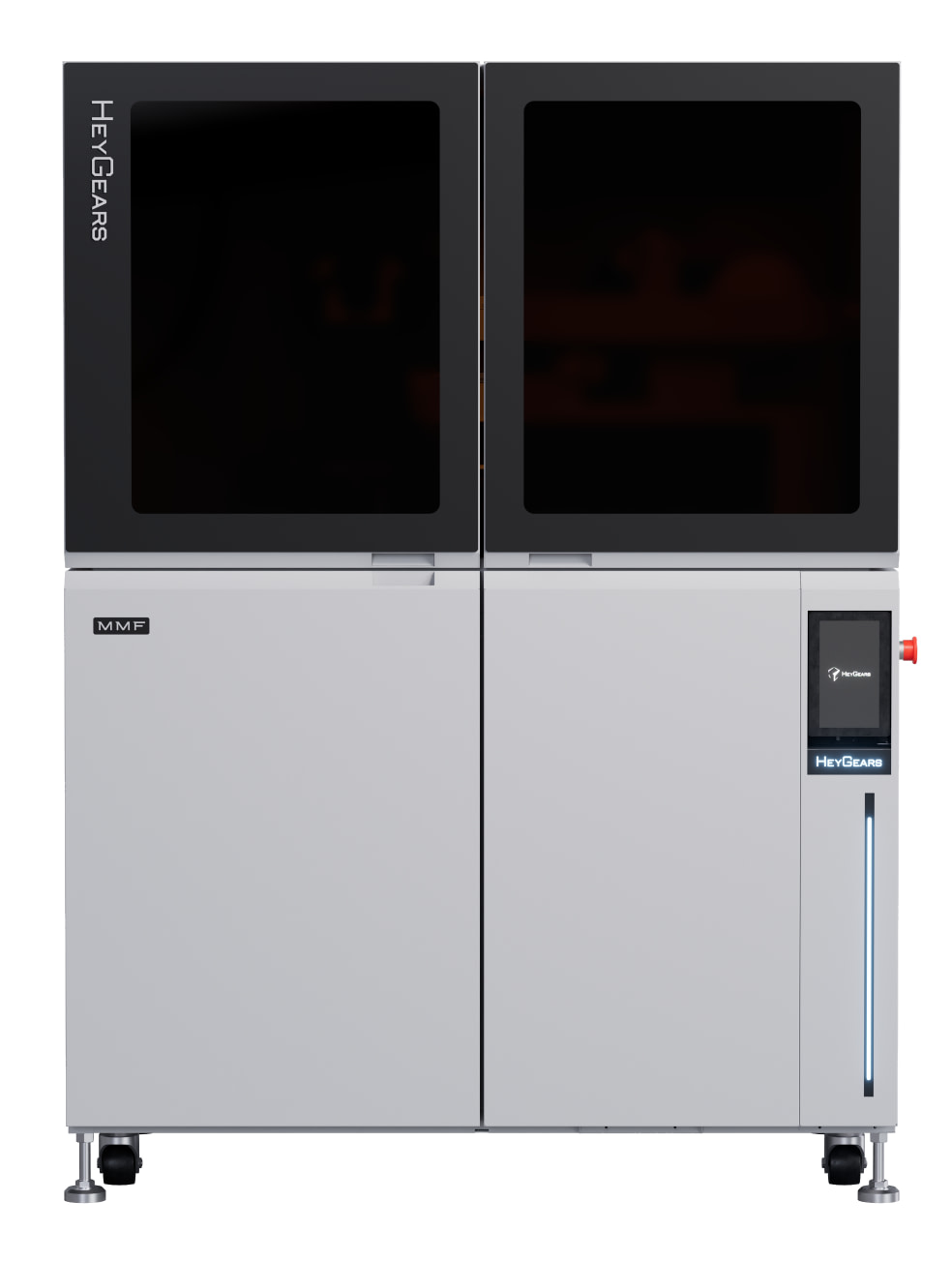
The UltraCraft MMF uses what HeyGears describes as a dual-DLP-engine architecture. Cool concept - two print engines and two resin trays working in parallel inside a single machine. Basically, 2 printers in one.
Base resin and tooth resin are deposited and cured in the same build job, fusing into a single appliance with no joint between the teeth and the gingival base. I saw the sample dentures from this system at LMT Lab Day Chicago 2026 earlier in the year. The machine itself was not physically present at the booth, but the brochures and sample appliances were on display.
The company has shifted from the deposition-based multi-material tech that was their main headline and what HeyGears previewed at Lab Day in 2025 to this dual-engine DLP concept.
For context, HeyGears lists the MMF as a large floor-standing unit at around 480 kg, with 4K resolution, a 42.5-micron pixel size, and a stated accuracy of ±21.3 microns. So this is very much a lab machine.
HeyGears also claims that the seamless interface between the two materials transmits occlusal stress uniformly and reduces sites for bacterial adhesion, since there is no bond line for biofilm to colonize. Those are reasonable claims on first principles, but they are manufacturer statements rather than findings from independent clinical literature, and they should be read as such.
Where Lucitone Digital Print is now validated
The new MMF validation sits within a broader picture worth understanding. As of June 2026, the Lucitone Digital Print Denture System is validated for full denture workflows on the following printer platforms.
- Carbon M-Series (M1 and M2). The original Lucitone partner platform.
- Asiga MAX UV, Asiga PRO 4K, and Asiga Ultra 50.
- HeyGears UltraCraft A2D and UltraCraft A2D 4K. Two-piece workflow, validated December 2024.
- HeyGears UltraCraft MMF. One-piece workflow, validated June 2026.
- Formlabs Form 4B, using Open Material Mode.
A separate group of printers, including Rapid Shape D90+, D50+, and PRO 20, has Dentsply Sirona Print to Finish guides but only for Lucitone Digital Value crown and bridge applications, not for the denture system. Those are deliberately not included above.
This list shows that Lucitone has progressively moved from a Carbon-exclusive material in its early years to a genuinely cross-platform-validated system spanning four printer brands. The MMF is the first validated platform for one-piece monolithic printing of Lucitone dentures. It is also notable that HeyGears, rather than Carbon or Asiga, was the partner Dentsply Sirona chose for that step.
What this changes for the lab workflow
The bonding step in printed dentures has always been one of the annoying parts of digital dentures and is somewhat technique-sensitive. The technician applies Lucitone Digital Fuse, seats the printed teeth into the printed denture base, performs an initial light cure, and then completes a final cure. While this protocol is well-validated and consistently produces clinically acceptable dentures at scale, it increases fabrication time and introduces a manual step in which minor inaccuracies in handling or positioning can affect the final result.
A monolithic workflow removes that step entirely. According to HeyGears, the result is fewer production steps, less labor per arch, and the elimination of any risk of detachment between teeth and base.
Where this fits in the wider denture landscape
One-piece dentures are not a new concept. Milled monolithic dentures, in particular Ivoclar's Ivotion, have offered single-disc base-and-teeth fabrication for several years and have a meaningful clinical track record. What is new with the MMF is that the one-piece concept has moved into 3D printing, and into a material system (Lucitone) that already has lab familiarity (+ massive support) and a validated workflow on multiple other printers.
The trade-off, as always, will come down to economics. Milled Ivotion uses a single PMMA disc containing both base and tooth material, with longer milling times and a meaningfully higher per-arch material cost than printed denture resin. A two-piece printed Lucitone denture is faster to produce and uses a cheaper resin, but it requires a manual bonding step. The MMF promises printing-style economics without the bonding step, but at the cost of a large dedicated floor-standing printer. The break-even calculation for an individual lab will depend on volume, existing equipment, and labor mix.
Regarding price - the MMF is not currently sold as a standard retail product. Instead, it is available predominantly through commercial leasing and rental agreements, with pricing customized for each customer. We'll update this review if retail pricing becomes publicly available, but for now, it is clearly intended for labs and high-production facilities, not clinics.
Closing thoughts
This validation is the logical next step in the partnership between HeyGears and Dentsply Sirona. It moves the MMF from a Lab Day display piece featuring reasonably looking sample dentures into a printer with a major OEM material system formally behind it. Whether it changes the digital denture conversation in 2026 will come down to availability, price, and the first wave of independent clinical experience.
For now, this is a workflow option to watch rather than one to commit to without further evidence. Once we have hands-on time with the MMF and the validated workflow, we will share a proper first-look review.
If you want to go deeper on digital denture workflows in the meantime, our online course library covers the topic from several angles. Dr. August de Oliveira's 3D Printed Dentures - Efficient Workflows for Dentists walks through the printing-focused side, including printer selection, post-processing, and staining and glazing.
For a CAD-focused complement, Akruti Tataria's Transitioning to Full Digital Dentures using 3Shape Dental System covers the design workflow end to end, and the full Digital Dentures collection brings together the clinical and lab perspectives from several iDD educators.
Have you seen the UltraCraft MMF in person, or are you running Lucitone on one of the existing validated platforms? If you have any questions or experience to share, please leave them in the comments below.
Thanks for reading.