

There are product launches, and then there are product launches that make you stop and pay attention.
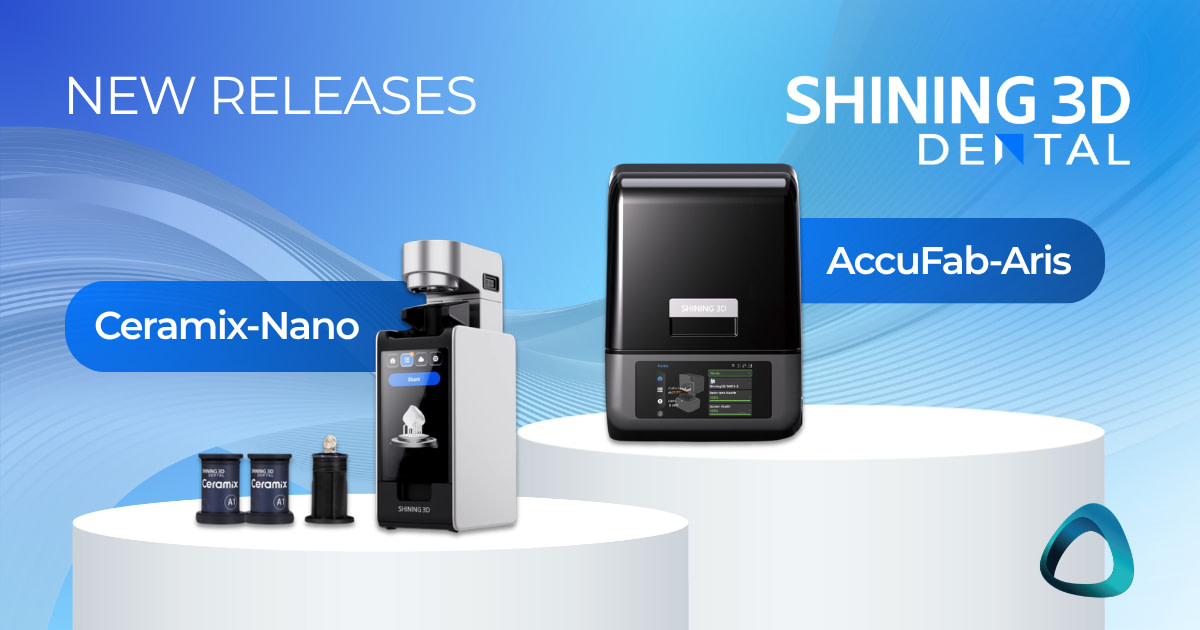
Today, Shining 3D Dental announced two new chairside 3D printers: the Ceramix-Nano Capsule Pod 3D Printer and the aggressively priced all-rounder, the AccuFab-Aris.
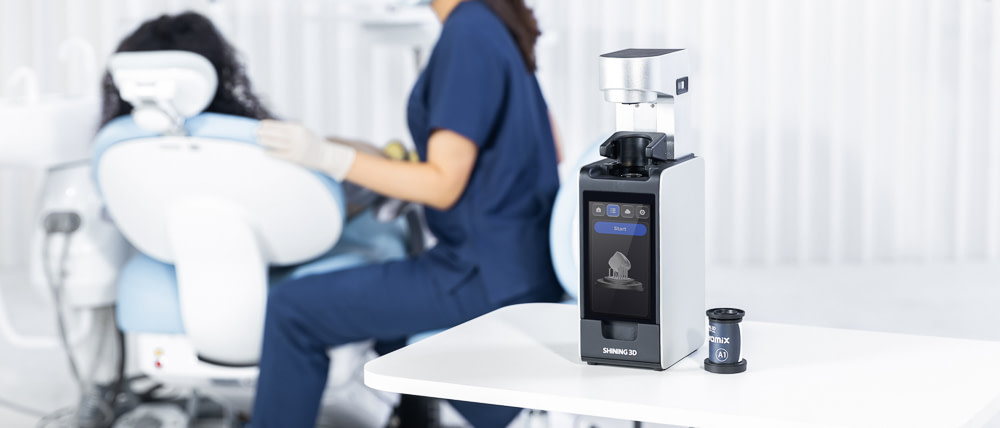
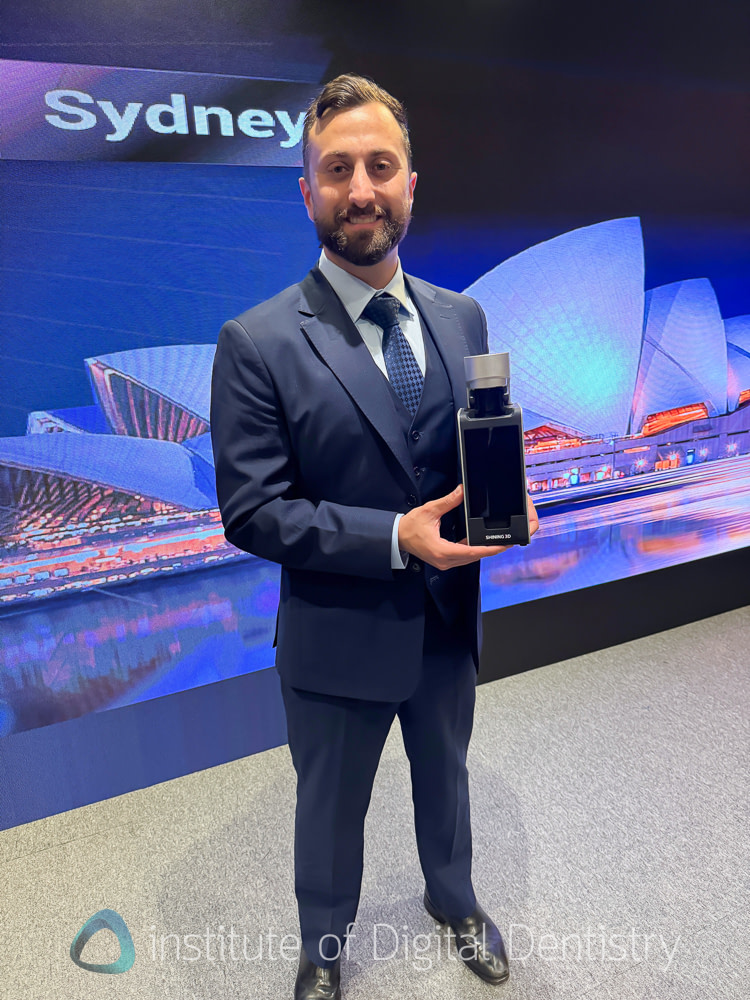
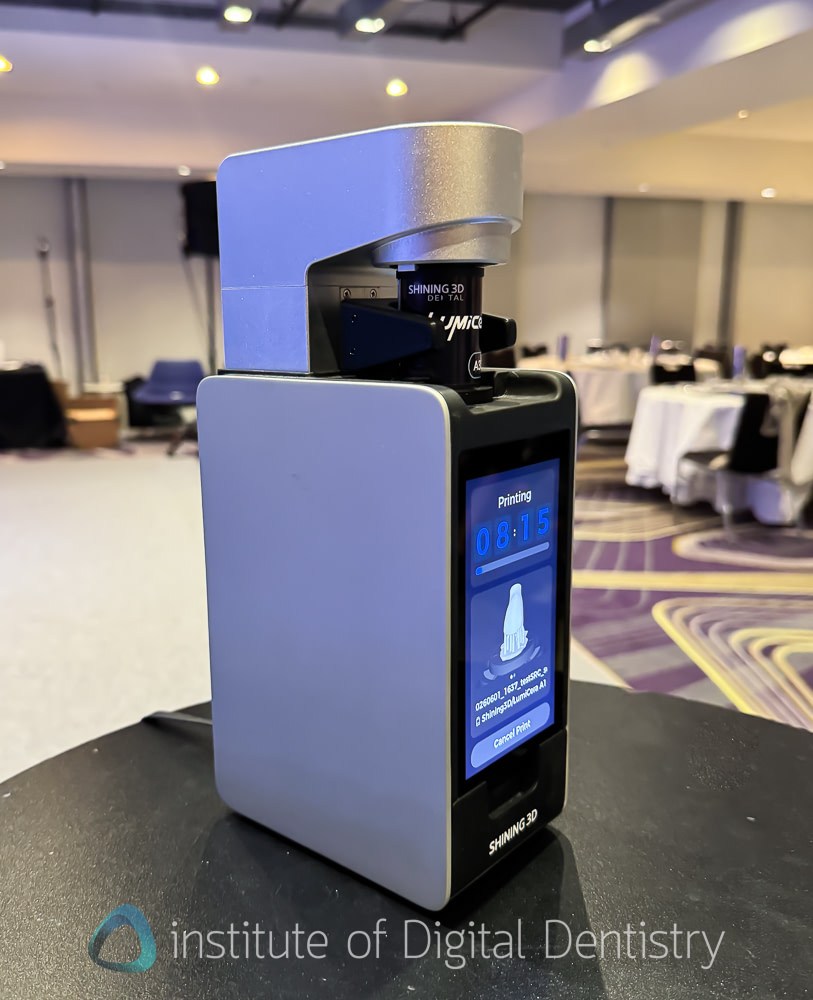
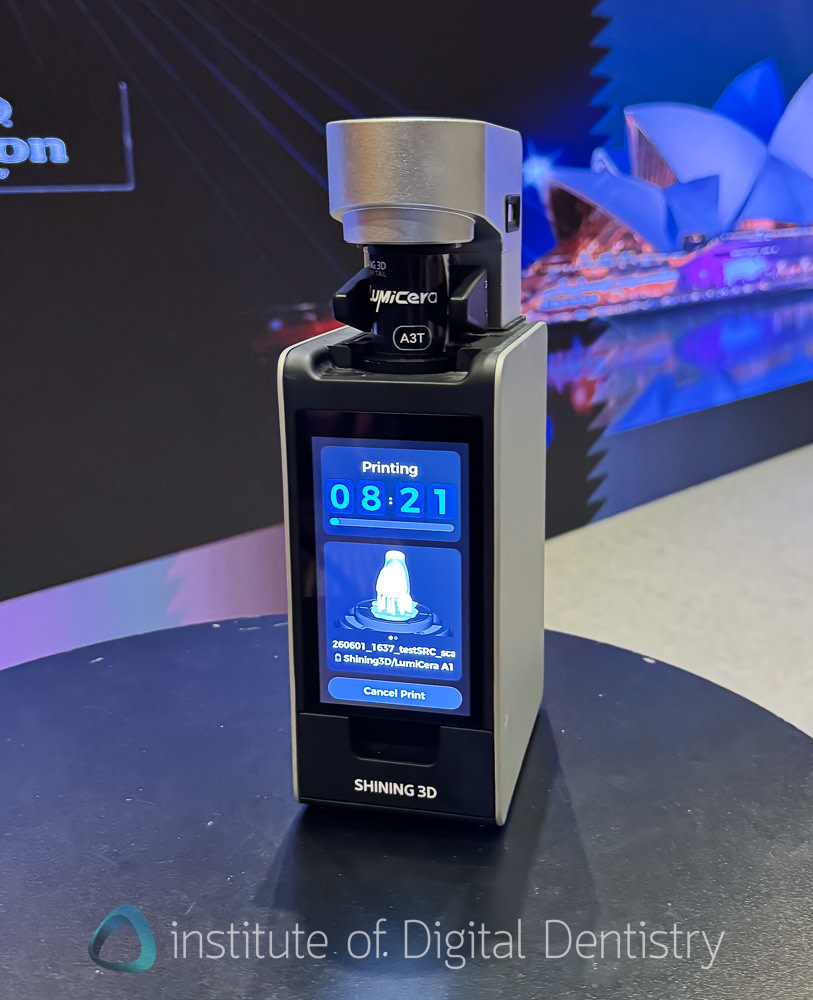
I got my hands on the Ceramix-Nano recently, and I will say this off the bat, the size of this printer is something you have to see to believe. It is tiny. It prints resin crowns and cures them in the same unit. And it can run on a portable power bank if you want it to. Wild.
The dental 3D printing market has been building toward something like this for a while. In true iDD fashion, let's go over everything and all the details you need to know about these new releases.
Ceramix-Nano - The Capsule Dental 3D Printer
The Form Factor
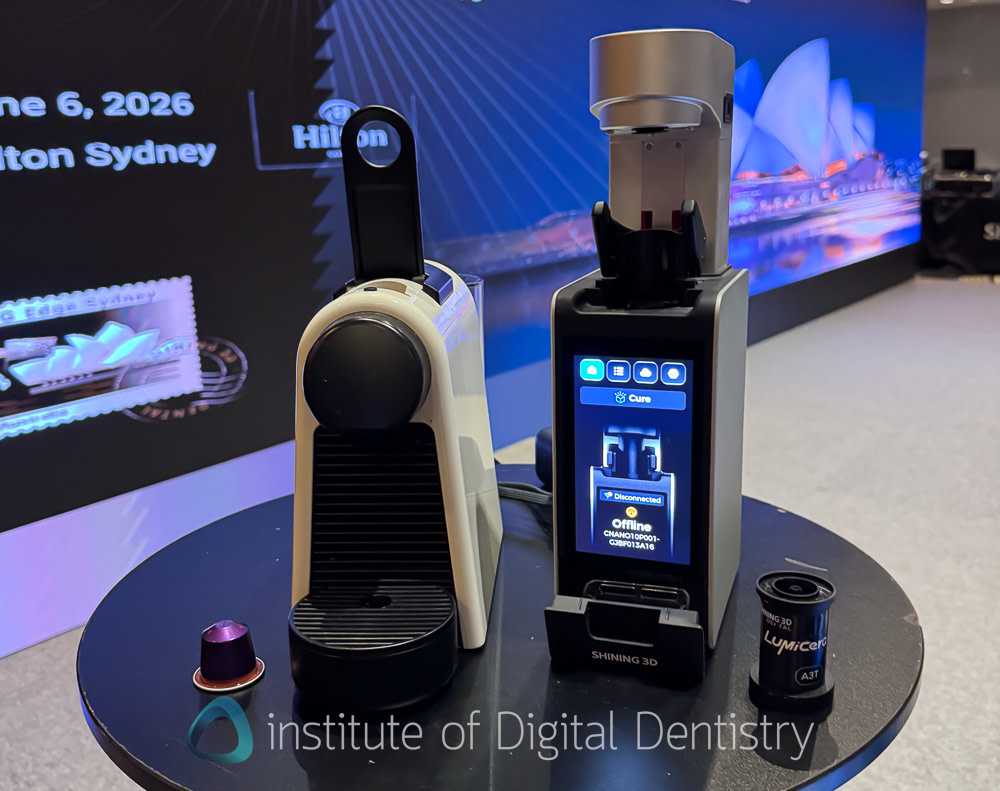
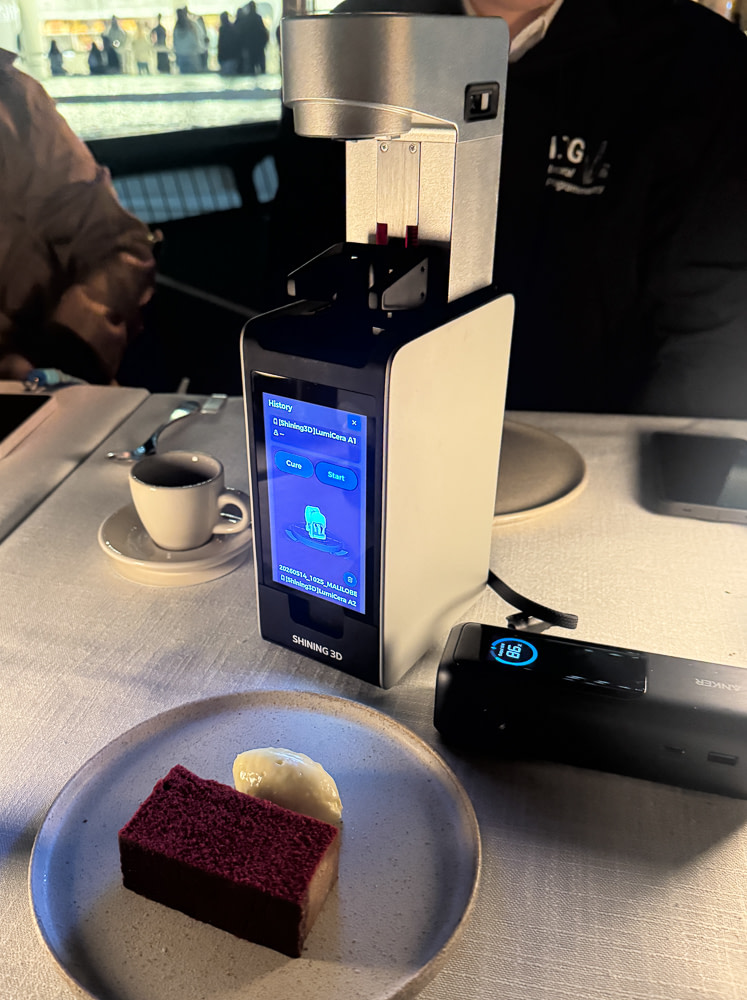
The Ceramix-Nano measures 3.43 x 5.16 x 10.87 inches (8.71 × 13.11 × 27.61 cm) and weighs 4.5 lbs (2 Kg). Shining 3D describes it as smaller than a shoebox. I compared it to a Nespresso machine I had in my hotel room (see below). There is no other dental 3D printer on the market today with a footprint like this.
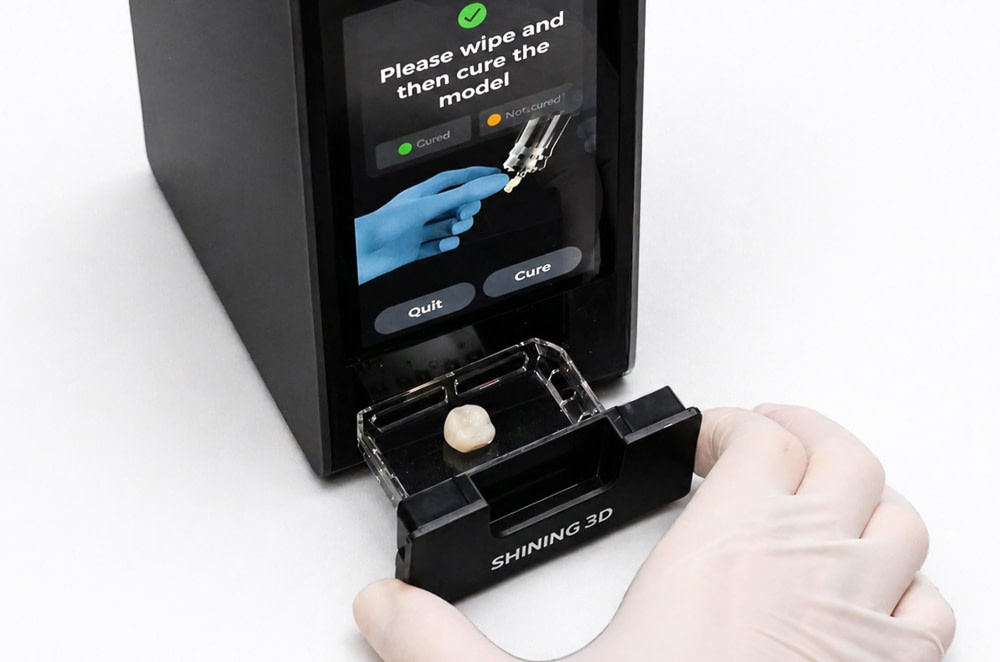
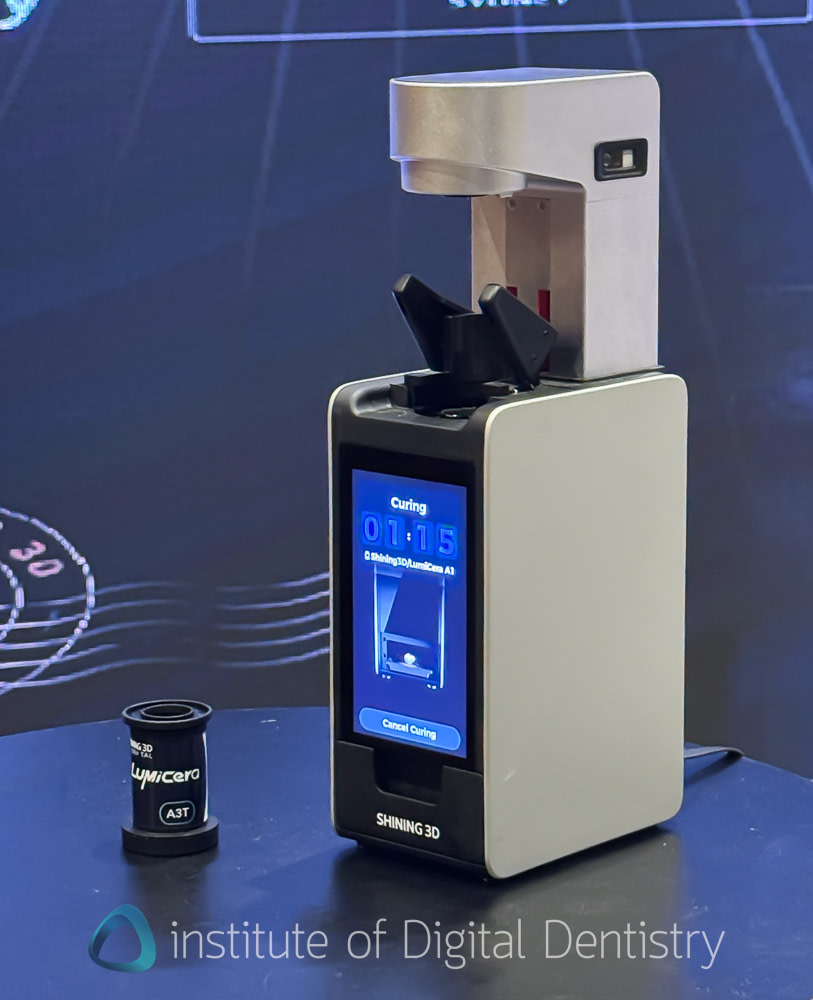
What makes this remarkable is not just the size in isolation. This device integrates both printing and curing within the same footprint. There is no separate post-curing unit to buy. No second device to find counter space for. One machine does both.
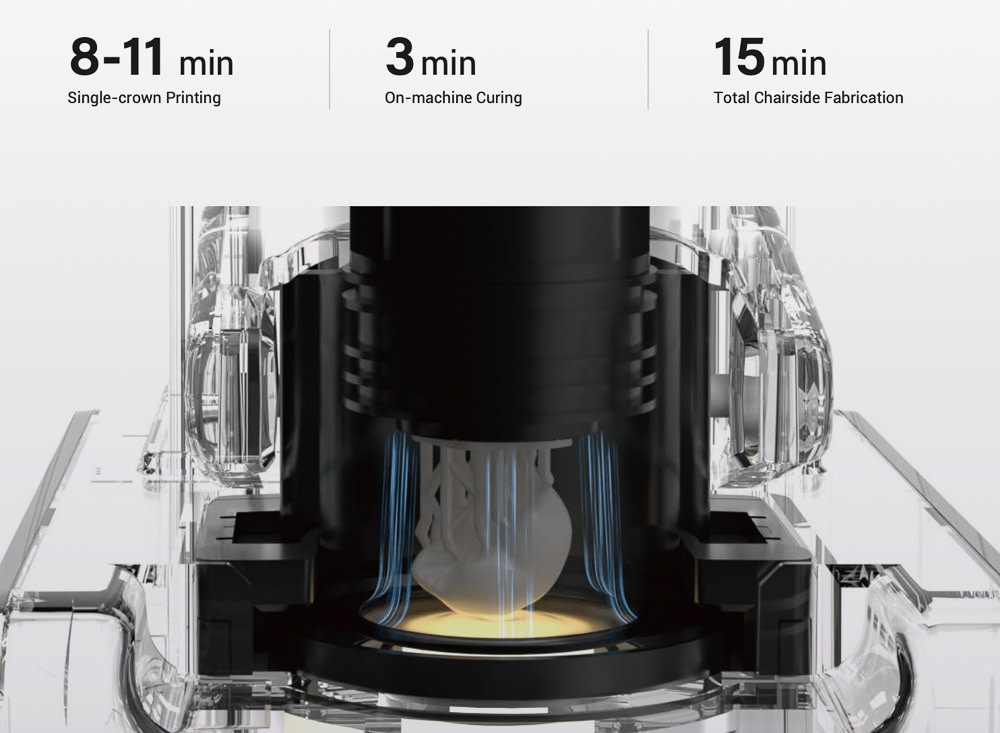
The full scan-to-cementation workflow, including AI design, printing, and curing, completes in as little as 30 minutes. Print time for an anterior crown averages 7-8 minutes. A posterior molar runs 9-11 minutes. Curing takes 3 minutes on-machine. That is 15 minutes of active machine time for a posterior crown.
APS - Adaptive Pneumatic Stereolithography
The technology that makes the compact form factor possible is Shining 3D's patented APS (Adaptive Pneumatic Stereolithography). This is worth understanding, as it differs from what we have seen in other printers like Sprintray Midas.
With conventional dental DLP printers, each printed layer requires the build platform to physically separate from the FEP film at the base of the resin tank. That travel can exceed 10 millimeters per layer. Multiply that across hundreds of layers, and you have a meaningful chunk of print time, as well as a mechanical system that demands physical space inside the machine.
APS handles layer separation differently. Instead of relying on mechanical travel alone, it uses air pressure to gently push the film away from each freshly cured layer, keeping the separation distance under 1 millimeter. The result, the company says, is faster print cycles, a dramatically smaller machine, and more efficient resin usage since only a thin layer of material needs to sit at the base of the capsule at any given time, rather than filling a large open tank.
This is a novel engineering approach to dental 3D printing, and it is the primary reason this machine is the size it is. It is also the system used to mix the capsules automatically before starting a print. Yes you read that right, you dont need to mix or prime the capsules in this machine.
The Capsule System
The Ceramix-Nano uses pre-loaded resin capsules rather than traditional open tanks and pouring resin. As soon as the Midas was released a few years ago, I said I expected capsule printing to be a market trend, and here we are.
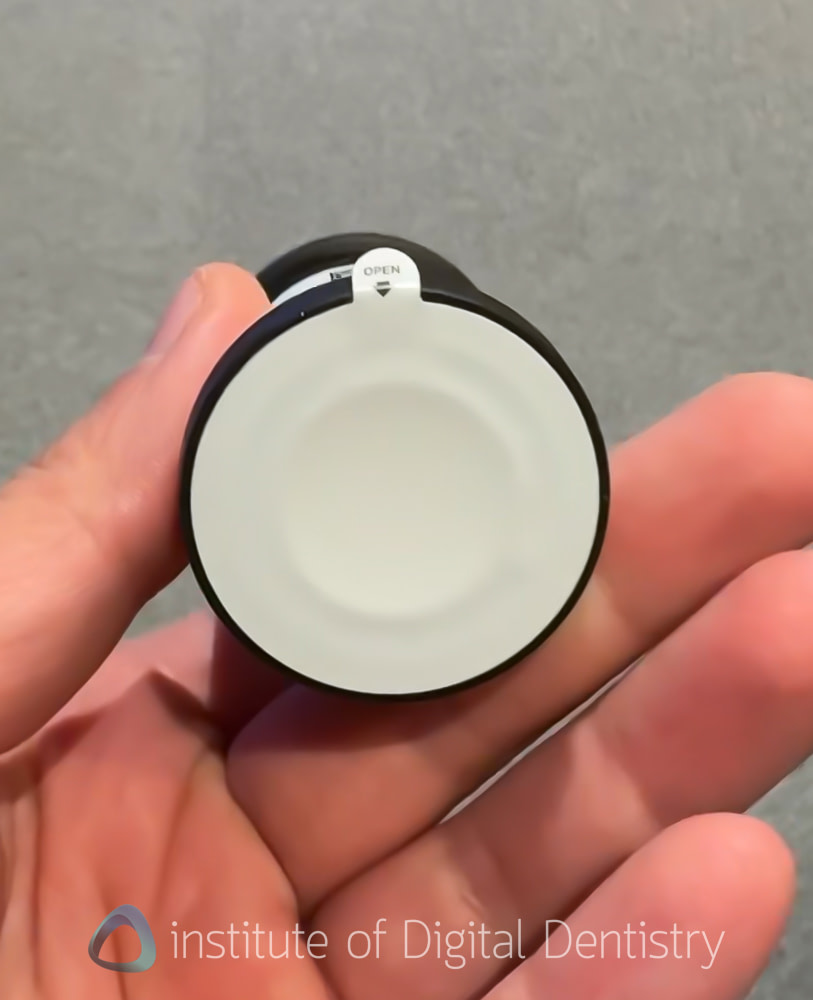
Each capsule contains a pre-measured quantity of ceramic-filled resin. You insert the capsule, scan its QR code, and the machine automatically configures itself, stirs the resin internally, and begins printing. No measuring, no mixing, no preparation steps.
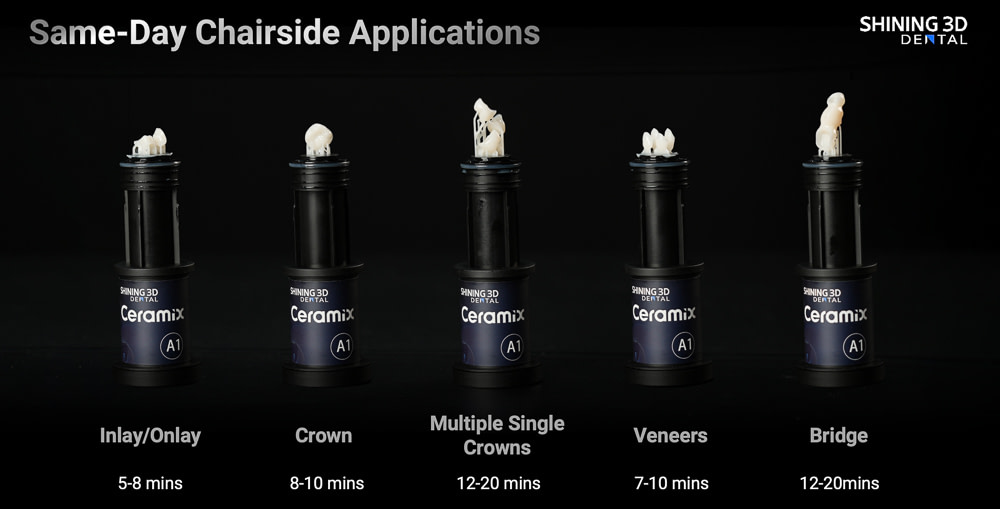
One capsule can print up to three restorations. The build space accommodates bridges up to 1.5 inches, so you are not limited to single-unit work thanks to the vertical dimension. The capsule format also keeps variability low across users, which is significant in a chairside workflow where a dental nurse or assistant may be operating the printer.
These are all the advantages of capsule printers. It is fascinating to see Shining 3D move relatively quickly in this direction in response to SprintRay Midas, and essentially faster than any other company with its own dedicated pod printer. They obviously believe this will be the future of restorative 3D printing.
Integrated Curing Chamber
The curing chamber is built directly into the base of the Ceramix-Nano and is not sold as an add-on. Standard curing runs for 3 minutes at up to 80°C (176°F), using hybrid wavelengths at a light intensity of 200 mW/cm². The curing size is 1.97 x 1.58 x 0.79 inches (5×4×2 cm), which is sufficient for single- to three-unit restorations, as the machine is designed for.
For those wanting oxygen-free curing, there is an optional "Aesthetic Curing Module". This accessory enables nitrogen-based curing by connecting a nitrogen gas tank, eliminating oxygen inhibition at the surface. They are covering all bases. I have to say, it will be kind of ironic to connect a huge nitrogen tank to such a tiny, compact machine.
One additional feature that stands out is that the Ceramix-Nano supports printing directly from a portable power bank. A 10,000mAh unit supports approximately 5 complete print-and-cure cycles. This is the first ceramic dental printer designed to operate completely untethered from a fixed power source, which opens up genuinely interesting clinical possibilities beyond the traditional practice setting.
LumiCera - The Resin
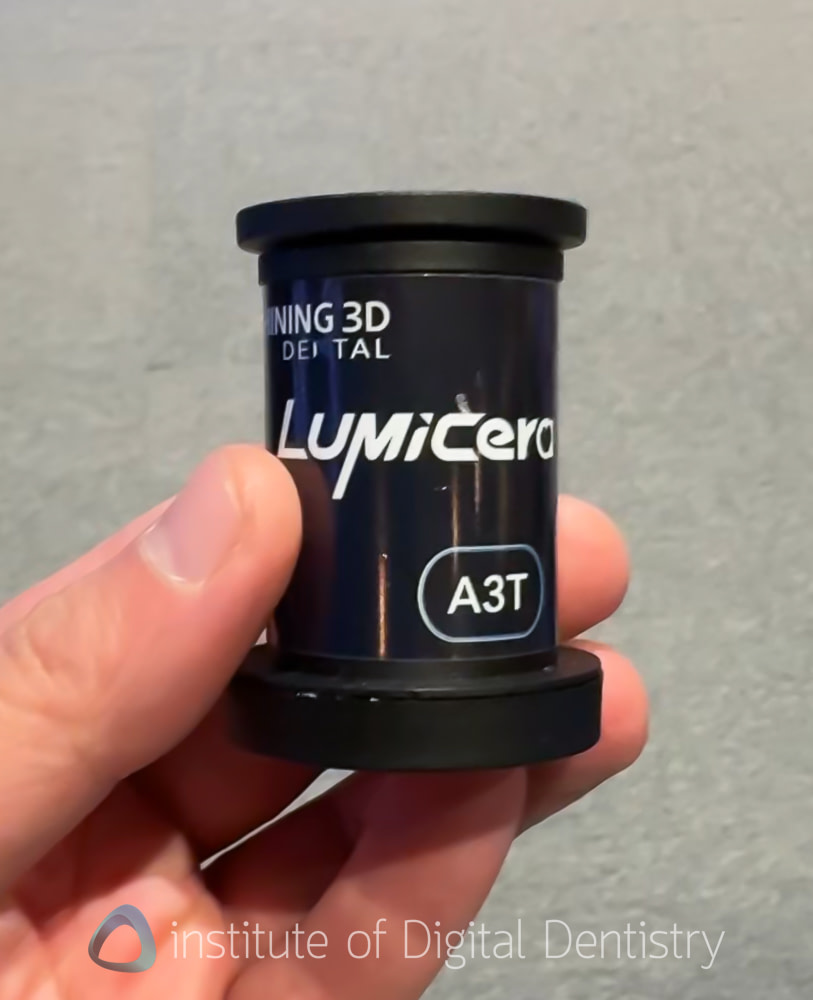
The Ceramix-Nano launches with LumiCera, Shining 3D's own ceramic-filled resin delivered in capsule format.
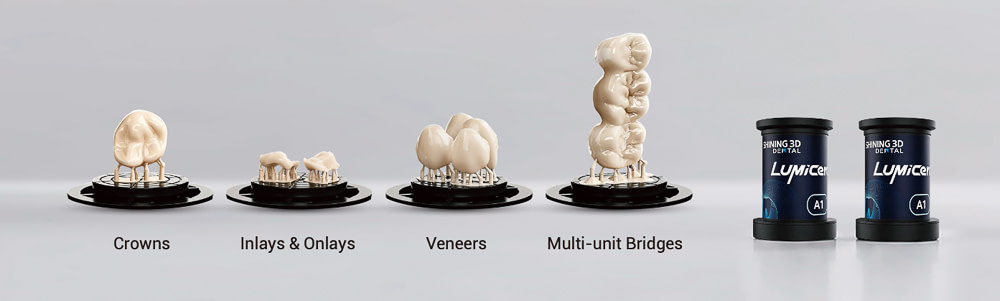
LumiCera has FDA Class II 510(k) clearance for permanent intraoral use, has a flexural strength of 200 mPa, and contains over 55% ceramic filler. It launches in five VITA shades: BL, A1, A2, B1, and C2. The current version is LT (low translucency). MT and HT versions are confirmed to be in development and are expected to follow.
A few things worth understanding about LumiCera. The 55% ceramic filler content is a meaningful figure for wear resistance and mechanical performance and, importantly, for claiming it as a ceramic crown for USA insurance purposes. The company positions this as a genuine permanent restoration material, not an interim or provisional option.
On the translucency limitation: achieving high ceramic loading while maintaining optical translucency is a formulation challenge the broader industry is working through. It comes down to matching the refractive index of the ceramic powders to the surrounding resin matrix. As ceramic filler content increases for mechanical benefit, achieving the right optical match becomes harder. LumiCera, in its current LT form, is best suited to posterior restorations where mechanical performance matters more than optical subtlety. For anterior cases requiring high aesthetics, early adopters should set expectations accordingly and wait for the MT and HT versions.
The Ceramix-Nano also supports SAREMCO CROWNTEC for practices that already have material preferences, which keeps the system from being fully closed on the resin side.
Shining Flow - The Connected Workflow
The Ceramix-Nano does not operate as a standalone device. It is the final step in Shining Flow, Shining 3D's new cloud-based design platform that ties the entire restorative workflow together without requiring you to switch software or manage files between separate systems.
The workflow is four steps: scan, design, print, and deliver. Importantly, it works with any intraoral scanner. You are not locked into Shining 3D hardware on the scanning side, which is the right call for a platform trying to reach a broad clinical audience.
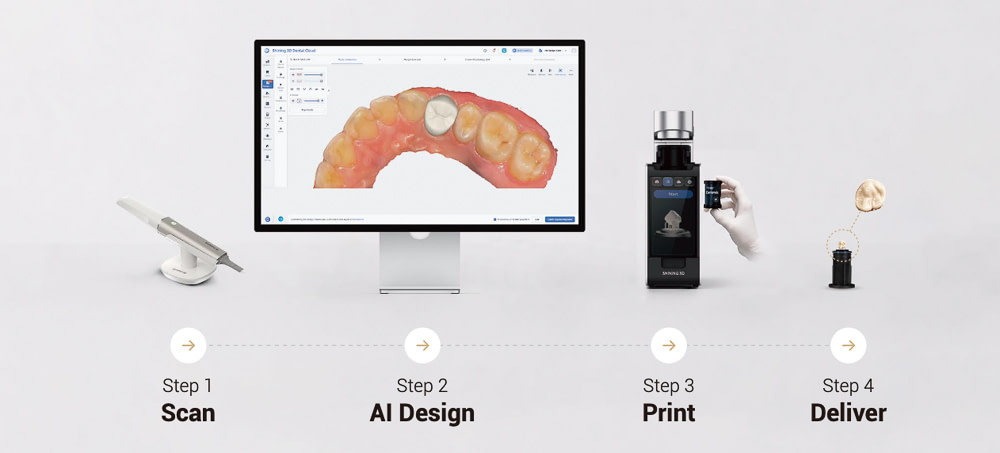
After scanning, you upload to the Shining Flow cloud platform, where a new AI Design tool generates a restoration in under 2 minutes. The AI produces anatomy-driven crown morphology and is configured to keep supports off the occlusal and proximal surfaces, the two areas where surface detail and contact accuracy are most critical. A die model is printed alongside every restoration so you can seat-check the intaglio fit before committing to the cure. From design approval, the cloud takes over: automatic nesting, orientation, and slicing, then one-click transmission directly to the Ceramix-Nano.
The current AI design scope covers single-unit posterior crowns, anterior crowns, and bridges up to 3 units. Inlays and onlays are in active development. For practices already invested in exocad or other design software, third-party workflows are supported, so you are not forced into the AI design path if you prefer to work your own way.
The company has also advised me that they are developing a range of workflows, not just for crown-and-bridge cases. This includes All-on-X, Implants, Orthodontics, and Removable Prosthodontic workflows.
About the credit model, AI design credits are bundled with machine activation and automatically topped up each time you print a capsule. It is likely you will need to purchase credits for AI design in the future.
Everything runs in the cloud, accessible from any device, any time. There is no local software to install and no design work tied to a single workstation.
The Cost of the Ceramix-Nano Printer
So the part you are all curious about... The Ceramix-Nano is priced at around $6,000 USD.
Basically, this makes it more affordable than the SprintRay MIDAS ($10,995 USD) in terms of upfront investment. This is a hugely aggressive play by Shining 3D Dental.
One important consideration is the ongoing consumable costs, in other words, the single-use resin cartridges. For the Ceramix-Nano, the capsules it launches with are around $22 USD per capsule. In this regard, the capsule cost is comparable to that of the SprintRay MIDAS.
This creates an interesting value proposition - a cheaper entry point into chairside 3D POD printing, but without a big reduction in per-restoration material costs.
Technical Specifications of the Ceramix-Nano
- Core Technology: APS (Adaptive Pneumatic Stereolithography)
- Optical Engine: DLP
- Wavelength: 400-410 nm
- XY Resolution: 50 µm
- Cycle Time: 8-11 minutes (average ~8 minutes for anterior crowns)
- Dimensions (W x D x H): 3.43 x 5.16 x 10.87 inches
- Weight: 4.5 lbs
- Leveling: Calibration-free auto-leveling
- Curing Size: 1.97 x 1.58 x 0.79 inches
- Light Intensity: 200 mW/cm²
- Curing Time: Under 3 minutes
- Curing Wavelength: 360-385 nm
- Max Curing Temperature: 176°F (80°C)
- Clinical Applications: Crown, Bridge (up to 3 units), Veneer, Inlay, Onlay
Availability: North America and Asia from June 18th, 2026. EU and other regions to follow shortly. Pricing to be confirmed.
AccuFab-Aris - A Compact Clinical Production Printer
The AccuFab-Aris is the second printer in today's announcement, and it targets a different use case than the Ceramix-Nano.
While the Ceramix-Nano is a dedicated capsule restorative printer that seems built for speed and simplicity at chairside, the AccuFab-Aris is a compact, full-range clinical 3D printer designed for practices that want broader production capability across a wider range of applications. The design philosophy the company mentions is "Just Print It," with one-click operation and intelligent automation as its central features.
To me, this seems like a direct challenge to the RayShape Edge Mini printer that has seen success in emerging markets.
At 257 x 236 x 364 mm and under 10 kg, the footprint is also small for a full-range printer. The company says print times are 19 minutes for a restoration, 25 minutes for a dental model, and 30 minutes for a splint.
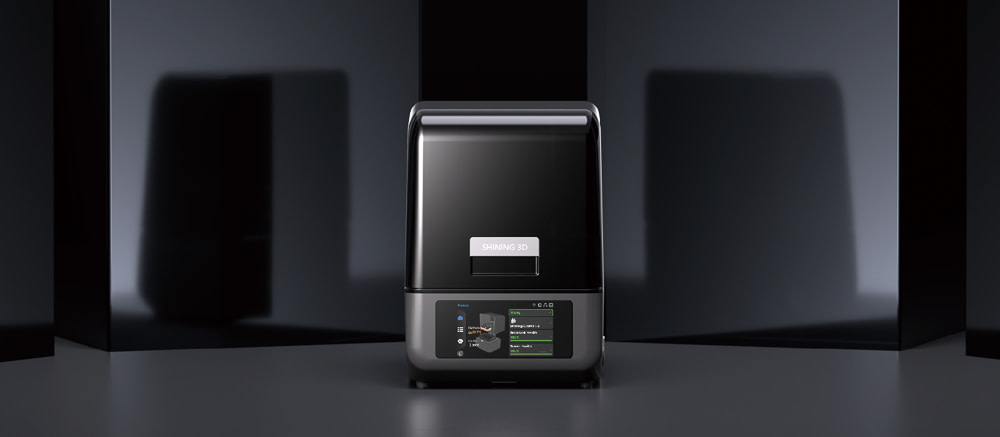
The headline technical specification is a 34 µm pixel size, 4K high resolution, and ±50 µm printing precision. That puts it among the sharper options in its class for clinical detail work, particularly relevant for restorations and implant components where marginal fit matters.
A thermostatic build platform automatically maintains 30°C during printing, reducing the risk of resin warping and detachment. There is one-click auto-leveling and automatic Z-axis calibration handle setup without manual intervention, and smart fail-safe sensors with real-time residue detection and NFC resin tank monitoring keep production stable.
The quick-release screen system allows screen replacement in as little as 10 seconds, which is a practical feature for high-volume practices. The Aris Health Dashboard provides real-time monitoring of resin tank and light panel status to support proactive maintenance.
Connectivity includes USB, Wi-Fi, and Ethernet. The AccuFab-Aris integrates with the Shining Flow platform for cloud-based nesting, orientation, and slicing, covering All-on-X, crown and bridge, dentures, orthodontics, and implant restorations.
One important regional note: the AccuFab-Aris is not available in the North American market. North American practices should focus on the Ceramix-Nano from today's release. The Aris is available in other regions. It seems to be for emerging markets.
Final Thoughts
Chairside restorative printing has had a credibility problem for a long time. The category has been full of promising hardware let down by weak resins, cumbersome workflows, and post-processing steps that make chairside clinical adoption impractical. The Ceramix-Nano is a serious attempt to address those problems simultaneously in a single device.
The size of the unit is unreal. The APS engineering is fascinating. The integrated curing removes a real friction point. The capsule system reduces variability. The power bank compatibility is unexpected and genuinely cool. And the Shining Flow AI design workflow addresses what has historically been the other major barrier: most dentists are not going to learn exocad to do a chairside crown, and an AI-driven design system that generates a restoration in under 2 minutes is exactly what this category needs - IF the AI can do it right and consistently, especially with a wide range of prep qualities out there.
Ultimately, though, the success of this printer will come down to one thing: the resin. That has always been the biggest challenge for chairside restorative printing, and it remains the biggest question mark here. LumiCera launches in LT only, and translucency is a known limitation. The obvious comparison is SprintRay Midas, which has had a significant head start in this category and has spent years developing and refining its restorative materials ecosystem. They currently lead in restorative 3D printing with resins like Crown HT. And then we have the Asiga with the PrintPods, too, trying to make some waves.
How quickly Shining 3D can bring MT and HT versions to market, and more importantly, how much confidence clinicians have in the long-term performance of those materials, will determine how widely this system is adopted. There is still an ongoing debate about whether 3D-printed resin crowns represent a truly acceptable permanent restorative solution. The industry remains divided.
That said, Shining 3D has a recent track record of moving quickly and disrupting established categories. The pace of development from this company over the past few years has been genuinely impressive, and the team tells me they already have additional resin developments in the pipeline. Whether they can execute on that vision remains to be seen, but if they can deliver the materials, the Ceramix-Nano has the potential to become a very serious player in the chairside restorative market.
It will be fascinating to watch how the market responds.
What are your thoughts or questions? Leave them in the comments below.
Very useful information, thank you very much
My pleasure.
Thank you, Ahmad, for once again posting such a comprehensive and fascinating article about the brand-new Ceramix-Nano and the AccuFab-Aris. Your contribution to digital dentistry truly deserves a medal!
The Ceramix-Nano will undoubtedly become a formidable competitor to the Midas. As dentists, we can only welcome this development—the future of chairside, same-day dentistry looks very promising indeed!
Thank you. I appreciate the kind words!
Dentistry just keeps getting better and better.
Salve vorrei avere informazioni in italiano grazie
Hey there. Use a translator on the site is the best option.
Print and cure in the same machine for ceramix nano – is there a wash portion?