
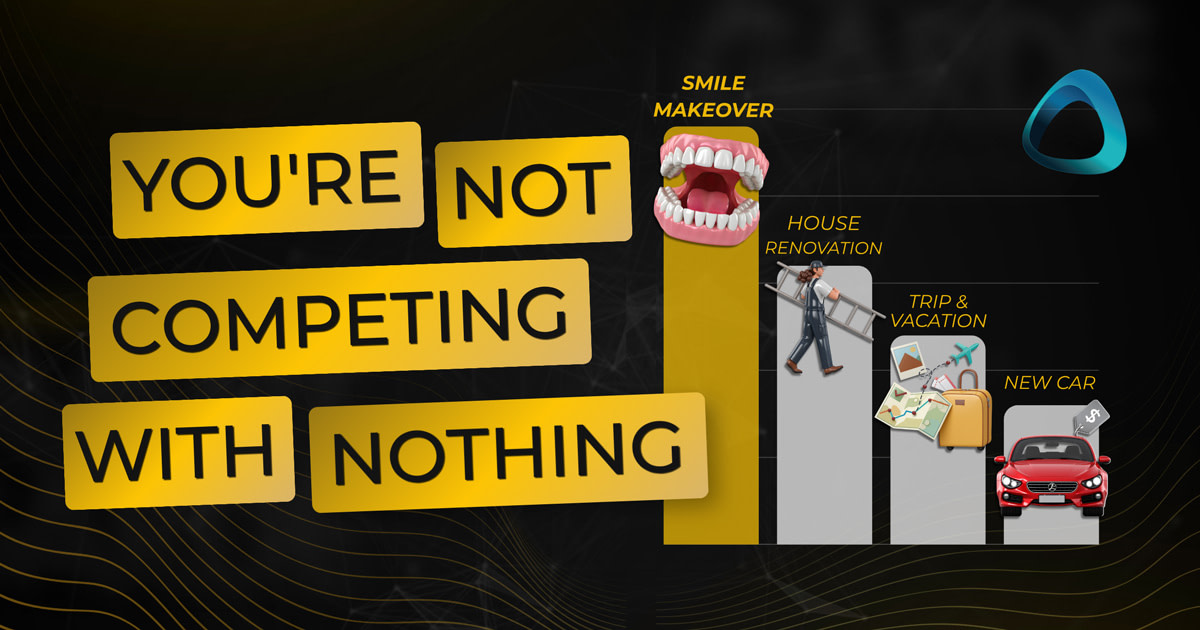

A patient does not decide to go ahead with treatment by weighing your diagnosis against doing nothing. They decide by weighing how they feel about you, about the outcome, and about themselves in that outcome, against everything else competing for the same money and the same nerve.
That is emotional dentistry, and it is the subject of Chapter 8 inside our Aesthetic Smile Design Excellence course, taught by Dr Milad Shadrooh. Milad has spent his career working out why two patients with the same diagnosis make opposite decisions, and what changes when you stop treating the mouth in isolation and start treating the whole experience around it.
This post walks through what he teaches, and what it looks like in a real appointment.
Dentistry starts at the bottom of the list, and that is not about money
Milad makes a point in the chapter that reframes the whole case acceptance conversation. Your smile makeover is not competing against "doing nothing." It is competing against a new car, a house renovation, a holiday, a child's university costs, even plastic surgery elsewhere.
Dentistry usually loses that competition, not because it costs more, but because of what it is associated with. Pain, discomfort, injections, noise, expense. Meanwhile, the holiday is associated with joy, memories, and instant gratification.
Milad's conclusion is simple. Your job is to move dentistry into the second pile. Make it feel like joy, like a goal achieved, like keeping up with your peers, not like a procedure you endure.
Before anyone can feel excited about a smile, you have to clear the fear that is sitting underneath it. Milad names four things patients commonly hate, and none of them are the price.
The sound of the drill. The injection and the needle. Gagging. And the fear of the unknown, which is really a fear of losing control while lying back with their mouth open.
Each has a fix that costs nothing and changes everything. Warn the patient before a sound comes rather than letting it surprise them. Use topical before an injection, warm the anesthetic, and inject slowly. For gagging, Milad is blunt about the scanner's role, since almost every patient who used to gag on alginate does not gag on a scan. And for the fear of the unknown, tell the patient they are in control, and mean it. If they raise a hand to stop, stop.
None of this is about being gentle for its own sake. It is about clearing the emotional static so the patient can actually hear what you are offering them.
Get the most out of your Intraoral Scanner
You already own the scanner.
Now you want the full workflow, the guided system that turns it into predictable, name-on-it smile cases.
Show, don't tell - the scanner as an education and treatment acceptance tool
Milad's own words on this are worth quoting directly, because they reset how most of us were trained to think about the scanner. "This scanner isn't an impression replacing tool, it's an education tool. It's a treatment acceptance tool... It's a record-keeping tool. It's a, you know, in the future defense tool."
That reframe is not theoretical. Milad has a documented case where a patient said no to a full-mouth rehabilitation plan worth around 14,000 pounds. Six months later, his associate scanned the same patient again, showed him the comparison on screen, and he said yes, with nothing else in his life having changed.
The scan did what the conversation alone could not, it let the patient see what Milad could see.
The same protocol shows up in the numbers. Milad's SEP protocol, short for Scan Every Patient, was written up in a white paper with iTero. It documents his associate, Dr Ploy Intawong, recording a 35 percent increase in her own monthly earnings over seven months of scanning every patient, moving her from well behind two comparable associates to ahead of both of them. You can read the full study, with the methodology and every figure, in the iTero Scan Every Patient white paper.
It is not just Milad's practice. Our faculty member Emily Roscoe, who teaches the injection molding chapters later in the course, tracked her own case acceptance rate climbing from 47 percent to 95 percent as she rebuilt her consultations around showing patients rather than telling them. Two educators, two very different techniques, the same underlying mechanism.
If you want to see exactly how the scanner workflow fits into the wider course, the Complete Course Guide lists every chapter and lesson, free, no email required.
Rapport is not small talk, it is the first yes
Before any of this works, the patient has to trust you, and trust is built subconsciously before it is built consciously. Milad teaches this through mirroring and matching, the practice of quietly reflecting a patient's posture, pace, gestures, and tone.
People feel safest around people who feel similar to them. Done with subtlety, mirroring and matching build that sense of similarity fast. Done badly, or noticed, it reads as mimicry and breaks the exact trust you were trying to build.
Rapport is not a soft skill you layer on top of clinical competence. Milad is direct about the order of operations, without it there is no trust, and without trust there is no case.
Ask the why before you explain the how
Once rapport exists, Milad moves to what he calls the why, borrowing the Golden Circle framework. The why is the patient's real motivation. The how is your process. The what is the result. Most of us lead with the how, launching straight into the treatment plan before we understand what the patient actually wants.
He teaches a short set of questions to surface the why instead. How long have you been thinking about this. What made you decide to finally do something about it now. If you had a magic wand, what would this look like. What would it mean to you to finally have this taken care of.
Then you listen, summarize it back to them, and close with something like, "I'm super excited to start this journey with you and to be able to help you achieve all of these things." That single sentence turns a consultation into a partnership before any treatment has been discussed.
The mock-up is where they say yes to themselves, not to you
Everything up to this point has been preparation for what Milad calls the crucial, defining stage, the mock-up.
His method is specific. Film the patient before, saying a short scripted line. Place the mock-up, then film them again saying the same line, same background, same setup. Play both clips side by side on a screen, not a handheld mirror, so the patient sees the transformation the way an outside observer would.
That sequencing matters. A mirror invites the patient to hunt for flaws up close. A screen lets them see the whole picture first, the same way everyone else in their life will see it. Only after that first reaction does Milad bring the mirror out for fine-tuning.
By the time the mock-up comes off, the patient has already said yes, not to your sales pitch, but to their own reflection.
Where this goes next
Fear management, rapport, the why behind the treatment, and the mock-up that makes the outcome real, that is the shape of Chapter 8. It is one chapter inside a course built specifically to take the guesswork out of aesthetic case acceptance, across all 8 modules and 193 lessons with the full Avant Garde faculty.
If you want to see exactly what that covers, the Complete Course Guide lists every chapter and lesson, free, no email required. And the course itself, including Milad's full Emotional Dentistry chapter, is here: Aesthetic Smile Design Excellence.
Patients are not rejecting your dentistry. Most of the time, they just have not been shown it yet.
Dr Robbie Hughes is the founder of Avant Garde Dentistry and creator of the Same Day Smile system, and leads the faculty behind Aesthetic Smile Design Excellence.