Shining 3D Just Announced a Chairside Printer the Size of an Espresso Machine
Shining 3D Dental has been on an impressive streak.
First, the Aoralscan Elite disrupted photogrammetry. Then the Elf came out and turned heads with its value. Now the company has announced something that could genuinely shake up chairside restorative dentistry - the Ceramix Nano, a DLP resin printer so compact it can fit in your backpack.
I sat down with Da Chen, the R&D Manager of the 3D Printing Division at Shining 3D, to discuss this announcement in detail on the Digital Dentistry Decoded podcast.
Da Chen has been with the company since 2019 and has been at the center of their 3D printing development. Here's what came out of that conversation. Listen below or read the summary.
The Size Is the Story
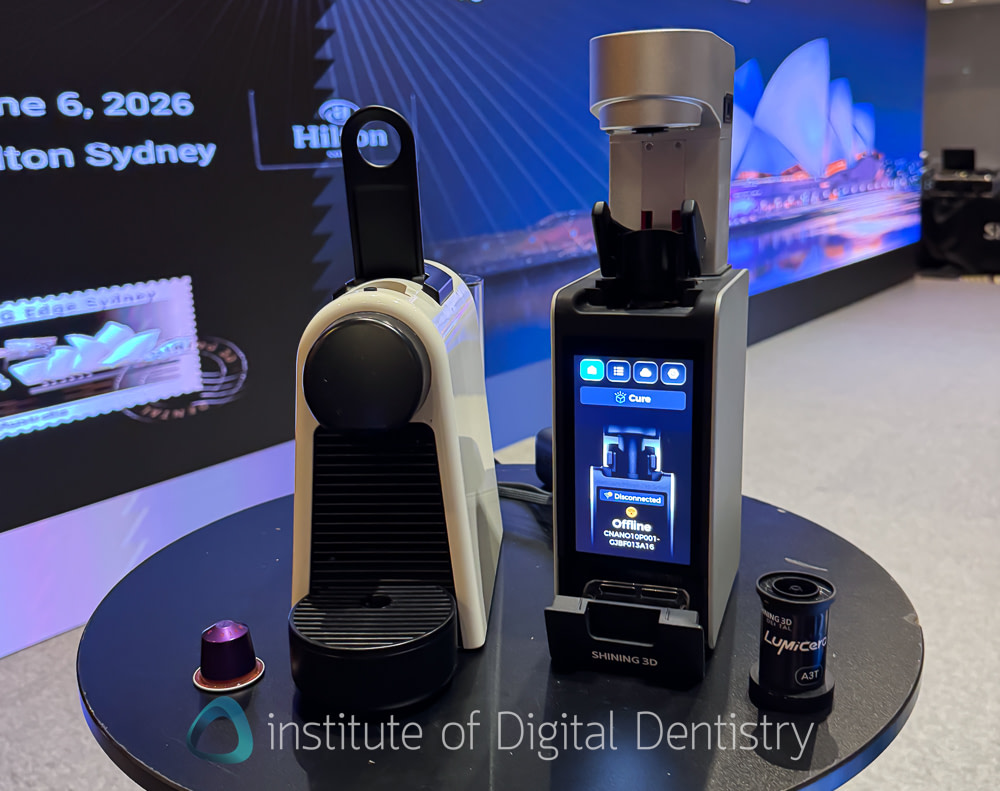
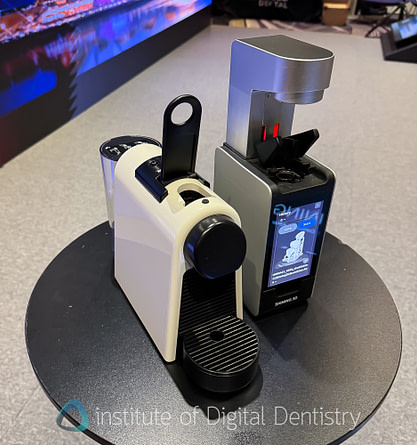
The most obvious thing about the Ceramix Nano is its form factor. We're not talking "compact for a dental printer." We're talking genuinely small. Smaller than an espresso machine that I had in my hotel room.
Da Chen explained that the design philosophy came directly from their intraoral scanner division. Rather than starting from existing dental printer dimensions and trying to shrink them, the R&D team asked a different question entirely: why not build a DLP projector the size of an intraoral scanner tip?
"My supervisor asked me, 'We've been developing intraoral scanners for decades. Why don't you use projectors of a similar size?"
That reframe is what led to the Ceramix Nano. It's a DLP printer, not a smaller version of an existing design. It's a fundamentally different engineering approach.
It is seriously impressive how small it is. I got to test it out at the Shining Edge event, where I recently lectured, and was very surprised by this release.
Pneumatic Printing - What That Actually Means
Inside the Nano, Shining 3D uses a pneumatic layer-separation system. This is worth understanding because it's what makes the compact form factor possible and also drives speed.
With traditional dental printers, each printed layer has to physically separate from the film at the bottom of the resin tank. That separation travel can be 10 millimeters or more per layer, and that adds up fast. The Ceramix Nano maintains that separation distance under 1 millimeter by using air pressure, rather than mechanical movement, to gently push the film away from each freshly cured layer.
The result is faster print times, a smaller machine footprint, and more efficient use of material. Because you're not running a fully filled resin tank, you only need a thin layer of material at the base of the capsule at any given moment.
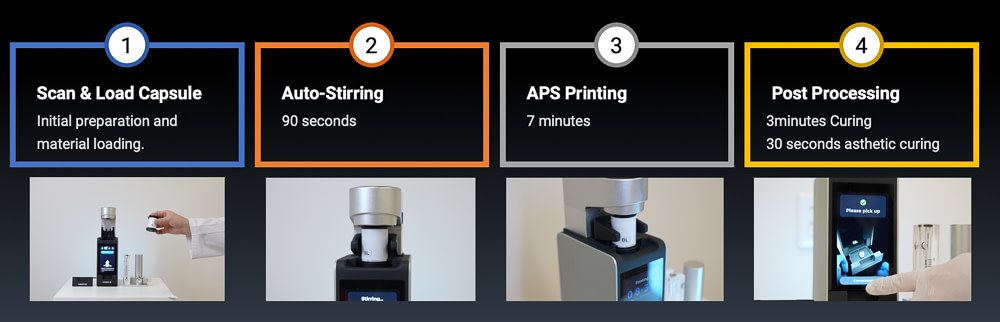
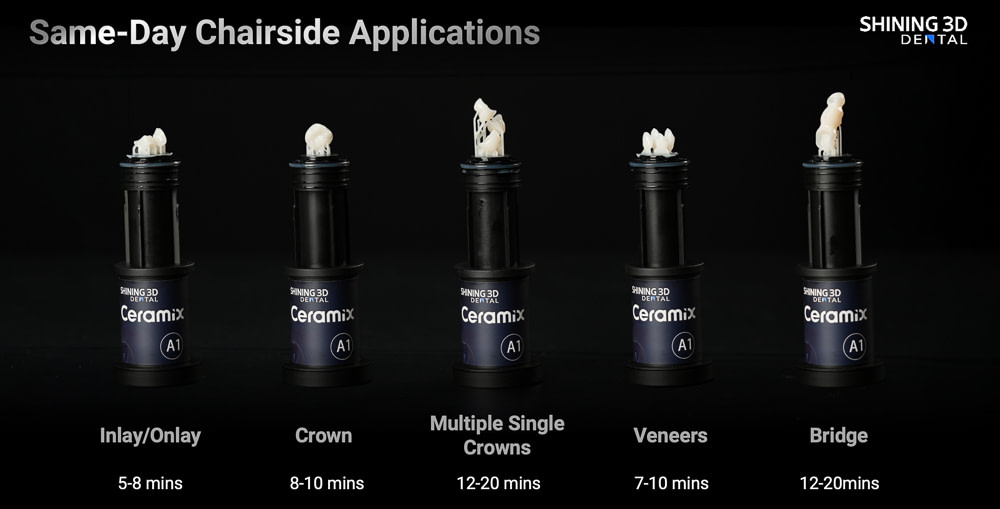
For an anterior crown, Da Chen quoted print times of 7-8 minutes. For a posterior molar, 9 to 11 minutes. In practical terms, Da Chen described a scenario where members of their cross-functional team sat down for a meeting with a Nano on the table, started printing mid-conversation, and the crown was done before they'd gotten far into the discussion.
This pneumatic system also mixes the resin before the printer starts the print job. All done automatically.

Know what’s next in dentistry. Before everyone else.
The innovations, clinical insights, and digital trends that matter - curated by iDD and delivered straight to your inbox every week.
The Pod System and What It Solves
The Nano uses a capsule-based pod system rather than open resin tanks. This is becoming a market trend.
Each capsule contains preloaded material, so you don't need to prepare it before inserting it. No mixing, no measuring, no mess.
Da Chen was direct about why this matters: the goal was to remove as many user-side variables as possible before a single layer gets printed.
The capsule is also what enables the integrated curing chamber. Rather than needing a separate curing unit on your bench, the Nano cures at its base. You print, remove the crown, clean it, and then cure it in the same unit. Standard curing takes three minutes, with the chamber heating to 80 degrees Celsius using a combination of hybrid wavelengths. There is also an "aesthetics curing cycle" in that mode that takes 15 seconds for candy coating or when using light cure staining and glazing etc.
For those wanting nitrogen curing, there's an accessory - a small transparent box into which you can connect a nitrogen tank and flood the cure chamber with inert gas.
In terms of workflow timing: print a molar (9-11 minutes), clean it (a few minutes), and cure it (3 minutes). Da Chen confirmed that within roughly 15 to 20 minutes, you have a finished posterior resin crown.
There is a real story behind this claim, by the way. De Chane shared that one of their beta testers in Japan received the wrong crown from his lab on the day of a patient appointment. With roughly 20 minutes before he'd have to turn the patient away, he used the Shining system to design and print a replacement crown with the Ceramix Nano. The patient was treated, and the problem was solved.
The Resin Situation - An Honest Assessment
Here's where I want to be transparent about what Da Chen said, because he was notably honest about it himself.
The launch resin is called LumiCera. It's a ceramic-loaded material with over 50% ceramic filler content and has FDA registration. It currently comes in five shades and is available only in LT (low translucency), with MT and HT versions in development.
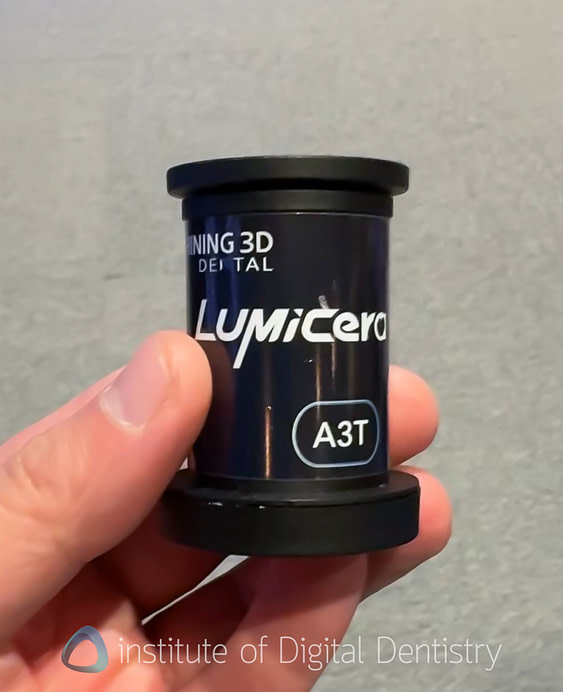
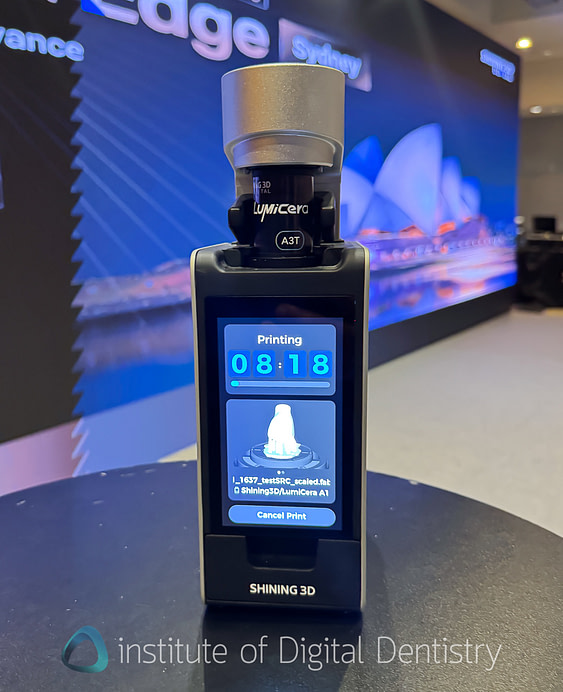
The limitation is translucency, and Da Chen didn't dodge it. When I asked directly about this, he explained the materials science problem clearly: as you increase ceramic loading for better wear resistance, the mismatch between the refractive index of the ceramic powder particles and that of the resin matrix makes the material opaque. Getting that translucency right is a supply chain and formulation problem. Shining 3D is actively sourcing better ceramic powders and working on a solution, but it's not there yet.
I gave him credit for saying so directly. It's not common for someone from a company to acknowledge known limitations this candidly in a public conversation. So for those who want to be early adopters: the resin is wear-resistant, has real ceramic content, and is FDA-registered. But the aesthetics are not yet at the level of SprintRay's Crown HT or similar established restorative resins. Be realistic going in.
Post-processing is another honest challenge. High-ceramic-loading resins become chalky if not cleaned properly. The intaglio surface, in particular, needs thorough washing to ensure an accurate fit. Shining 3D's current answer is a combination of better user instructions, a mobile app with step-by-step cleaning guidance, and ongoing work on both the material formula and cleaning accessories. It's a work in progress.
Shining Flow - The Bigger Picture
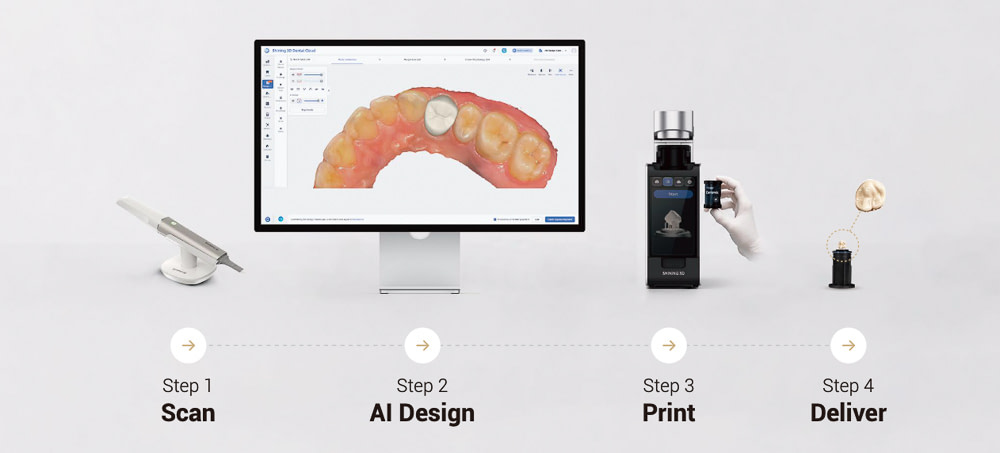
The Ceramix Nano isn't just a printer announcement. It's part of what Shining 3D is calling Shining Flow - an end-to-end restorative workflow from scanning to AI design to printing.
That workflow looks like this. Scan with the Elite / Elf or any compatible scanner (the system is open, meaning you're not locked into Shining 3D hardware). Upload to their cloud platform. An AI design system generates the restoration, currently covering posterior crowns, anterior crowns, bridges up to 3 units, and inlay/onlay work in development. You review the design via an app, send it to the printer, and print it.
The AI design credit system is worth noting. When you activate the Nano and connect it to your account, you start with design credits. Importantly, Da Chen explained that each time you print with a capsule, you earn additional credits. In practice, your credits should never run dry during normal use.
The AI design system is also genuinely focused on getting the details right - support orientation that avoids the occlusal surface, adjustable proximal contact tightness based on clinician preference, and die model printing alongside the crown so you can verify intaglio fit before curing. It's not a "generate and hope" workflow. There's verification built in.
Da Chen also mentioned that the team is working toward jaw motion tracking as a future integration, which would extend the Shining Flow concept into occlusal analysis and more complex restorative applications.
Open System, Third-Party Compatibility
One thing worth being clear on - the Ceramix Nano works with any scanner, and you can design with third-party software like exocad if you prefer. You're not required to use Shining's AI design system or their scanners.
That said, the AI-assisted design route is where Shining 3D is making a significant investment, and if you're already in their ecosystem with an Aoralscan Elf or Elite, the integrated workflow will be more seamless.
Where This Fits in the Market
This is not a replacement for zirconia or e.max. Da Chen said so explicitly, and I think that framing is important.
What the Ceramix Nano is positioning itself as is an answer to a specific clinical gap - the cases where a dentist would otherwise do a direct composite restoration, but wants something more controlled and predictable. Inlays and onlays for posterior teeth, where speed and accuracy matter. Cases where the patient is already in the chair, and traditional lab-based dentistry isn't an option.
The comparison Da Chen kept returning to wasn't zirconia or ceramic. It is a composite. And if you frame it that way, the value proposition gets clearer: a 15-to-20-minute, chairside, ceramic-loaded restoration with AI-assisted design is a significant step up from freehand composite, especially for a clinician who doesn't want to spend 35 minutes on preparation and buildup.
The market timing is also interesting. Two or three years ago, resin printing for posterior crowns was widely dismissed. That's changed. Clinicians and labs are increasingly open to high-ceramic-loaded resins as a restorative option. Shining 3D has entered at a more receptive moment than this technology would have received even recently.
What to Watch For
There are a few things I'll be following closely as the Ceramix Nano comes to market.
The resin development is the key variable. The hardware engineering here is genuinely impressive. The pneumatic system, the integrated curing, and the compact form factor all reflect serious R&D thinking.
But this product's real-world success will ultimately depend on what LumiCera HT and MT look like when they arrive, and whether Shining 3D can close the gap on translucency.
The AI design system is the other piece. I have been saying for some time now that AI CAD is the unlock for chairside 3D printing. When a dentist doesn't need to know exocad to produce an accurate crown, the barrier to adoption drops significantly. Shining 3D clearly sees this, too. The question is execution.
Pricing was not confirmed in this conversation (Da Chen is R&D, not marketing), but Shining 3D has historically been aggressive on price. I'll update with pricing details as they become available.
Know what’s next in dentistry. Before everyone else.
The innovations, clinical insights, and digital trends that matter - curated by iDD and delivered straight to your inbox every week.
Final Thoughts
Shining 3D has done something that requires real engineering courage - they have looked at the pod printer market and tried to improve it. They didn't just make a smaller version of an existing 3D printer. They rethought the machine from first principles using what they learned building intraoral scanners.
Is the Ceramix Nano currently a complete chairside restorative solution? Not yet. The resin is the honest limitation, and the post-processing workflow needs refinement in terms of washing, especially. But the hardware is remarkable, the integrated design workflow is compelling, and the company has a track record of improving quickly.
Fascinating. That is all I can say. Our industry is moving so fast.
If you want to hear the full conversation with Da Chen, the episode is live now on the Digital Dentistry Decoded podcast.
If you have any questions, please leave them below.