
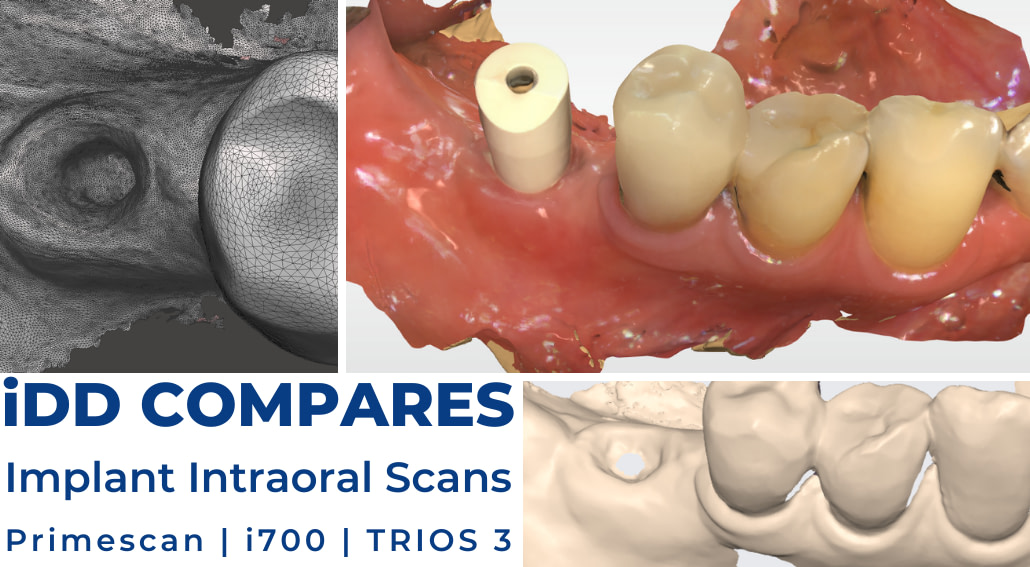

We compare how three different intraoral scanners performed when scanning the same implant patient, specifically a scan body and the soft tissue around the implant. In this article, we’re comparing scans taken with CEREC Primescan (Dentsply Sirona), i700 (Medit) and TRIOS 3 (3Shape).
After posting similar comparisons to our social media in the past, the iDD team was asked to show how various IOS capture a scan body and the soft tissue around the implant. I scanned this patient with three different intraoral scanners, these being:
- CEREC Primescan (Dentsply Sirona)
We have previously published detailed reviews on each of these intraoral scanners. If you haven't already, check them out by clicking the links above.
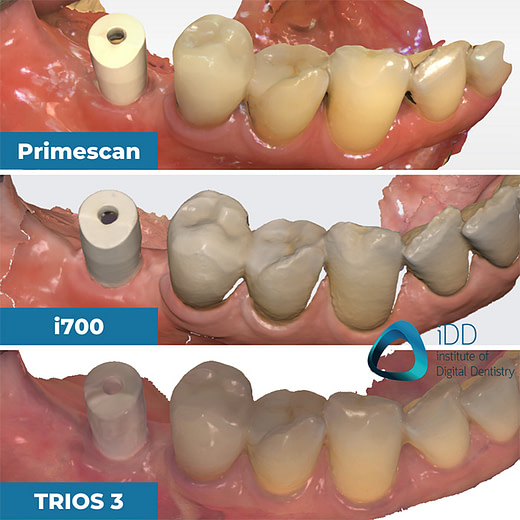
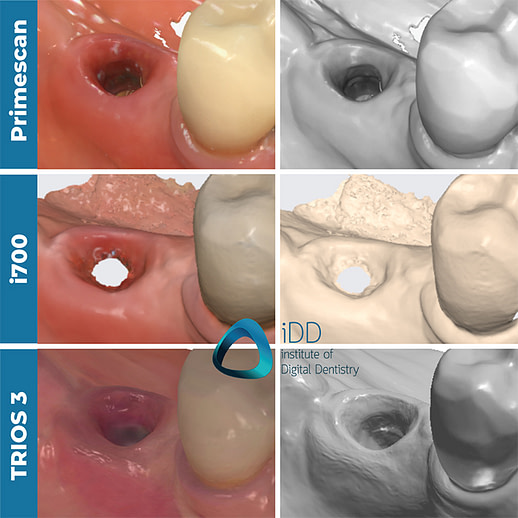
All scans were captured and exported in the highest, uncompressed definition, including the Medit i700, which was set up to scan in HD mode. In this series of pictures below, you will see multiple screenshots with a focus on the scan body and soft tissue, both in color and monochrome as previewed in their native software.
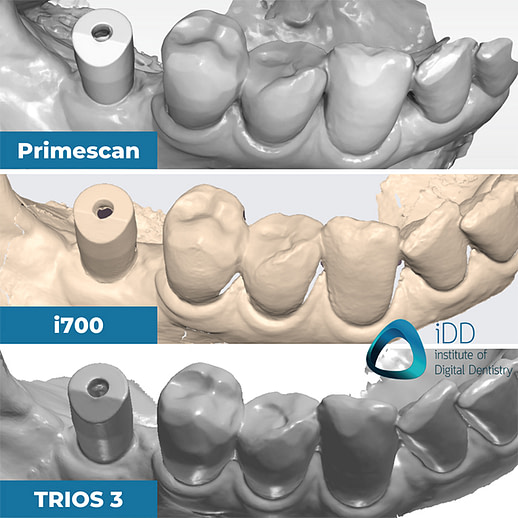
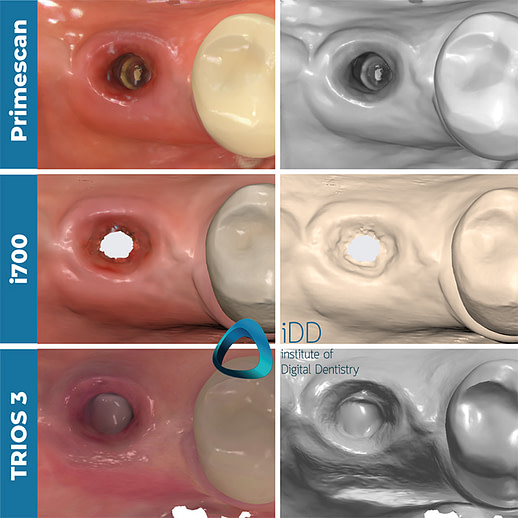
Below you can also see the exported STL files in a third-party software (Meshmixer by Autodesk), with and without the tessellated mesh.
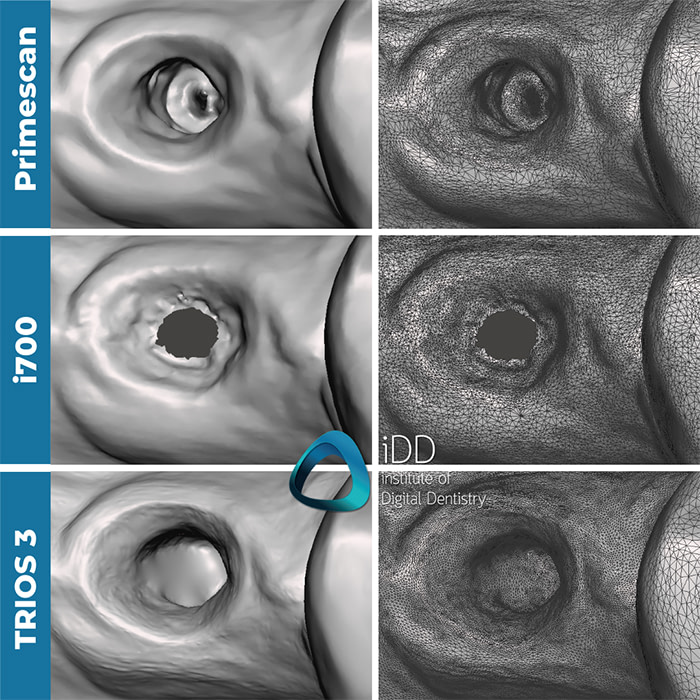
Scans imported into a third-party software (Meshmixer by Autodesk).
All scans were exported in their uncompressed, high-definition state.
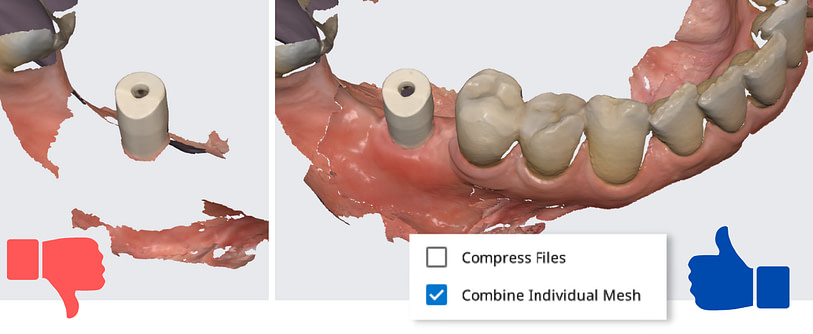
An additional tip for those using Medit intraoral scanners - when exporting your implant scans you may notice that the Medit scan body scan looks patchy and incomplete. This is a workflow issue as there's a specific way to export such files from the Medit Link software. This is done by simply checking the "Combine Individual Mesh" option in the Export window before exporting the files. You can read the full step-by-step tutorial here.
Here at the Institute of Digital Dentistry we are fortunate to have access to over 15 intraoral scanners. We objectively test and review these scanners to help other dental professionals to form their own opinion. We hope posts like this helps answer some questions you may have and helps you make an informed purchase.
With that being said, if there is anything else you would like us to post, leave a comment below. Which IOS or type of cases would you like to see next?
so, what`s the conclusion about these three intraoral scanners? which is the best?
Thanks for the question. The conclusion is as you see. They all have different algorithms and software that render the data differently.
What’s ‘best’ is subjective. They all are accurate enough in our experience to use for the fabrication of prosthetics.
Hii! Very interesting to see your comparison and knowledge shared. Thank you for that. I would like to know if with the TRIOS 3 you also tried cutting and using the "Zoom tool", that is in the scanning page. It helps a lot with details in some cases.
Hi Ligia!
Yes, we did zoom up and tried to be as fair as possible to each scanner.
Thanks for the comment and kind words.
Hi Ligia!
Yes, we did zoom up and tried to be as fair as possible to each scanner.
Thanks for the comment and kind words.