
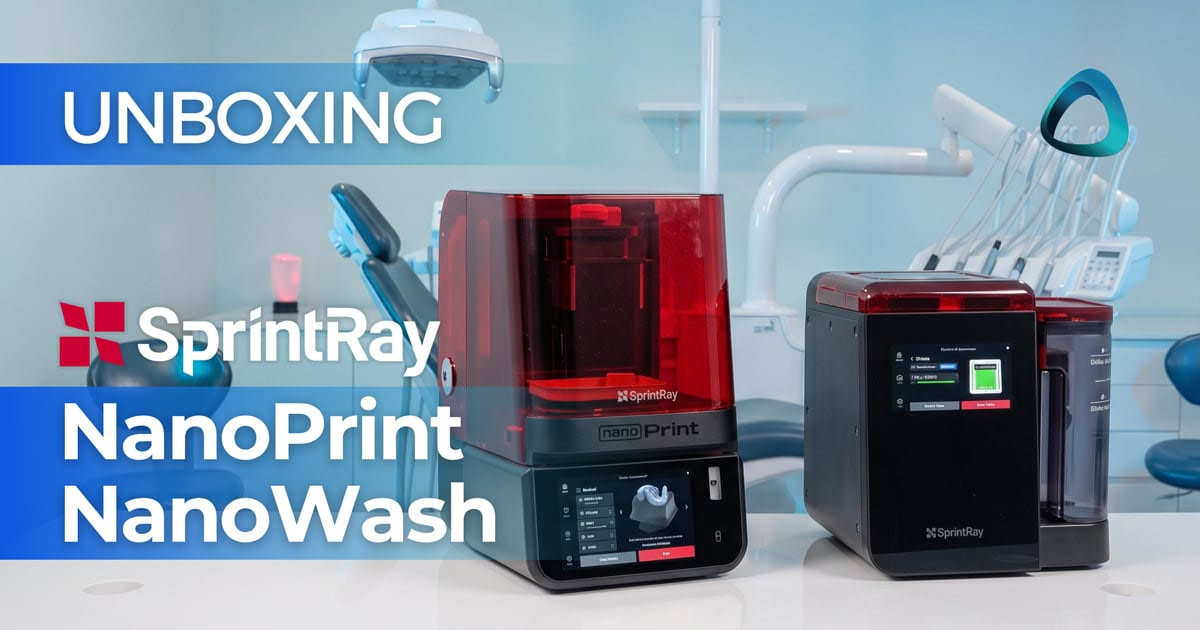

SprintRay used its 3DNext event in Miami to launch two new products, the NanoPrint and the NanoWash. They complete the Nano series that began with the NanoCure in 2024, and I was lucky to unbox and test both at the iDD studio ahead of launch.
Watch the unboxing here:
Of the two launches, the NanoPrint is the first new "traditional" clinic 3D printer we have seen in a while, and the NanoWash looks like a direct answer to the most common complaints about the ProWash (SprintRay's previous wash unit). Much of the industry's attention has gone to capsule printers lately, so a compact resin printer built for everyday patient workflows is a noticeable move. The price is also very competitive.
As always, this post is completely independent. SprintRay supplied the NanoPrint and NanoWash ahead of launch but has not sponsored or paid for this piece; the opinions are ours.
Before we dive in, let me set expectations. I have unboxed and handled both units, and have printed, washed, and cured with them in the clinic. I'll do a full review once I have tested them extensively.
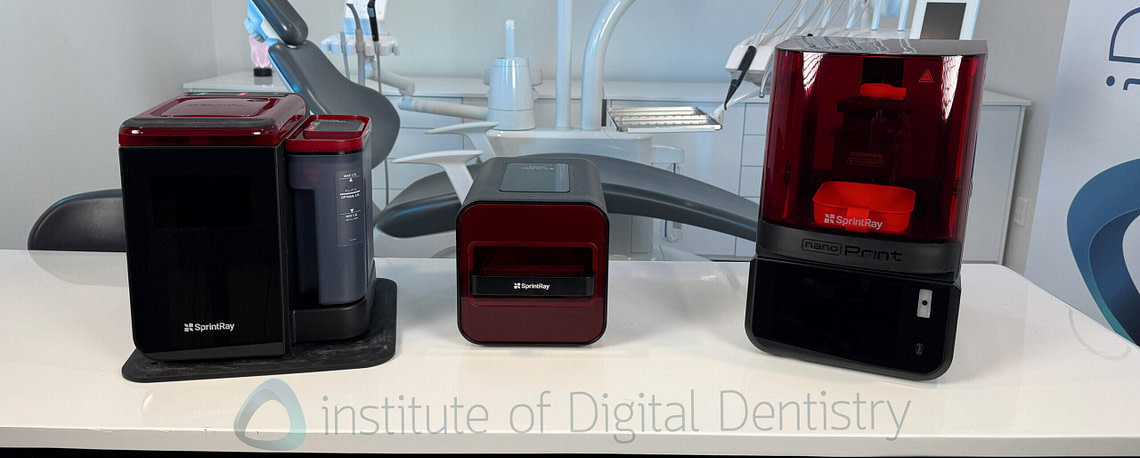
The Nano series at a glance
NanoPrint - Compact Printer Built Around the SR Arch Kit build platform
NanoWash - Compact wash and dry unit with sealed, swappable solvent tanks
NanoCure - Compact curing unit, launched in 2024
What Looks Promising
- The printer is compact enough to fit under cabinetry.
- Built around one case at a time (based on SprintRay data of current customer behaviors). You can now print something like a nightguard start to finish in under 30 minutes
- Swappable solvent tanks, so one wash unit can handle clear and colored resins separately, without causing any color issues. In general, it is a good idea to keep solvent tanks separate for most resins. This makes it very easy to do so with the modular design of the tanks.
- Contained solvent tanks help eliminate odor (sealed) and prevent evaporation, which dilutes the cleaning properties
- A sealed wash chamber with an option to duct the exhaust away, aimed at reducing the IPA smell.
- A launch bundle price of around $10,000 USD.

NanoPrint, the compact SprintRay printer
SprintRay now has three printers for different jobs.
The Pro 2 is the large platform printer for high-volume work, and the Midas (the capsule printer for restorations) gives access to highly filled resins. The NanoPrint is built around the Arch Kit, SprintRay's platform for printing a full arch, making it the printer for day-to-day patient work such as full arches, All-on-X restorations, splints, and surgical guides.
Though the Crown Kit still has its place, restorative work now basically belongs to the Midas it seems.
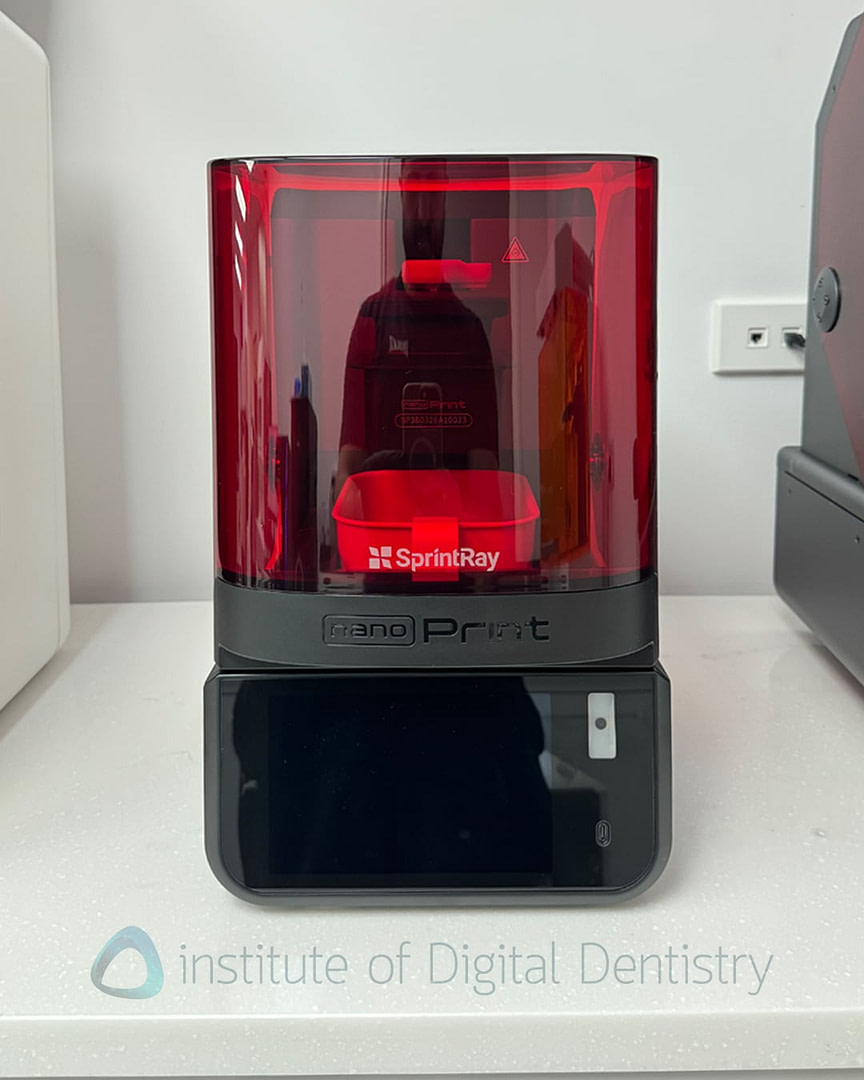
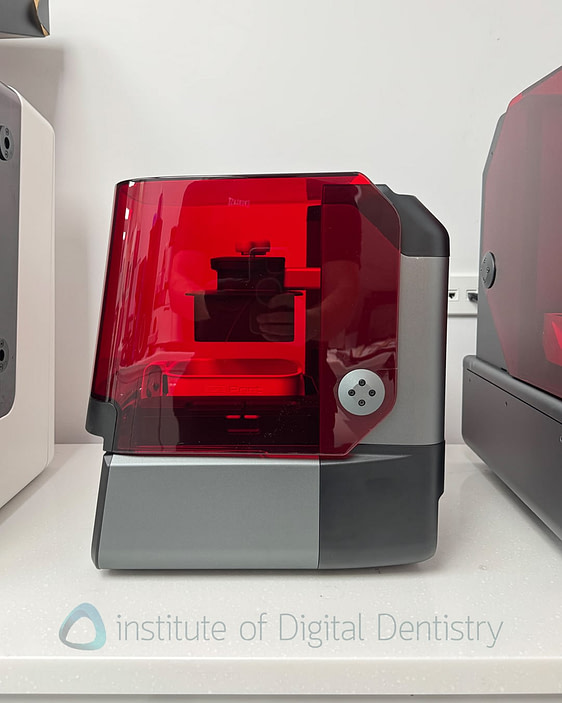
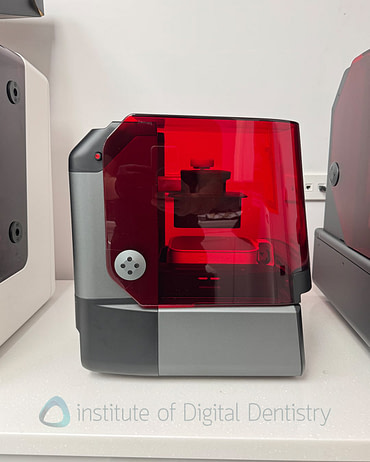
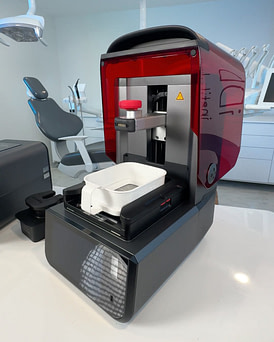
SprintRay's listed specifications match the Pro 2: a 385 nm UV LED and a 35-micron optical panel, which I covered when the Pro 2 launched. According to the company, the NanoPrint is sized for one patient at a time, with a 150 mL resin tank and sixteen indications.
Two design choices stood out when I opened it. First, the printer cover hinge sits low, so the lid does not lift high. That lets the printer sit on a desk under cabinetry, which suits a clinic where space is tighter than in a lab.
Second, the resin tray: the NanoPrint uses the same trays as the Duo Kit on the Pro 2, with a handle, and they slot straight in. Add the build platform, and you are ready to print. I am a big fan of the Duo Kit style trays. Very user-friendly.
The NanoPrint is also significantly smaller than the Pro 2. This becomes very obvious when we place them side by side.


In the box, you get the usual manuals, a sticker, and standard accessories: pliers for removing supports, a spatula for lifting parts off the build platform, etc. None of that has changed much over the years. What I do like about SprintRay is the onboarding, including virtual one-on-one sessions and online training. For a practice new to 3D printing, that counts for a lot.
In saying that, the NanoPrint is not a replacement for the Pro 2. With the Arch Kit platform, it can't exactly handle the larger volume of work the Pro 2 can, so a busy practice printing many cases a day may still want the Pro 2. The NanoPrint earns its place with its compact size and price, which I come back to below.
NanoWash, the biggest upgrade
For me, the NanoWash is the more interesting of the two, because it is the bigger upgrade. Most of you will know the ProWash as a capable system with a love-hate reputation. Common complaints include its size, the drawbacks of the jetted wash, and the smell of isopropyl alcohol (IPA) during drying.
Clearly, SprintRay has heard that, and the NanoWash is a total rethink, not just a refresh.
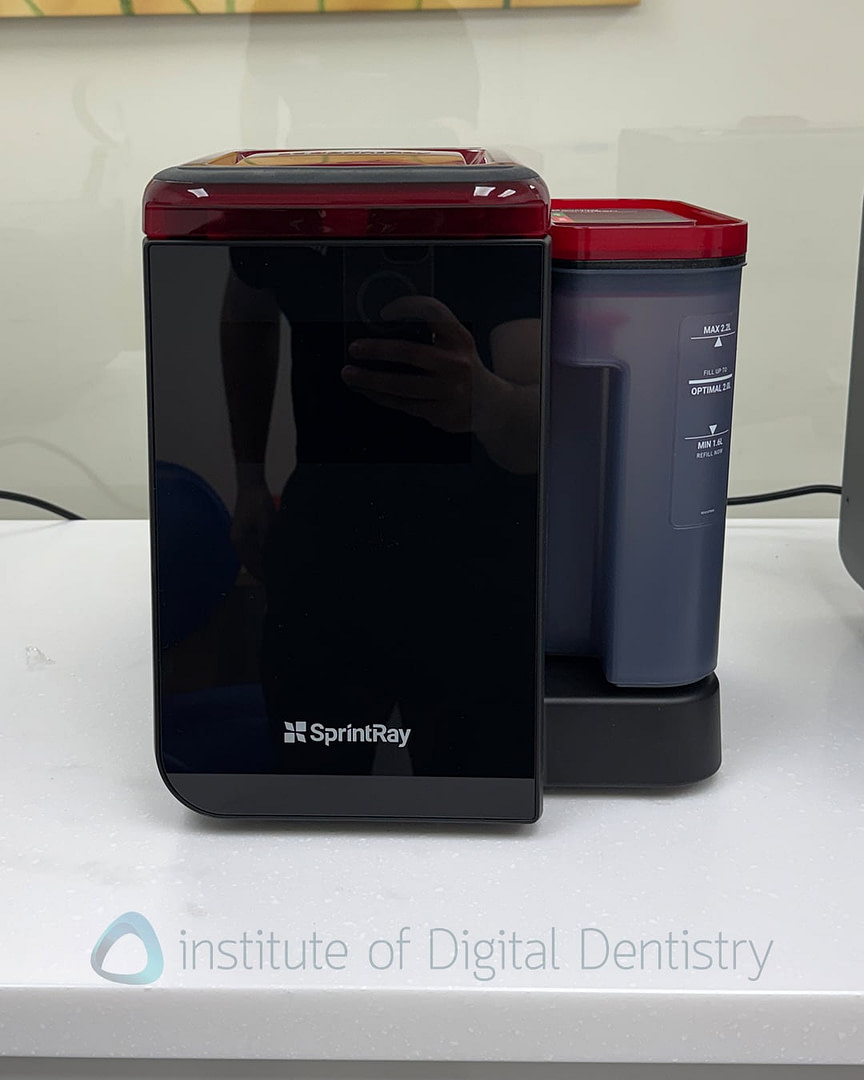
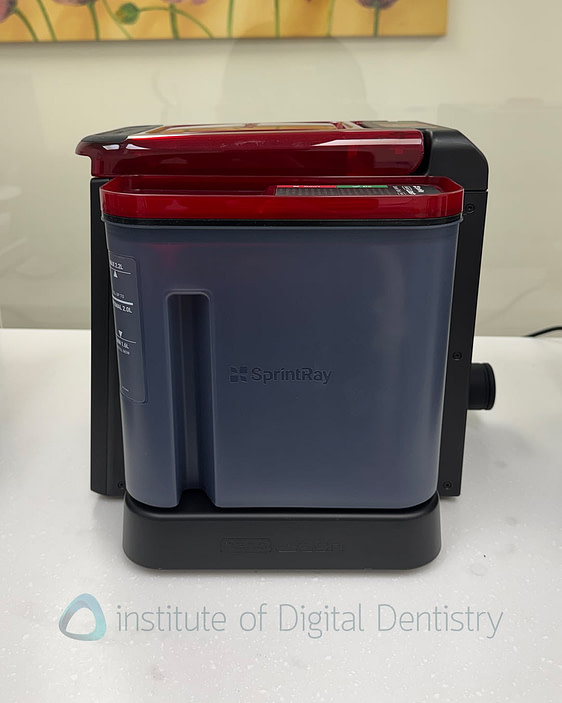
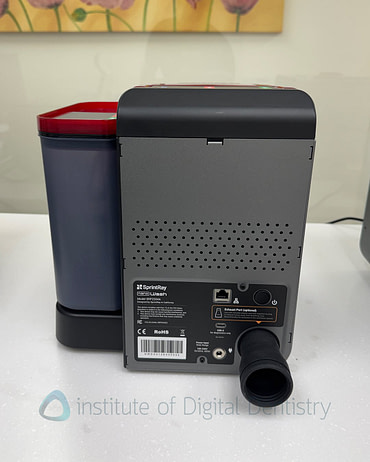
Size is the first thing you notice. Next to the previous-gen ProWash, it is A LOT smaller, much as the NanoPrint is a lot smaller than the Pro 2. SprintRay claims it's 40 percent smaller.
The wash process has changed too. Where the ProWash used jetted washing and air drying, the NanoWash goes back to submerging the parts in solvent and agitating them. SprintRay says the agitation comes from several directions (it calls it a whirlpool action), with a wash-and-dry cycle of about six minutes.
I tried it. It's fast, and basically what we have come to want from a wash unit these days. It does a good job washing parts and drying them. The main issue I can think of for the industry to solve is IPA and how corrosive it is to resin parts.
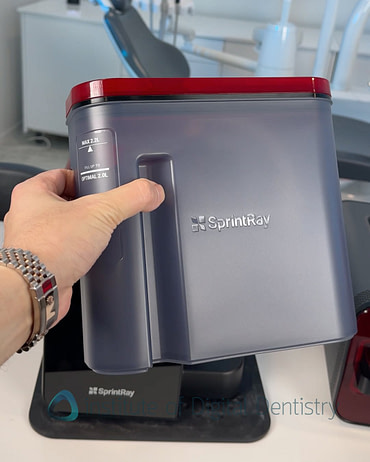
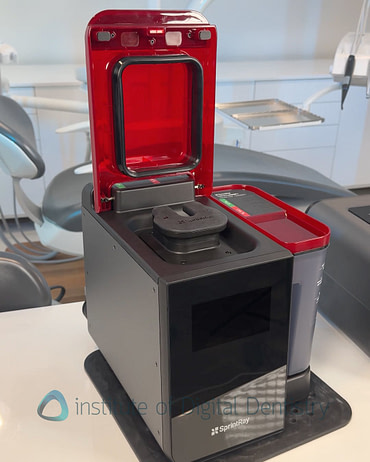
What I like most is the modular solvent tank. Anyone who prints knows that biocompatible and non-biocompatible resins should not be washed in the same tank. Even though all SprintRay resins are biocompatible (including model resin, etc.), it is good to keep that in mind if you have other printers.
We have also learned over years of printing that clear resins shouldn't share an IPA tank with colored ones, with a strongly red sports guard resin being the obvious example. On most wash units, that meant owning two machines. Of the wash units I have seen, this is the first to let you quickly and simply switch the IPA to suit the resin, thanks to the modular solvent tanks.
Solvent is a key word here too. The company is not calling them IPA tanks. Maybe different types of solvents are to come?
SprintRay offers two modes in the software with this wash unit. In Open Mode, you run any resin through the same tank, which suits a practice that prioritizes throughput over separation. In Assigned Mode, you dedicate a tank to one material, so no pigment carries over between shades. Tanks are sealed, UV-protected, and RFID-tracked, so the unit knows what is loaded and runs the matching program; they hold 1.5 to 2.2 liters. Each tank costs $299 USD.
Smell is the other complaint. You can insert a hose into a vent at the back, aimed at the IPA smell during drying. According to SprintRay, the wash chamber is sealed all the way around, the exhaust leaves through that rear port, and an optional extension hose routes it outside the building (via a window) or into an air purifier. SprintRay calls it odorless and quiet. It is much quieter than the ProWash by a large margin, thanks to the lack of jetting, but if you don't use a hose, you can still smell IPA during drying, albeit definietly less.
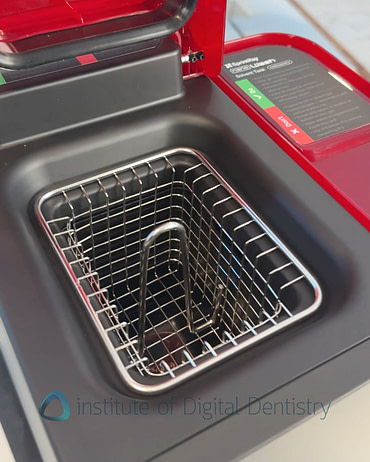
On compatibility, the platform takes the Arch Kit directly, so it works with the NanoPrint and with Arch Kit prints from the Pro 2. If you use the Pro 2's standard build platform, there is a basket for the printed parts.
Note - With the Midas, the advice is to hand wash rather than soak, because IPA can pull filler out of highly filled resins and leave chalky lines on the restoration. This wash unit is not for highly filled resins. None on the market are, really.
NanoCure and how the three fit together
The NanoCure is not new. It dates from early 2024, when I covered the launch. Curing comes from two wavelengths: 365 nm for the surface and 385 nm through the part, with controlled heat and no nitrogen. The fastest in dentistry is the claim SprintRay's deck makes.

The idea for these 3 devices is a cloud-connected workflow, with each step handing off to the next, from print to wash to cure. AutoPrint, SprintRay's software, nests, orients, and supports the job for you. In terms of counter space, it's one of the smallest full systems on the market.
As I have said for years, this is not about the individual gadgets. What counts is the workflow and, for 3D printing, the resins. Arguably some of the strongest on the market are SprintRay's, including Midas Restore, OnX Tough, its splint resin, and its surgical guide resins. Hardware matters less than what you print with it, and I wrote more about that strategy in SprintRay Is Building an Ecosystem, Not Just a Printer.
Price and availability
One of the most compelling aspects of SprintRay's new Nano ecosystem is its pricing.
At launch, SprintRay is offering the complete NanoPrint, NanoWash, and NanoCure bundle for around $10,000 USD as a limited-time promotional offer.
For a complete dental 3D printing workflow, including printing, washing, and curing, this is an aggressive entry point, particularly from a manufacturer with SprintRay's established position in premium chairside 3D printing.
The individual pricing is equally interesting. The NanoPrint retails for $8,995 USD, while the NanoWash is priced at $1,999 USD. Together, these two components total $10,994 USD before adding the NanoCure. This makes the introductory bundle particularly attractive for practices looking to adopt in-house 3D printing without investing in a larger, more expensive system.
For context, SprintRay's previous Unlimited Smile ecosystem bundles, incorporating the Midas, Pro 2, ProWash S, NanoCure, training, and protection plan, have been advertised in the $20,000–$23,000 USD range and above.
Although these are fundamentally different equipment configurations, the new Nano ecosystem offers a much more accessible entry point into SprintRay's excellent digital manufacturing platform.
Availability initially focuses on the United States, with the NanoPrint and NanoWash scheduled for orders starting October 10, 2026, and initial fulfillment beginning November 2, 2026.
Overall, the pricing suggests SprintRay is responding to an increasingly competitive dental 3D printing market. Rather than simply pushing the capabilities and price of its flagship systems higher, the company is making a deliberate move to bring its integrated printing ecosystem within reach of more dental practices.
Final Thoughts – A Smart Move by SprintRay
After spending some time with the NanoPrint and NanoWash, I think SprintRay has made a very smart move with this launch.
The NanoPrint is not trying to replace the Pro 2, nor does it need to. Most dental practices are not printing dozens of appliances every day. They are printing a surgical guide, a nightguard, a temporary restoration, or a single patient's case. For these everyday workflows, a smaller, more affordable printer that delivers the same fundamental printing technology makes a lot of sense.
The NanoWash, however, is arguably the more impressive product. SprintRay has addressed several frustrations with its previous washing system, particularly the size, noise, solvent management, and IPA smell. The interchangeable solvent tanks are an excellent addition, and something I would like to see become standard across the industry.
What makes this launch particularly interesting is the bigger picture. SprintRay already has an excellent portfolio of dental resins, mature software, and an established ecosystem. By introducing a complete print, wash, and cure solution at around $10,000 USD, the company is significantly lowering the barrier to entry without requiring practices to compromise on the overall workflow.
My biggest takeaway is that dental 3D printing is entering a new phase. For years, manufacturers have competed on bigger build platforms, faster print speeds, and increasingly impressive specifications. But for most dentists, the question is much simpler: how easily, reliably, and affordably can I produce an appliance for the patient sitting in my chair?
That is where I think SprintRay is heading with the Nano ecosystem.
And perhaps that is the most important thing about this launch. The future of chairside 3D printing may not be about building bigger and more powerful machines. It may be about making the entire process so simple, compact, and accessible that 3D printing becomes a routine part of everyday dentistry.
SprintRay is certainly making a strong case for that future.
If you have any questions, let me know below!

Know what’s next in dentistry. Before everyone else.
The innovations, clinical insights, and digital trends that matter - curated by iDD and delivered straight to your inbox every week.